
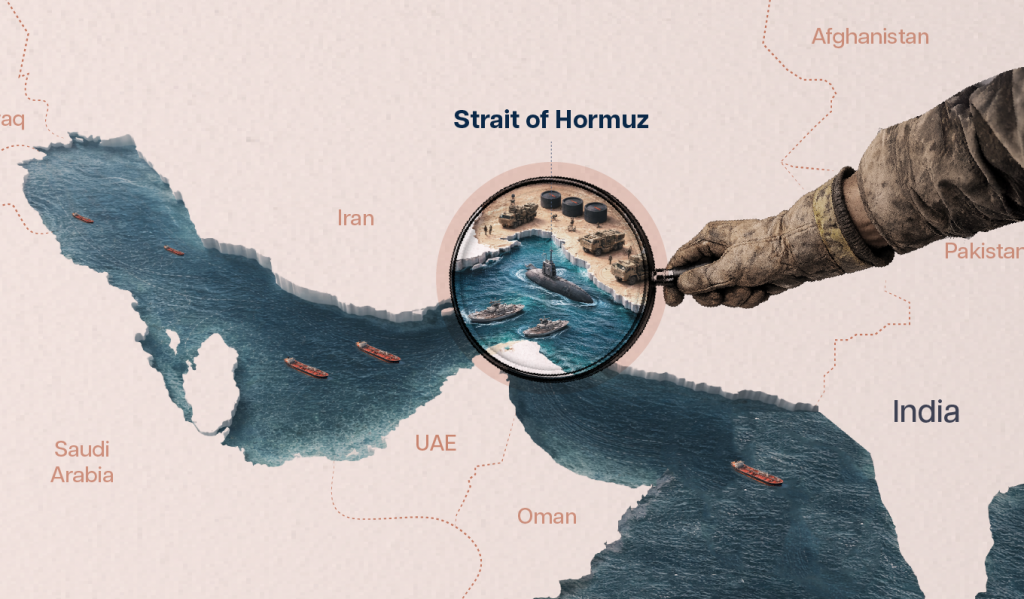

A 33-kilometre stretch of water separates India’s kitchen from the Persian Gulf. Most Indians may have never heard of the Strait of Hormuz. Yet right now, it is the single most consequential economic variable in the country, more than the RBI’s rate decision, more than any quarterly earnings report.
Through this narrow passage flows one-fifth of all the oil the world consumes every day. And when tanker traffic through it grounded to a near halt in March 2026, the effects landed not in some distant commodity market but in the LPG cylinder sitting behind your stove.
Here is the number most people do not know: India’s strategic reserve for crude oil covers roughly 74 days. For LPG, the fuel that heats 330 million Indian households, that buffer is estimated at just 10 to 30 days.
This edition is not about geopolitics. So this week, instead of adding to the noise, I want to do something more useful. I want to map, as clearly as I can, exactly what this crisis means for India, and what it does not. Because the story, it turns out, is considerably more nuanced than the headlines suggest.
In this edition:
- The Strait of Hormuz : what it is and why it matters?
- How exposed India really is?
- First-order shocks: the rupee, the deficit, interest rates and inflation
- Second-order shocks: food prices, remittances, and the export damage
- The sector scorecard: who hurts, who gains
- What does history actually say?
- India’s buffers – why this is serious, but not fatal
- What should you actually do right now?
Let’s begin!
What really happened?
Let me start with the geography, because it explains everything that follows. Picture a very narrow stretch of water between Iran and Oman called the Strait of Hormuz. At its narrowest point, it’s only about 33 km wide. Yet through this tiny passage flows about 20 million barrels of oil every day, roughly one-fifth of everything the world consumes.
That makes it one of the most important energy routes on the planet.
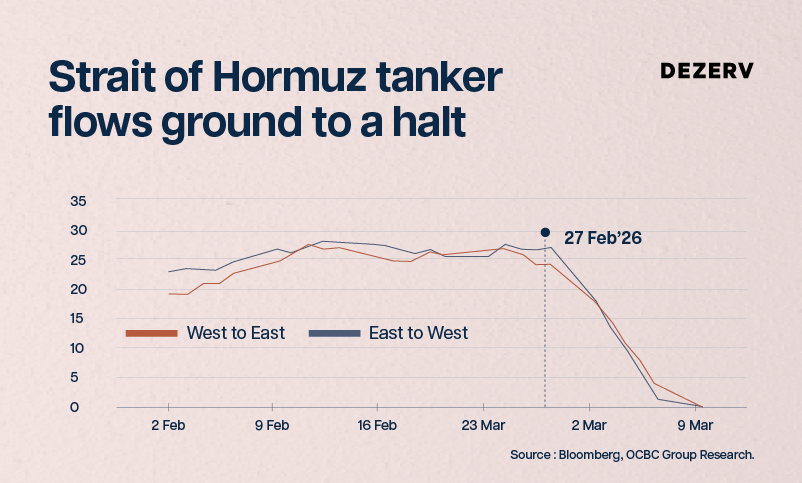
On 2 March 2026, following the US-Israel strike on Iran, tanker traffic through the Strait ground to a near halt. Formally, no one closed it. Iran said it had not blocked the waterway. And yet, shipping effectively stopped, not because of a blockade, but because of insurance. Oil tankers need war-risk insurance to sail through dangerous areas.
When tensions rose, many insurance companies stopped covering ships in the Gulf. And without insurance: ships cannot enter ports, cargo owners cannot protect their goods and banks refuse to finance the shipments. And reopening it can take time, because insurers will only return once they believe the region is truly safe again, not just because politicians say the conflict is over.
Can oil avoid this route?
A little bit can.
- Saudi Aramco has a pipeline that sends oil across Saudi Arabia to the Red Sea.
- The United Arab Emirates also has a pipeline that sends oil to the port of Fujairah.
Together, these alternatives can move around 6–7 million barrels per day. But that’s only about one-third of what normally passes through Hormuz. The remaining two-thirds has no quick alternative route.
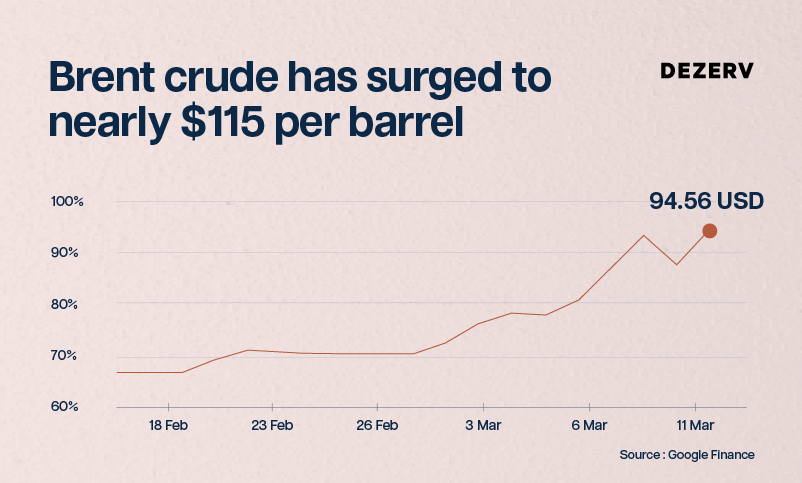
What began as a US-Israeli military operation against Iran on 28 February has cascaded into the most significant energy disruption in over a decade. Brent crude has soared past its baseline, currently sitting 70% above the $68 average recorded in 2025.
How exposed India really is?
Since the conflict began on 28 February, Indian markets have shed roughly ₹25 lakh crore in market capitalisation. The Nifty 50 has fallen about 10% from its January peak, entering correction territory. FIIs sold nearly ₹21,000 crore in the first week alone, and the selling has been broad — aviation, paints, auto, PSU banks, and metals have led declines.
Behind this market reaction lies a deeper vulnerability.
India imported 67% of its LPG requirement in 2024, up from 47% a decade ago. More than 95% of those imports come from the Middle East, Saudi Arabia, UAE, Kuwait, and Qatar, all sitting behind the Strait of Hormuz chokepoint.
The wider energy dependency tells the same story at every level.
India imports 85–88% of its crude oil. Roughly 40% of those imports transit Hormuz directly. The strait is also the exit route for about 90% of India’s LPG imports and 53% of its LNG, sourced primarily from Qatar and the UAE.
But for crude oil, India has a buffer. Strategic reserves in Visakhapatnam, Mangaluru, and Padur cover about 74 days of consumption. For LPG, there is no equivalent strategic reserve. We have roughly 10 to 30 days of supply. If disruption lasts beyond that window, the risk moves from markets to household kitchens.
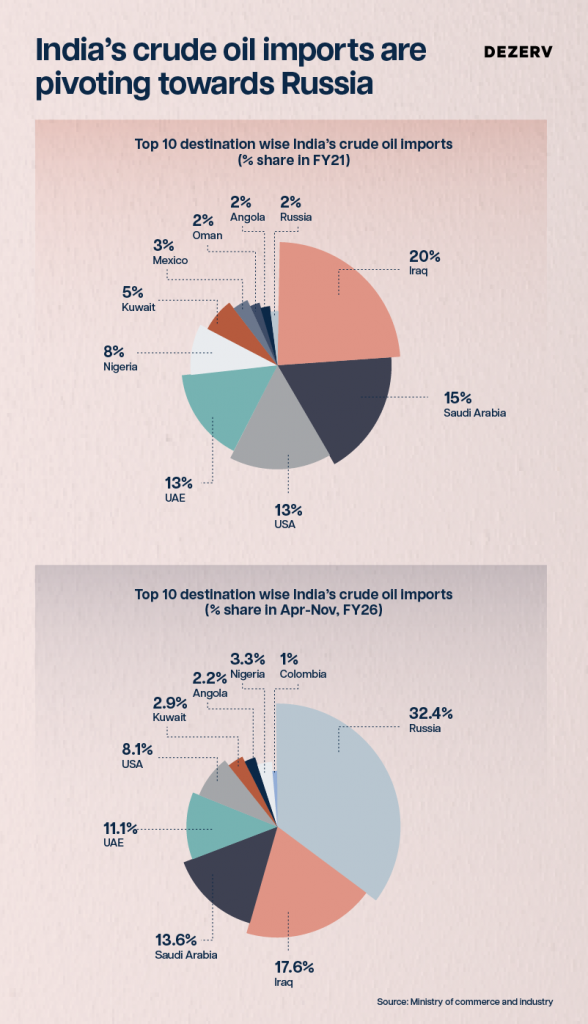
India has begun diversifying its energy sources. Higher crude purchases from Russia have reduced some dependence on the Middle East. In November 2025, state-run oil companies also signed a one-year deal to import LPG from the US, covering about 10% of annual demand, while Australia is in discussions to supply more. These are the right structural moves — but diversification takes time and does little to solve a 30-day supply shock.
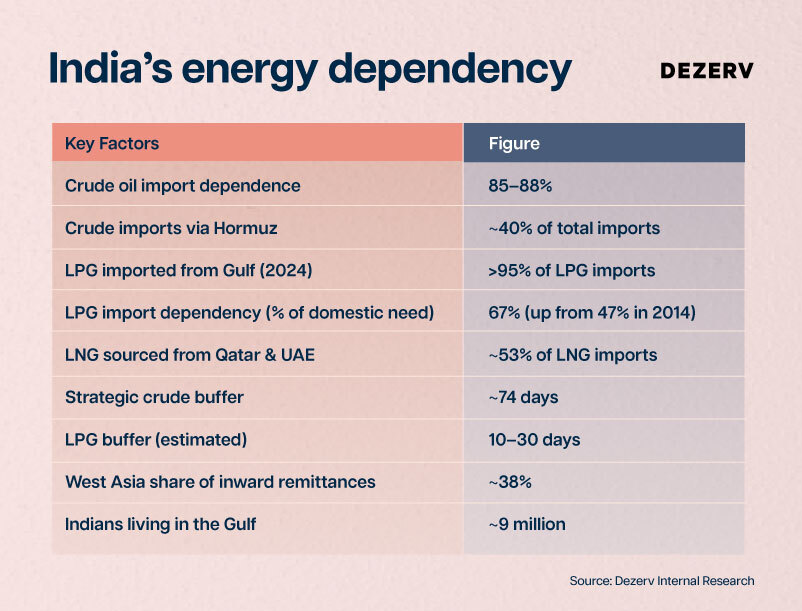
The dependency is structural, broad, and deep. Which brings us to the obvious question: how bad does it get, and for how long?
First order shocks : The macro hit
Widening Current Account Deficit (imports >exports)
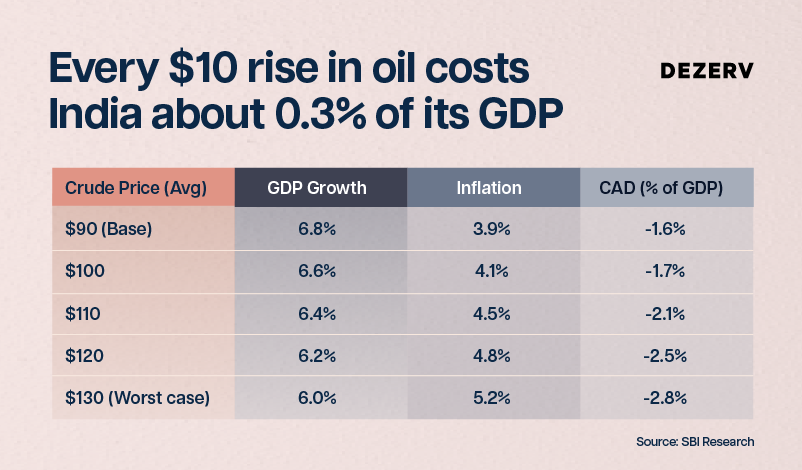
India imports about 80% of its oil, so when global oil prices rise, the country has to pay much more in dollars. Roughly, every $10 increase in oil prices costs India about 0.3% of its GDP. At current levels, that means $7–8 billion more leaving the country every month, or nearly $90 billion extra a year just to pay for oil imports.
Because oil is paid for in US dollars, India has to sell rupees to buy those dollars. When a lot of rupees are sold in the market, the currency weakens. That’s why the Indian Rupee has been falling against the US Dollar.
Inflation
A 10% rise in global oil prices usually increases India’s inflation by about 0.5–0.7 percentage points. Since oil has jumped from around $69 to nearly 50% higher, the full pass-through could add roughly 2.5–3.5 percentage points to inflation.
But India doesn’t pass this on immediately. State-run oil companies — HPCL, BPCL and IOC, often absorb part of the increase so petrol and diesel prices don’t rise as quickly. This shifts the pressure away from consumers and onto the government’s finances and the oil companies’ margin.
Interest Rates
Everyone thought the RBI would cut interest rates (easing) down to 5.00% to make loans cheaper and boost the economy. Because oil is high and the Rupee is weak, the RBI cannot afford to cut rates. If they cut rates now, the Rupee might fall even faster. Rate cuts are off the table.
The Rupee: Record Lows
The rupee touched ₹92.29 per dollar earlier this cycle. A weaker Rupee makes everything we import (especially that expensive oil) even more costly. The RBI (Reserve Bank of India) is currently intervening, basically spending its savings (foreign forex reserves) to stop the Rupee from crashing even further.
When oil goes up, the Rupee goes down. When the Rupee goes down, inflation goes up. To stop inflation and save the Rupee, the RBI has to keep interest rates high. All of that is the macro layer. Now let us move to where you actually feel it.
Second order shocks : What you feel at home
Macro variables like the current account, the rupee, or interest rates matter. But the real impact shows up closer to home — your gas cylinder, grocery bill, or a family member working in the Gulf.
LPG Crunch
On 5 March 2026, the government invoked the Essential Commodities Act, directing refineries to prioritise household LPG over commercial users. Restaurants in cities like Mumbai and Bengaluru are already facing shortages. India’s LPG buffer is only 10–30 days, compared with 74 days for crude, so supply pressure could emerge quickly.
Fertiliser to Food
India imports about 40% of its fertilisers from West Asia. With supply disruptions and higher diesel costs, food inflation could rise 150–200 bps next quarter — a delayed effect that typically appears 6–8 weeks later.
Remittance Risk
The human dimension that macro commentary always misses: 9 million Indians live in the Gulf. And the money they send home helps support India’s finances and reduce the current account deficit. Gulf countries account for about 38% of India’s remittances ($51.4B of $135.4B in FY2025).
Export Damage
West Asia is not just where India’s oil comes from. It is also a major market for what India sells. GCC countries account for 13% of India’s exports and 16% of imports, with the UAE alone at 8.75% of exports. Both channels are disrupted simultaneously.
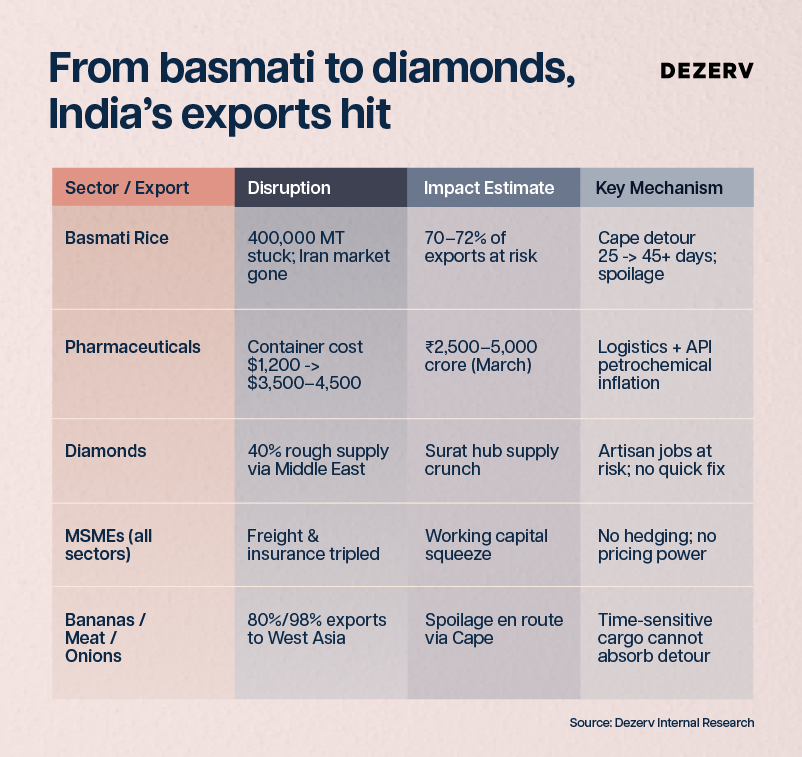
This is the full picture: a macro shock layered over a supply shock and a trade shock, all hitting at once. Knowing where the damage lands tells you which parts of your portfolio are exposed, and which ones offer cover.
The sector scorecard : Who hurts, who gains
Not every part of your portfolio is equally exposed. Some sectors are directly in the line of fire. Others are natural beneficiaries of exactly the conditions this conflict has created.
Who hurts
Airlines are the most direct casualty. Aviation turbine fuel represents 30–40% of operating costs. Airspaces have been closed, flights cancelled, and emergency hedging notices filed. If rates stay elevated, the sector faces a double hit: higher fuel costs and rising interest rates on already leveraged balance sheets.
PSU Oil Marketing Companies (HPCL, BPCL, IOC) are caught between rising crude procurement costs and politically constrained pump prices. Gross refining margins are collapsing.
Paint companies
If you look at a bucket of paint, about one-third of what’s inside (and the cost to make it) comes directly from petroleum. So when oil rises sharply, input costs jump. Companies such as Asian Paints and Berger Paints India Limited can’t raise prices immediately, which means profits per bucket shrink — a classic margin squeeze.
Real Estate
Real estate isn’t directly linked to oil, but it’s sensitive to interest rates. If higher oil pushes inflation and rate hikes, mortgage costs rise and housing demand can slow.
Who gains?
EVs and Renewables: At $100 oil, the green transition becomes an economic necessity. In 2025, India added 44.5 GW of renewable capacity, nearly double the 24.7 GW added the previous year. Solar crossed 100 GW in January. High fuel costs are also pushing fleet operators toward EVs faster to protect margins.
Defence manufacturing: HAL, BEL, Mazagon Dock, can benefit structurally. Even if this specific conflict resolves quickly, a more fragmented world order will underpin higher defence spending for the foreseeable future.
IT Services: Revenues are in dollars, costs largely in rupees. With the rupee around ₹91–92, each dollar converts into higher rupee earnings, while global uncertainty often accelerates digital spending.
Upstream Oil
Producers like ONGC and OIL benefit directly from higher oil prices. When crude recently jumped 12%, both stocks rallied 5–7%, while refiners like BPCL and HPCL face margin pressure.
Now, before you act on any of this, there is a body of evidence worth sitting with carefully — because it tells a story that most investors, in the grip of a crisis, actively resist believing.
What history actually says
The instinct when oil spikes is to act. History, quite consistently, says the right instinct is to stay. The 2003 Iraq War is the closest historical parallel — a US-led military confrontation with a Middle Eastern state, Brent crude peaked at $40 per barrel in early 2003 (30% premium), and Sensex declined approximately 15% in the weeks following the invasion.
What happened next is what your instincts will fight against believing. Within 12 months of that trough, the Sensex delivered 83% returns. The investors who sold during panic missed one of the great bull runs of the decade. We mapped five recognisable phases of war, and the lesson from each is sharp.So, the pattern is simple: conflict creates fear, fear creates discount, discount creates opportunity. The same pattern holds across every major geopolitical shock in Indian market history.
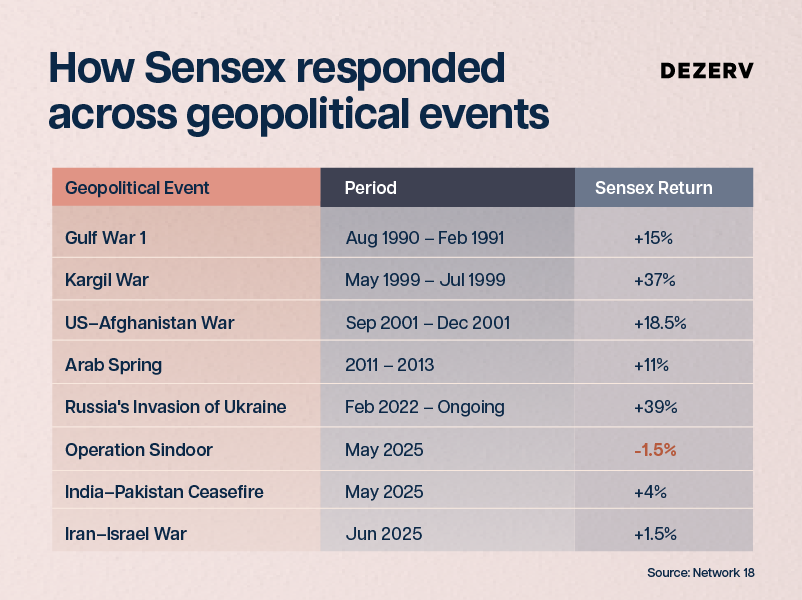
Every major geopolitical crisis in living memory has eventually resolved, and Indian equities have rewarded patient investors. The first month after a major oil spike is often negative. If you can hold through 90 days of volatility, the 6-month and 12-month windows are overwhelmingly positive.
The investors who get hurt are not the ones who stayed, they are the ones who sold during the gut-punch month and watched the recovery from the sidelines.
India’s current position
Every time India faces an external shock, the comparison to 2012–2013 surfaces. Back then, the rupee crashed to ₹68, the current account deficit hit 4.8% of GDP, and the phrase Fragile Five entered the lexicon. That experience left a lasting psychological scar.
But the balance sheet looks meaningfully different today.
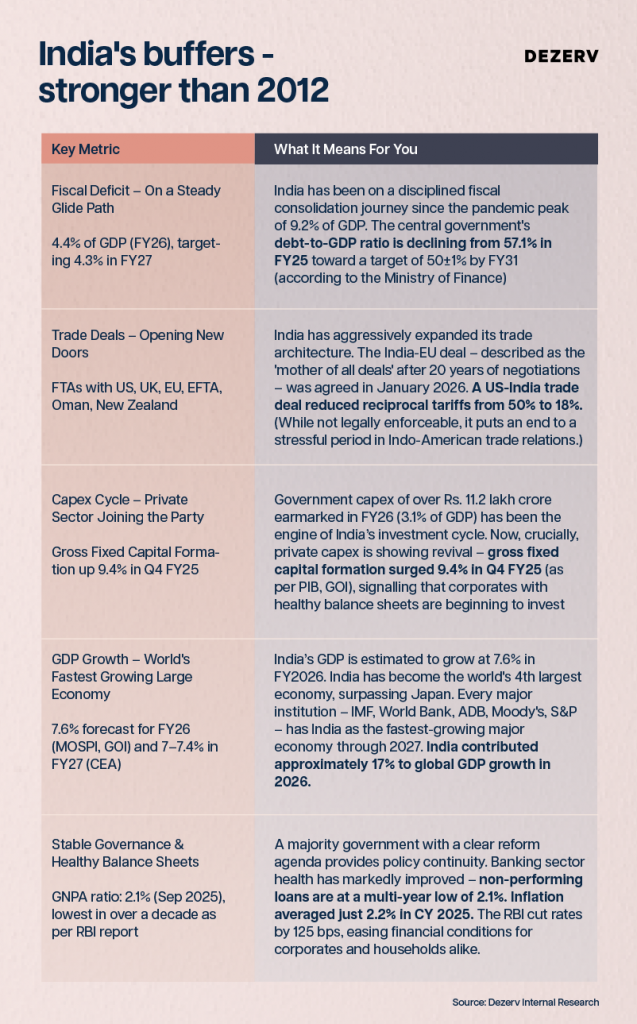
The Russia crude pivot is crucial here. After 2022, India increased Russian crude imports from under 2% to over 40% in just 18 months. That shift doesn’t remove the Hormuz risk, but it softens the impact in moderate scenarios by providing a structural cost hedge.
Here is the thing about this shock: India in 2026 is not India in 2008 or even 2013. The buffers are real, and they are historically strong.
What you should actually do (about your money)
Let me bring everything together into the practical question: what do you do with your portfolio right now?
1. Watch Oil, Not Headlines
Brent at $90–95 is still manageable for India’s macro stability. Sustained prices above $100 strain earnings, and above $120 for more than a month would likely force downgrades. The oil price is your dashboard — not the news.
2. Do Not Exit. Rebalance.
Exiting equities to re-enter at a lower level sounds rational. In practice, it almost never works — you have to be right twice (when to exit, when to return). Your asset allocation was built to survive moments exactly like this. Honor it.
3. Use Dips as Accumulation Windows
If markets correct 8–15% driven by fear rather than a permanent impairment of India’s economic capacity, that is historically a gift. The 2003 and 2008 data are unambiguous on this.
4. Step Up Your SIPs
SIPs are most powerful in exactly this environment. When NAVs fall, each instalment buys more units. When the recovery comes — and historically it has, within 12–18 months — the compounding on a lower average cost is disproportionately powerful.
In conclusion
You can’t predict how this conflict unfolds, no one can do that reliably, but you can
ensure that your portfolio is positioned to endure volatility and capture opportunity on the other side. Uncertainty is uncomfortable. But for the patient, long-term investor, it has historically been part of the compounding process.
Disclaimer – Investment in the securities market is subject to market risks, read all the related documents carefully before investing. The information provided herein is intended solely for educational purposes and should not be construed as solicitation, or providing any financial or investment advice or an offer to buy or sell any financial instruments. Any statements about future developments are speculative and should not be taken as guarantees. In this material, Dezerv has utilized information through publicly available sources, and other data deemed to be reliable. All trademarks, logos, and brand names mentioned are used for identification purposes only and do not imply endorsement or recommendation.