

Picture this.
It’s March 2020. Your portfolio is down 38% in three weeks. The news is apocalyptic. Your WhatsApp groups are cycling between pandemic updates and screenshots of portfolios bleeding red. You’re a smart person, CXO, founder, someone who has navigated genuinely complex situations before. You look at the number on your screen and you make a decision that feels, in that moment, like the only rational one.
You pause your SIP.
Eighteen months later, the Nifty hasn’t just recovered. It’s at an all-time high. You’ve missed a 100% rally from the bottom, waiting for the “right moment” to get back in, which never quite announced itself clearly enough.
This story has played out, with different dates and different crises, in almost every investor’s journey. It happened in 2008, it happened in 2013, in 2016, and again in 2020. The years change but the feeling doesn’t. And the cost, invisible, unmeasured, never appearing on any statement, compounds for decades.
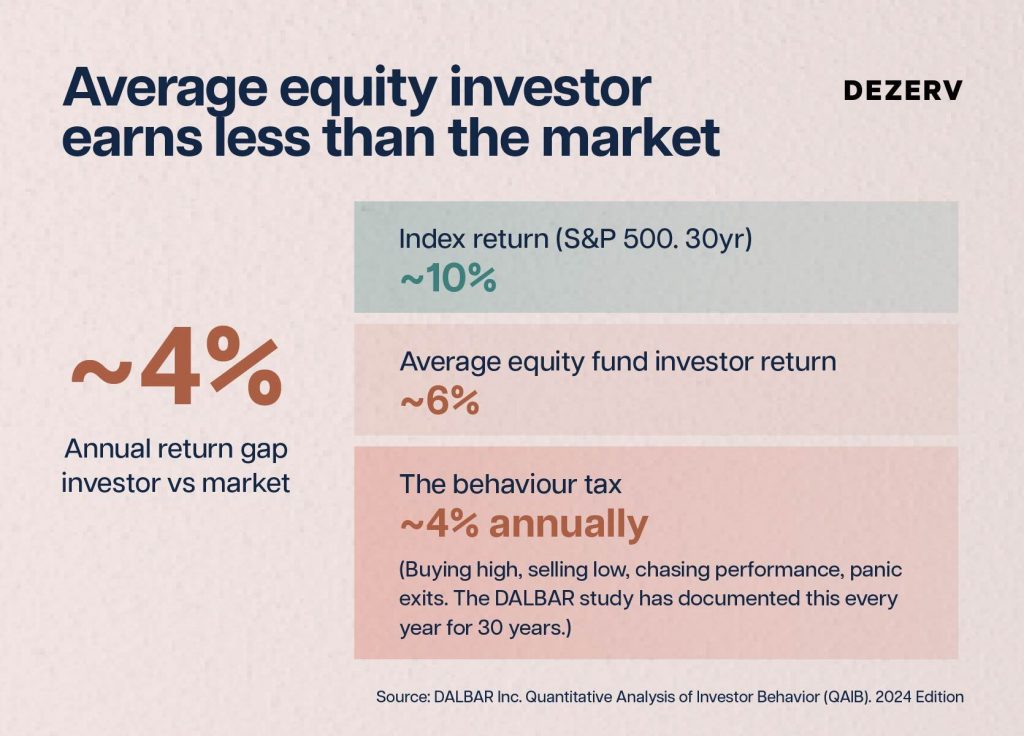
DALBAR, a research firm that has spent thirty years studying investor behaviour across market cycles, has documented a finding that is both simple and uncomfortable: the average equity fund investor consistently earns roughly 4% less than the market, every single year.
Not in one bad cycle. Every year, for three decades. Compounded across twenty years, that gap does not look like 4%. It looks like the difference between having three times your money and having seven times your money. In India, the Nifty 500 has delivered a 14% CAGR over the last twenty years, a 15x multiple on invested capital. But most investors walked away with something closer to single digits.
The question that should stay with you is: why? These aren’t people who don’t understand investing. Many of them understand it deeply. The gap between knowing and doing is where the real story lives.
In this edition
- Why the 14% return is real yet nobody actually lives through it
- How intelligent people reason their way into the worst investing decisions
- What the market’s own valuation data has been telling us for decades
- The honest cost of choosing a smoother ride over maximum returns
- One question that determines more than any fund you will ever pick
Let’s begin.
It’s the behaviour problem: How intelligent people make the most expensive mistake in investing
Only 3.8% of one-year periods in Nifty 500 history deliver returns close to the long-term average. In 96% of years, returns are either much higher or much lower, which means the 14% only becomes visible over decades and in any single year, it doesn’t feel like 14% at all.
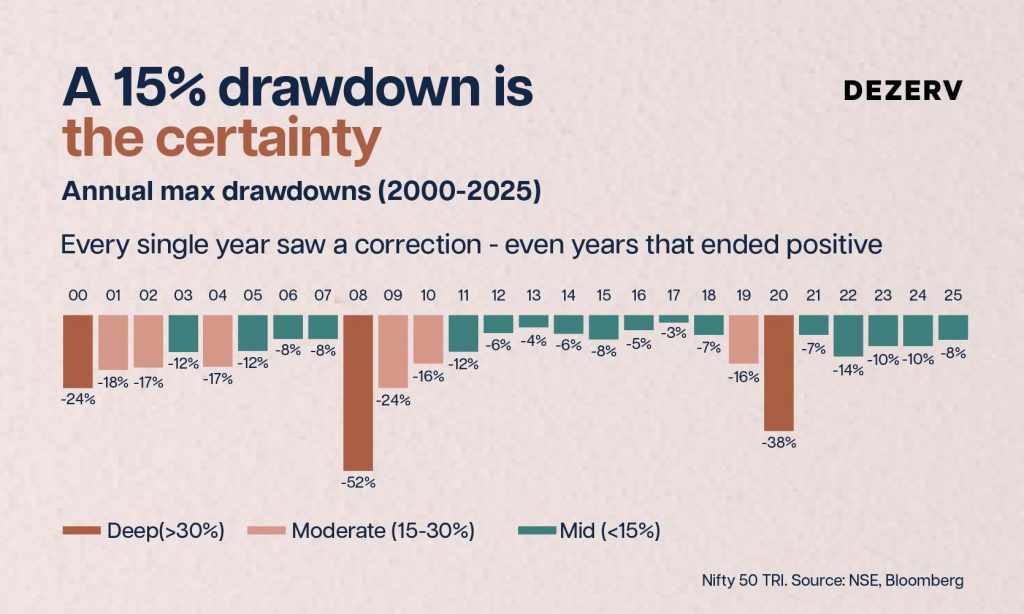
What it actually feels like is this. Out of roughly 290 months over the last 25 years, 119 ended in the red, which is your portfolio showing a loss once every two and a half months, without fail, across the entire run, including the years that ended strongly.
And in every single one of the last 26 years, the market saw a meaningful correction at some point, with the average fall from peak to trough sitting at 15% and three of those years seeing drops that exceeded 30%.
Most investors are not truly prepared for this. They understand it intellectually but experience it emotionally, one month at a time, and those are two very different things. So when the screen goes red and stays red, the natural response is not to panic but to think, to read, to assess, and to arrive at a careful and well-reasoned conclusion that stepping back for now makes sense.
That process feels exactly like good judgment, and in many ways it is. The investors who exited in 2008 had genuinely sound reasoning behind their decision, and so did the ones who moved to cash in March 2020. The situations were real, the fear was justified, and every credible voice around them seemed to agree.
The problem was never the reasoning. It was the timing. Markets recover long before things feel safe. And by the time confidence returns, the best months are already behind you.
That is where the gap lives. The 14% is not built from years of steady, comfortable growth. A disproportionate share of it comes from a handful of sharp recovery periods that arrive right after the worst of the falls. Missing those months, because you were waiting for a cleaner signal, is the single most expensive thing an investor can do.
The investors who collected the 14% were not smarter or better prepared. They were simply still there.
Why you shouldn’t sell in panic during falling markets
What the market has been telling us all along is actually very simple. There is a clear signal in the Nifty’s valuation that most investors can see but rarely act on: what you earn depends a lot on when you buy.
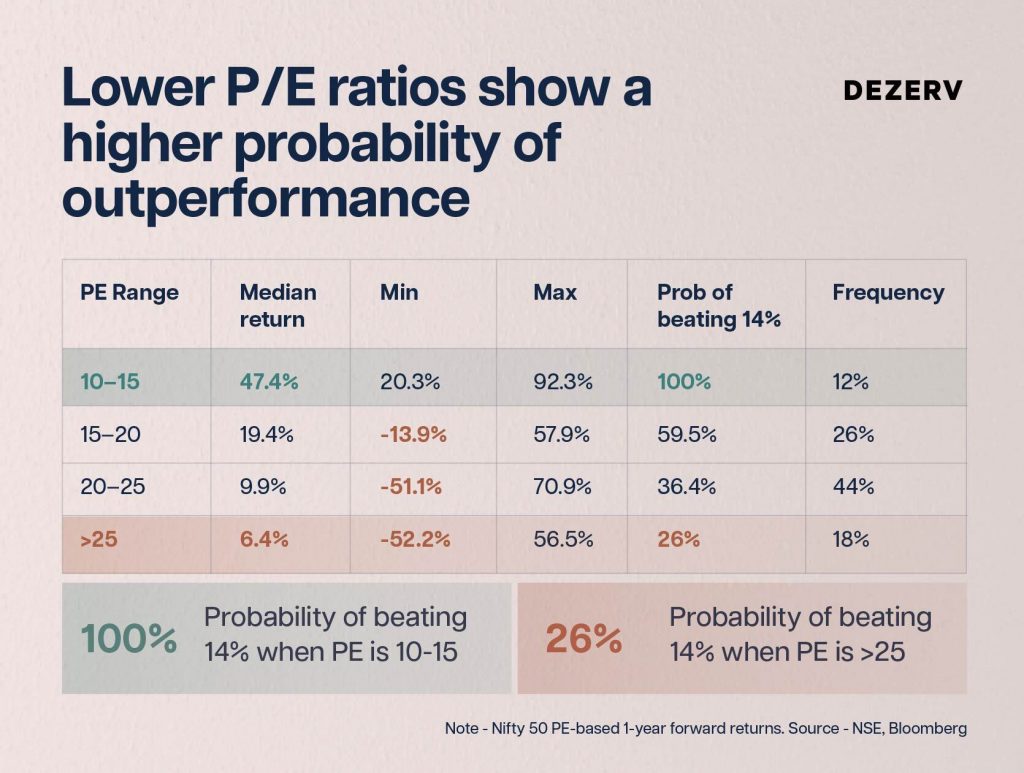
Every time in history that the Nifty’s PE has been between 10 and 15, returns in the following year have been above 14%. That is where the 100% probability comes from. But look closer at those instances and the picture gets more interesting. The typical outcome, sitting right in the middle of the distribution, was around 47%. The range ran from about 20% on the weaker end to 92% on the stronger end, with most instances clustering much closer to the middle. That 92% was an outlier, likely a sharp rebound year.
When PE goes above 25, the picture changes completely. The median return drops to around -6%, deep negative outcomes start appearing, and the probability of earning above 14% falls to 26%.
The pattern is clear in hindsight and hard to act on in real time, for the simple reason that a PE of 10 to 15 almost never arrives without a serious market fall attached to it.
That is because low PEs usually show up when markets have fallen sharply, when news is negative and people are pulling money out of equities. High PEs show up when markets have already done well and confidence is high. So the time that offers the best future returns feels the most uncomfortable, and the time that feels the safest tends to offer weaker outcomes.
Most investors respond to how things feel rather than what the data says, reducing or stopping their investments when markets fall and adding more when markets have already risen. Now this is an entirely natural way to behave, but it leads to doing exactly the opposite of what works.
The implication is not to predict markets or wait for the perfect entry point. It is something much simpler and, for most people, much harder to actually do: keep investing even when markets fall. The SIPs that continued through 2008, 2016 and 2020 bought more units at lower prices and captured the full benefit of the recovery that followed. The ones that paused during those same periods reduced long-term outcomes, not because the funds failed, but because they were stopped at exactly the wrong time.
What if you genuinely cannot handle the volatility?
At some point in any honest conversation about equity, the right question comes up. What if I genuinely cannot hold through a 20% drawdown? What if the volatility does not just make me uncomfortable but actually causes me to make decisions I later regret? This deserves a direct answer rather than a dismissal, because it is a fair and legitimate concern.
The worst outcome in investing is not earning a conservative return. It is being fully allocated to equity on paper and then selling near the bottom twice in a decade. That pattern, which is far more common than it should be, underperforms even the most cautious blended portfolio across a long horizon.
If you know yourself well enough to know you will not hold through serious corrections, a blended portfolio of equity, debt, and gold is the more honest answer. A balanced portfolio has historically seen fewer negative years than an all-equity one, the difference is roughly one bad year per decade versus two.
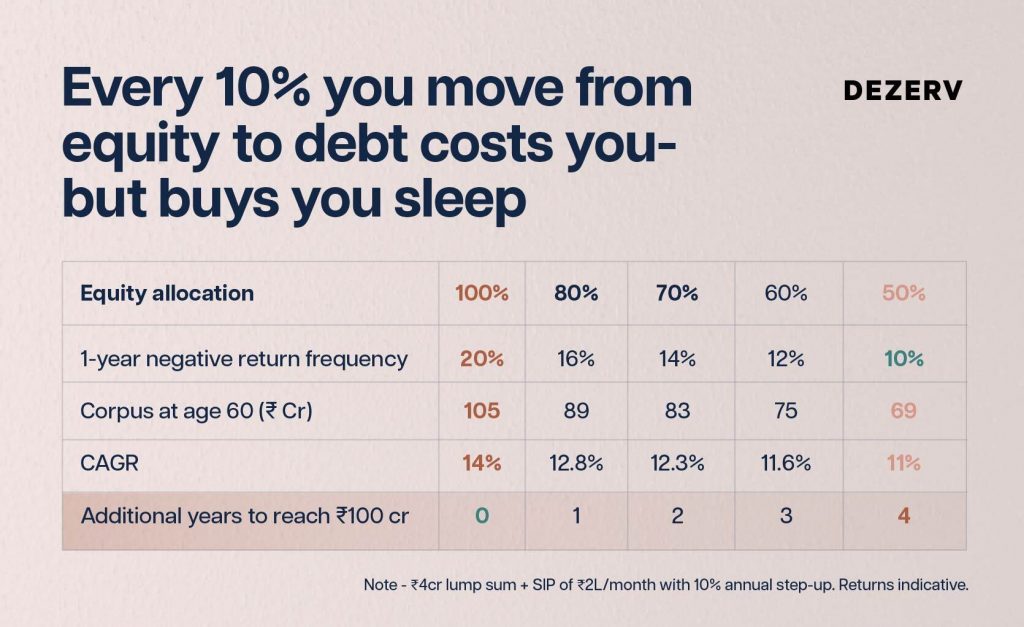
But the cost of that choice is not small, and it’s worth understanding clearly.
Historically, blending debt into an all-equity portfolio has come with a modest return trade-off, around 3% per year. Over a long period, that difference adds up to roughly four extra years needed to reach the same goal. That could mean four more years of working, or depending on an income for longer than you planned. This is not a theoretical gap, it directly affects when you can stop and what you’re able to build.
Gold is often underestimated in this discussion. Over the last 21 years, it has delivered returns similar to equities, slightly higher in some periods, while also helping protect purchasing power as the rupee weakens over time. For anyone investing over decades, that matters. So the role of gold is not just to reduce volatility, the return data supports having some allocation to it.
In the end, the choice between full equity and a mixed portfolio is not about right or wrong. It is a choice between two types of discomfort. One is dealing with volatility every year. The other is reaching your goals a few years later. The right answer depends on which one you can live with, and whether you can stick with your portfolio when markets become difficult.
One question worth answering honestly
Before allocation percentages, before fund selection, before tax optimisation, there is one question that determines more about your actual outcome than any of those decisions combined.
If your portfolio were down 20% six months from now, which is, as we have seen, a completely normal year in Indian equity and not a crisis — would you keep your SIP going? Would you treat that fall as a slightly better price on the same long-run future?
If the answer is yes, the path is clear: stay in equity, treat corrections as the market offering you a better entry point, and, if monthly portfolio checks are what trigger emotional decisions, stop looking so often. The discipline of checking less is underrated.
If the answer is no, build the blended portfolio with full awareness of what that choice costs, and then hold that portfolio through thick and thin. Because discipline applied to a conservative allocation still compounds. The 3% CAGR you give up is a real and measurable cost. Selling near the bottom is a permanent one.
One more thing before the allocation conversation begins.
Get the non-negotiables right first. Have health insurance in place before you start investing in equity, because one large hospital bill can undo years of savings in a single moment. Take term life cover if you have dependents or loans. And avoid borrowing for things that lose value. A car loan at 9% on something that is steadily depreciating is simply money leaving your future self every month. These are not glamorous decisions, but they are the foundation everything else depends on.
In summary
The gap between what the market delivered and what most investors actually earned has nothing to do with which funds they picked. It came down to what they did when things got uncomfortable. Whether they kept going or stepped back. Whether they treated a falling market as a reason to stop or a reason to stay.
The data is unambiguous on this. The investors who kept their SIPs running through 2008, through the flat years of the 2010s, through March 2020, did not do anything sophisticated. They just did not stop. And that single decision, to keep going when everything around them said pause, is what separated their outcome from everyone else’s.
Markets will always give you a reason to wait. A correction, a crisis, a valuation concern, a macro headwind. There will always be a compelling, well-reasoned case for stepping back right now. The behaviour gap exists precisely because that case always sounds sensible in the moment and always costs you something in the long run.
Consistency is not a personality trait. It is a strategy. And over twenty years, it is the only one that has reliably worked.
Disclaimer – Investment in the securities market is subject to market risks, read all the related documents carefully before investing. The information provided herein is intended solely for educational purposes and should not be construed as solicitation, advertising, or providing any financial or investment advice or an offer to buy or sell any financial instruments. The past performance is not indicative of future performance. Such past performance may or may not be sustained in future. Any statements about future developments are speculative and should not be taken as guarantees. Readers are advised to consult with their financial advisor before making investment decisions based on the information provided herein.
In the preparation of this document, Dezerv has used information developed in-house and publicly available information and other sources believed to be reliable. The information is not a complete disclosure of every material fact and terms and conditions. While reasonable care has been made to present reliable data in this article, Dezerv does not guarantee the accuracy or completeness of the data. The information / data herein alone is not sufficient and shouldn’t be used for the development or implementation of an investment strategy.
Any references to names of investment securities, or asset classes are for illustrative purposes only. Dezerv, along with its directors, employees, or partners or any of its affiliates, shall not be held liable for any loss, damage, or liability arising from the use of this document. Additionally, all trademarks, logos, and brand names mentioned are the property of their respective owners and are used for identification purposes only. The use of these names, trademarks, and logos does not imply endorsement or recommendation.