


On the night of June 23rd, a 30-year-old in Seoul sat with his phone, watching a third of his savings disappear. He’d put his money into a product that promised to double whatever SK Hynix’s stock did that day, expecting the stock’s recent surge to keep going. Instead, SK Hynix fell nearly 12% in a single day, and his investment lost more than 25%.
He wasn’t alone. Across Korea that day, ordinary investors were logging into stock forums to compare losses like casualties from the same storm.
Some had gone all-in on a Samsung product hoping for a rebound. Others had borrowed money to invest, only to receive margin calls from their brokers as prices collapsed. Margin loans across the country had already hit a record high just weeks earlier, as more and more people borrowed to get in on the excitement.
As of July 13th, over 1.2 million retail investors in Korea had hit margin call levels, about one in every 30 adults. The forced liquidation rate had jumped from 2.1% to 10% in just weeks. What began as one person’s bad night had become a nationwide crisis.
And it had all started with just two stocks. Samsung and SK Hynix, the two companies that anchor Korea’s entire stock market, had fallen nearly 12% on June 23rd, their worst since the 2008 financial crisis, dragging the KOSPI down almost 10% with it.
Over the following weeks, the Kospi fell about 25%, the Korean Won hit its weakest level since 2009, and the exchange had to halt trading several times after sharp market declines. By mid-July, South Korea’s President Lee Jae Myung was publicly calling the stock market “unstable,” admitting it would take time to settle.
For a market known for disciplined retail investors, sophisticated financial markets, and some of the world’s leading technology companies, it was an extraordinary turn of events. It’s not the kind of market you’d expect to fall apart overnight.
So what actually caused all of this?
It all traces back to a financial product most Indian investors have never even heard of: the leveraged ETF. And here’s the reassuring part. SEBI has never allowed this product for retail investors in India, and there’s no sign that’s changing anytime soon. Watching what unfolded in Korea, it’s hard not to feel grateful for that.
This week, we’re getting into what actually happened in Korea, what these products are, how they work, the risk they carry, and why India seems to have avoided a mistake that Korea is still cleaning up.
In this edition:
- What a leveraged ETF is, and how it’s designed to work
- Why it’s so different from the ETFs already in your portfolio
- Why it works against long-term investors, and how Korea’s markets are still feeling that
- Why SEBI has kept leveraged ETFs out of India
- What this teaches us about using leverage wisely
What is a leveraged ETF, and how does it work?
Imagine someone offers you a simple deal: whatever the market does today, you’ll get double the return. If the market goes up 1%, you make 2%. If it falls 1%, you lose 2%.
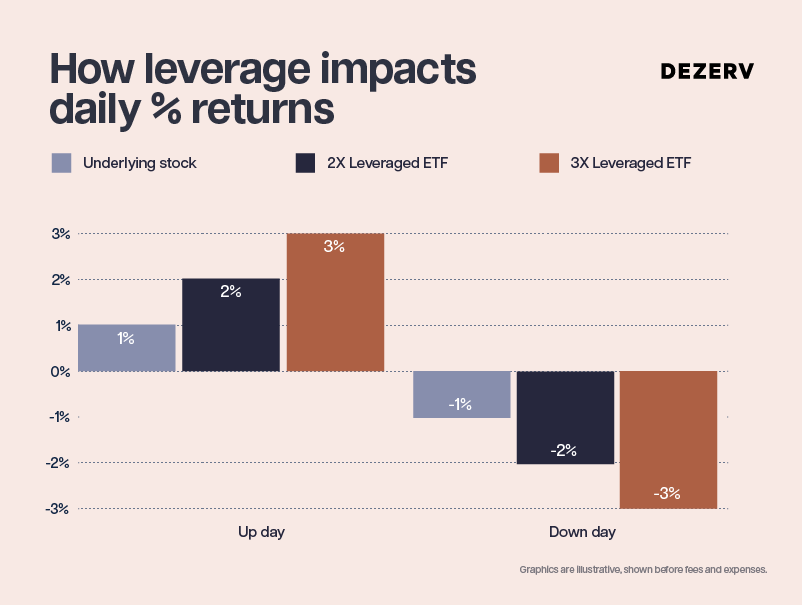
That’s essentially what a leveraged ETF does. It aims to deliver 2x or 3x the daily return of a stock or an index.
To make this happen, the fund doesn’t buy twice as many actual shares. Instead, it uses complex financial contracts like swaps and futures, agreements that track the stock’s price, letting the fund gain massive market exposure without needing to own all the physical shares directly.
This is the idea South Korea’s regulators reached for in late May. For years, retail investors had been moving money into US markets in search of better returns. To bring some of that money back, regulators launched 2x leveraged ETFs on Samsung and SK Hynix, two of the country’s best-known companies.
The idea worked, at least at first. Within weeks, products like the KODEX SK Hynix Single-Stock Leverage ETF had pulled in billions of dollars. By the middle of the year, assets in Korea’s leveraged ETFs had reached a record $45 billion. Retail investors made up 92% of the investors, and trading in these funds and the two underlying stocks accounted for more than 70% of activity in Korea’s stock market.
But the real danger in a leveraged ETF comes down to one rule: It has to reset itself every single day. To keep delivering exactly double the return tomorrow, the fund is forced to buy more of the stock when its price rises, and sell it off when the price falls. That’s a lot of buying and selling happening at the end of every trading session, and once enough money is doing this on the same stock, that daily churn stops just reacting to the price. It starts moving it.
That’s exactly what happened in South Korea. Every sharp move in Samsung or SK Hynix triggered even more buying or selling through these ETFs, amplifying the swings.
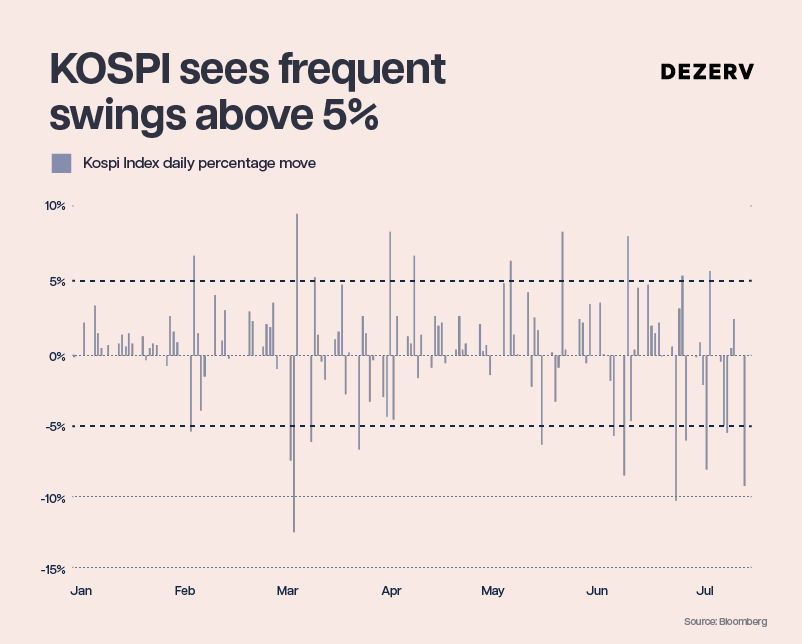
Before the launch, the index moved in a fairly normal range. Afterwards, the swings got bigger and far more frequent. To make matters worse, regulators approved both Bull ETFs, which profit when stocks rise, and Bear ETFs, which profit when they fall. Investors were placing leveraged bets in both directions on the same two stocks. A product that was meant to keep investors at home ended up making the market far more volatile.
Why it’s so different from the ETFs in your portfolio
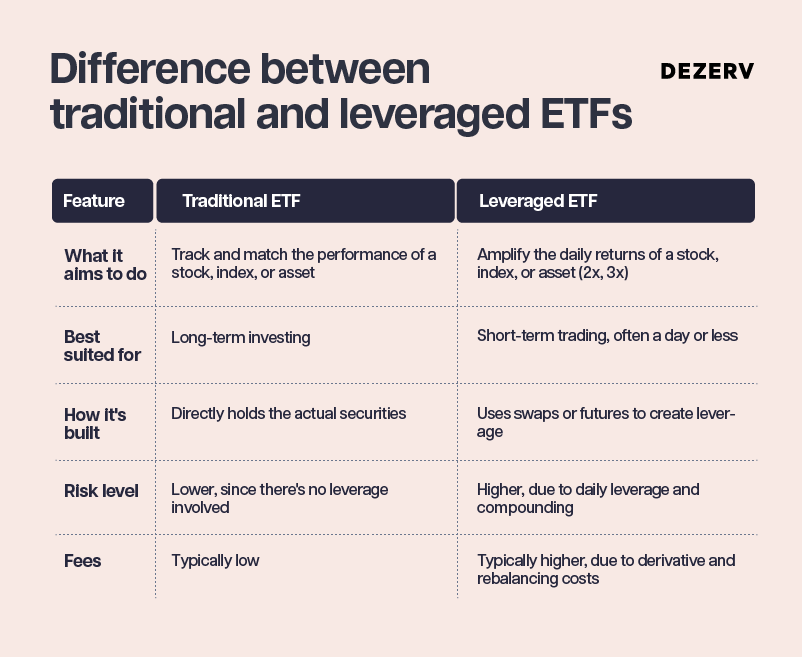
Most ETFs sitting in your portfolio right now are refreshingly simple. Buy a Nifty 50 ETF, and somewhere behind the scenes, the fund actually holds real shares of Reliance, HDFC Bank, Infosys, and the rest. Your investment just moves alongside them, nothing more complicated than that.
A leveraged ETF plays by a completely different set of rules. Here’s how the two stack up side by side:
How leveraged ETFs become risky over time
Let’s take a simple example. You invest ₹100 in a stock. It goes up 2% on Monday, so your investment becomes ₹102. On Tuesday, it falls 1.9%, bringing it back to about ₹100.06. After two days, you’re almost back where you started.
Now imagine you invested the same ₹100 in a 3x leveraged ETF. Monday’s 2% gain becomes 6%, so your investment grows to ₹106. Tuesday’s 1.9% fall becomes 5.7%, bringing it down to about ₹99.96.
The stock ended slightly higher than where it started. The leveraged ETF ended slightly lower. That’s because it resets every day, and small, repeated swings can slowly turn into permanent losses over time, a phenomenon known as volatility decay.
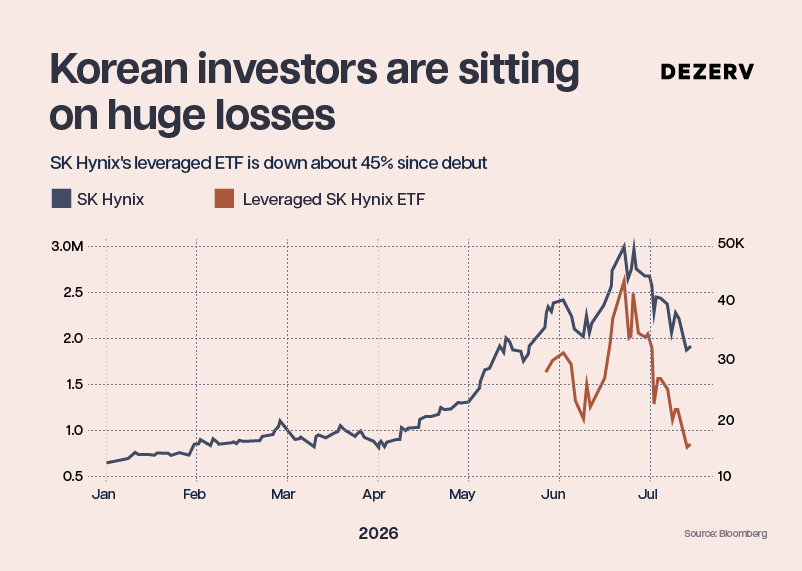
This is what investors in South Korea experienced. SK Hynix, the stock itself, continued to rise after the leveraged ETFs were launched. But the leveraged ETF tracking it was down by about 45%. The company kept doing well but investors in the leveraged ETF didn’t.
A similar story played out during the 2020 COVID market crash. The S&P 500 fell by about 34% from its peak to its trough. Because of daily compounding and amplified losses, UPRO, a real 3x leveraged S&P 500 ETF, fell by roughly three-quarters of its value over that same stretch.
By August 2020, the S&P 500 had already recovered all of its losses and was making brand-new highs. UPRO was still down more than 30% from its previous peak. The underlying market had fully recovered, but the leveraged ETF hadn’t.
And there’s one more risk. If the underlying index falls by just over 33.3% in a single day, a 3x leveraged ETF is effectively wiped out to zero. Once an investment hits zero, there might be nothing left to recover.
That’s why leveraged ETFs are fundamentally different from ordinary investments. With standard index funds, time is your ally, and it helps you recover from downturns. With leveraged ETFs, the longer you stay invested through a highly volatile market, the harder that recovery becomes.
Why doesn’t SEBI allow this in India?
SEBI has never approved leveraged or inverse ETFs for retail investors, and there’s no sign that’s changing anytime soon. It might look like an obvious cautious regulatory approach, but there’s likely more to it.
India has already seen what happens when retail investors get easy access to leverage. Take the futures and options market. It’s a different product, but it’s built on the same idea of using leverage to make bigger bets.
SEBI’s own study found that 91% of individual traders lost money in FY24, and 93% lost money in FY25. Together, they lost more than ₹2 lakh crore. Even after losing money, more than three out of every four traders came back and kept trading.
When you compare that with South Korea’s leveraged ETF story, you can see why regulators would be concerned. Both products appealed to retail investors with the promise of bigger returns, and in both cases, the majority ended up losing money.
What should you actually take from this?
Leverage isn’t inherently bad. It just isn’t designed for most long-term investors. Leveraged ETFs can be genuinely useful for an active trader with a short-term view. They let you amplify returns, hedge positions, and gain leveraged exposure without opening a separate margin account.
But those benefits come with equally large risks.
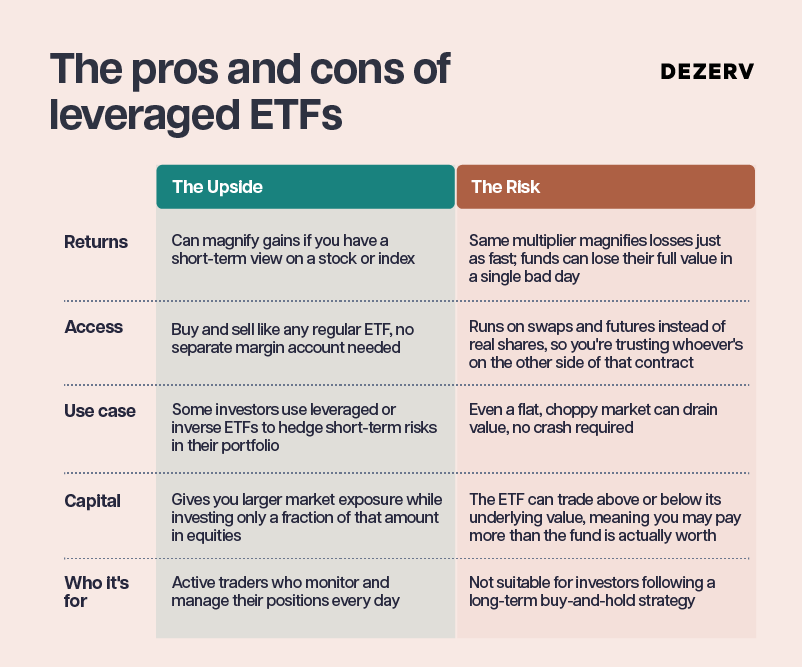
The same leverage that boosts gains can magnify losses. Daily resets can slowly erode returns, even when the market isn’t crashing. And in extreme cases, a single bad day can wipe out your investment. When you look at the pros and cons together, one thing becomes clear: these products are built for people who watch the market every day, not for investors who buy and hold for years.
In summary
South Korea learned about the risks of leveraged ETFs the hard way, through a real crash, billions in real losses, and a regulator publicly admitting he wished he’d stopped it sooner. India may not have needed to learn that lesson at all. SEBI chose not to open these products to retail investors, and in hindsight, that decision looks like exactly the right call.
Leverage has its place, but it isn’t meant for everyone. For most investors, wealth is still built the same way it always has been: by staying invested, being patient, and letting compounding do the quiet work it’s always done best.
Before I sign off
Last week, I launched my book, The Millionaire Employee. It’s built around an idea I feel strongly about: equity and ESOPs are becoming one of the biggest wealth creators for India’s professional class, not just its founders. Yet most employees still don’t have a good enough understanding of how they work or how to make the most of them. As a result, they’re often missing out on significant wealth.
If you’ve ever wondered how to evaluate an ESOP offer, when to hold, when to exit, or how ownership can change your financial trajectory, this book walks through all of it.
You can grab a copy here
Disclaimer – Investment in the securities market is subject to market risks, read all the related documents carefully before investing. The information provided herein is intended solely for educational purposes and should not be construed as solicitation, advertising, or providing any financial or investment advice or an offer to buy or sell any financial instruments. Readers are advised to consult with their financial advisor before making investment decisions based on the information provided herein. In this material, Dezerv has utilized information through publicly available sources, and other data deemed to be reliable. While reasonable care has been made to present reliable data in this article, Dezerv does not guarantee the accuracy or completeness of the data. Dezerv, along with its directors, employees, or partners or any of its affiliates, shall not be held liable for any loss, damage, or liability arising from the use of this document. All trademarks, logos, and brand names mentioned are used for identification purposes only and do not imply endorsement or recommendation.