



Stay updated
with our newsletter
Highlights
- Market surge: Indian hydroponics sector was worth USD 1.4 billion in 2022 — projected to reach USD 5.3 billion by 2031 at a 17.6% CAGR, unlocking major agricultural growth
- Productivity leap: Hydroponic lettuce yields ~41 kg per sq m vs ~4 kg in soil — enabling nearly 10× higher output and year‑round cropping
- Setup economics: A 1,000 sqm hydroponic unit costs INR 15–20 lakhs — multiple harvests and premium pricing can recoup investment swiftly
- Urban adoption: Nutrifresh’s D2C model serves 40,000+ homes within 24 hours of harvest — demonstrating strong consumer appetite for fresh, locally grown produce
Last weekend, I wanted to try a healthy meal and stumbled upon Herbivore Farms on Swiggy.
Usually, we order salads from a select few favourite cafes, and this new discovery was a pleasant surprise. The salad was fresh and tasted good – quite a change from the perpetual hits and misses with salads that are ordered online!
While looking up Herbivore Farms, I discovered they are growing their produce out of an indoor farm in the middle of Andheri, Mumbai!
When I read that the lettuce and vegetables used in the salad are grown hydroponically, it made sense suddenly. Hydroponics, an upcoming segment in agriculture and farming, is known for its fresh, hygienic and nutritious produce.
So, in this edition of the newsletter let’s delve into hydroponic farming and how it is transforming the way urban Indians are consuming and even growing vegetables.
Here’s what we will cover today
- What is hydroponic farming?
- How is hydroponic farming different from traditional farming?
- The hydroponics market in India
- Why is hydroponic farming gaining momentum in India?
- How much does a hydroponic set-up cost?
- Indian startups leading the hydroponic revolution
- What are new-age brands doing differently to appeal to modern consumers?
- The future of hydroponic farming in India
Join me as we explore hydroponics and uncover the economics behind this burgeoning industry.
What is hydroponic farming?
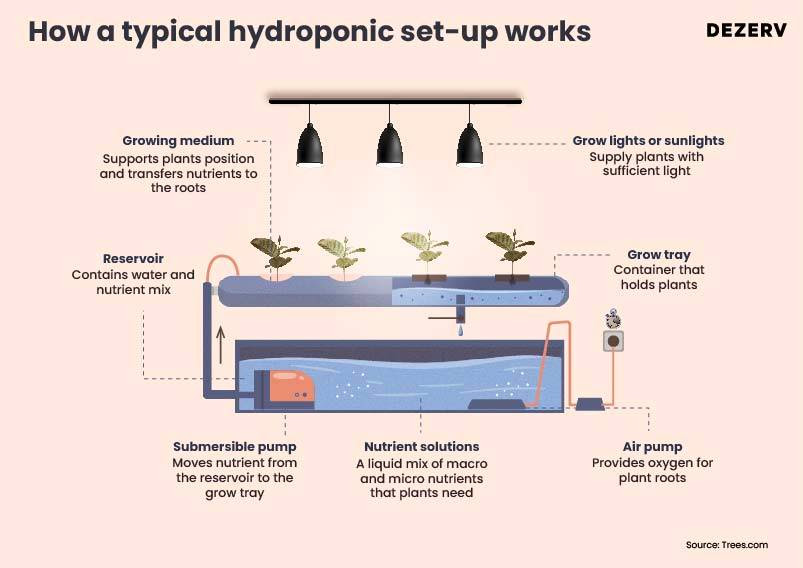
Hydroponic farming is a method of growing plants without soil, using nutrient-rich water solutions to deliver nourishment directly to the plant roots.
How is hydroponic farming different from traditional farming?
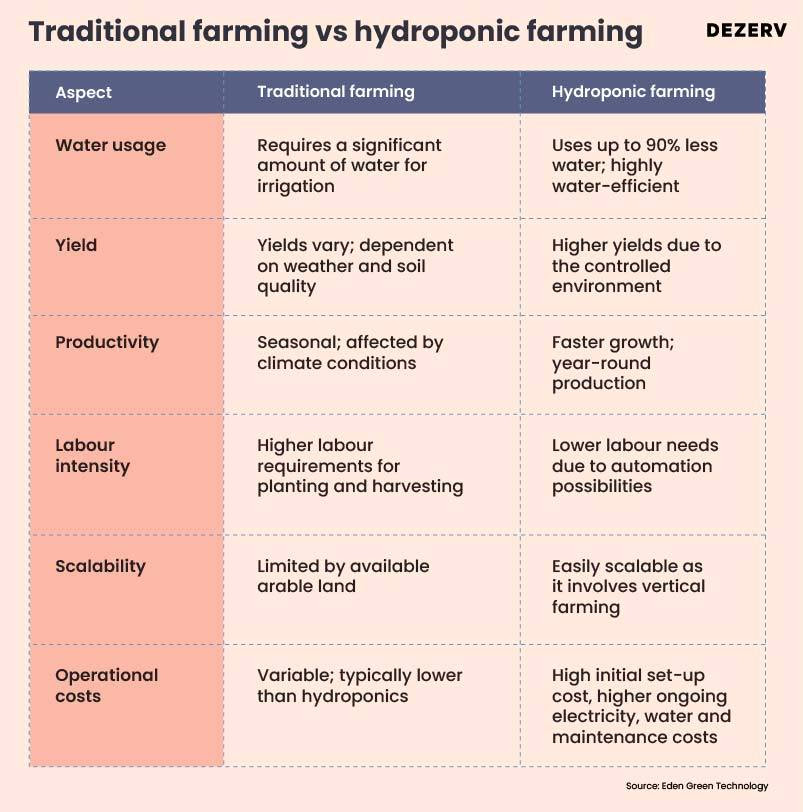
As the agricultural sector evolves, hydroponics is increasingly being compared to traditional farming methods.
Below, we analyse the key differences between these two approaches across various critical factors
The hydroponics market in India
According to Data M Intelligence, the Indian hydroponics market, valued at USD 1.4 billion in 2022, is projected to reach USD 5.3 billion by 2031. The expected CAGR between 2024 and 2031 is estimated to be 17.6%.
Still in its nascent stage, this segment is gathering steam as new-age brands are entering the market.
Why is hydroponic farming gaining momentum in India?
Hydroponics is rapidly gaining traction in India, driven by a combination of factors such as
- Rapid urbanisation: Between 1991 and 2019, India lost over 3 million hectares of agricultural land, while the urban regions gained 9 million hectares.
Although this trend has decelerated recently, agricultural land scarcity has driven the rise of hydroponic farms to produce food in urban areas efficiently. - Overcoming climatic difficulties: With hydroponics, farmers can cultivate various crops throughout the year, irrespective of the outside weather.
This method gives farmers more control over the crop incubating conditions and reduces the risks associated with traditional farming, such as crop failures due to drought or flooding. - Increasing population: India’s growing population creates a huge demand for produce, which can be facilitated by hydroponically grown produce. Further, as people become more health conscious, the demand for organic hydroponic products is set to grow.
With rising consumer interest, India is on track to become a major player in the global hydroponics industry. - Supply-chain vulnerabilities: The COVID-19 pandemic highlighted the importance of food security and resilience, leading to a surge in hydroponic farming in India.
With disrupted supply chains and a heightened focus on local food production, many turned to hydroponics as a sustainable and efficient way to grow fresh produce at home.
In addition to these factors, the rising trend of home-based hydroponic gardens contributes to the market’s growth.
Urban residents are increasingly setting up small-scale hydroponic systems in their homes, balconies, and terraces, growing their own vegetables and herbs.
Costs and benefits of setting up hydroponic farms
“Initial setup costs can be substantial, given the advanced systems and technology involved. There’s also a steep learning curve, as managing a hydroponic farm demands specialised expertise. Energy consumption, especially with artificial lighting, can be significant,” said Vihari Kanukollu, CEO and co-founder of Urban Kisaan, to Forbes in August 2023.
Hydroponic farming is not just an innovative way to grow crops; it’s also a potentially profitable business venture.
Let’s now understand the economic viability of this innovative farming method by decoding the costs, revenue, and profitability of the business.
The typical cost of setting up a hydroponic farming unit of 1,000 sq. mt. is around INR 15 lakhs to INR 20 lakhs. (source: Krishi Jagran)
Whilst the per unit area cultivation cost for different crops cultivated under a hydroponic setup is much higher than conventional farmland based cultivation due to higher energy consumption and the input materials utilised, the ability to cultivate the crops multiple times a year and achieve higher yield per unit area enables better returns on investment.
To give a comparison, lettuce grown in regular farmland yields about 4 kg per sq. mt. whilst lettuce grown in a hydroponic set-up yields about 41 kg per sq. mt. (source: Research Gate).
You get about 10X yield per unit area and you will be able to produce the crop multiple times throughout the year unlike conventional farming where you are dependent on soil, weather and water conditions.
Similarly, tomatoes, which yield about 8T to 12T per acre in open area cultivation (source: Agrifarming.in) i.e. 2kg to 3kg per sq. mt. under hydroponic setup you will tentatively get about 20kg to 30kg per sq. mt. (source: Research Gate)
It is also important to note that the quality of the produce cultivated in hydroponics is better than conventional farming conditions and the cultivation period tends to be faster than conventional cultivation duration. This leads to better price realisation for the produce.
Indian startups leading the hydroponic revolution
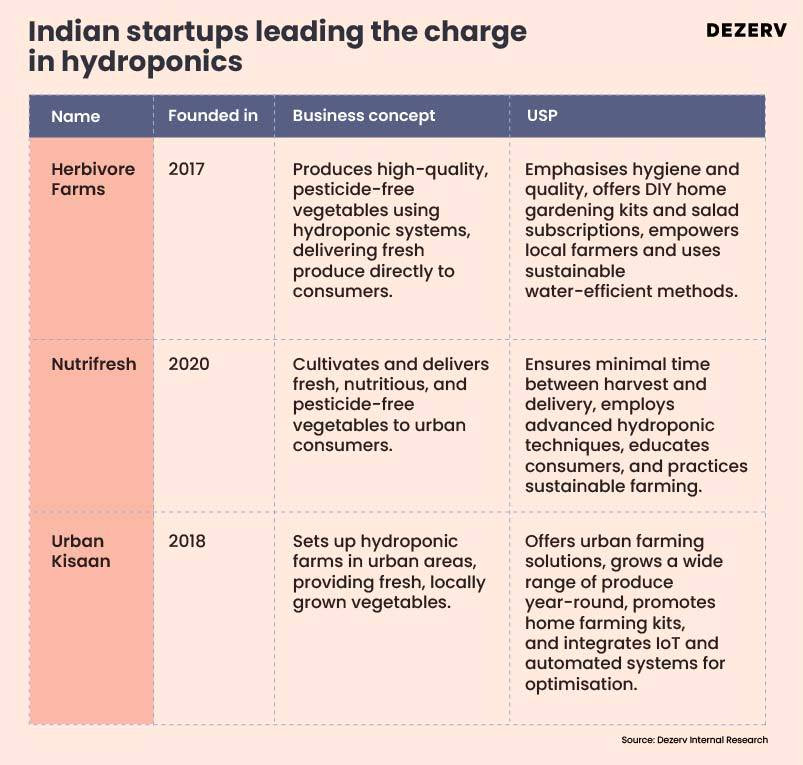
As hydroponic farming gains momentum in India, several innovative startups are at the forefront, revolutionising food production.
Few brands like Herbivore, Nutrifresh, and Urban Kisaan are making significant strides, each with its unique approach and success stories
What are new-age brands doing differently to appeal to modern consumers?
New-age hydroponic brands are adopting innovative strategies to attract and retain modern consumers. Some of them include:
1. Adopting the direct-to-consumer (D2C) model
Brands are increasingly forgoing the traditional supply chain and adopting a direct-to-consumer approach to ensure freshness.
Through its D2C farm-to-door model, Nutrifresh delivers fresh produce to over 40,000 homes within 24 hours of plucking, ensuring that it stays fresh and retains nutrients.
2. Customisable and convenient offerings
To cater to the diverse preferences of modern consumers, these brands offer customisable and convenient product options.
For instance, after the success of its produce subscription model, Herbivore Farms has introduced ready-to-eat salads with seasonal produce for customer convenience.

3. Focus on health and quality
Most hydroponic growers strive to provide optimal and complete plant nutrition. This promotes faster plant growth, enabling quicker harvests and allowing growers to produce more fresh vegetables efficiently.
All hydroponic farms, including Herbivore, Nutrifresh and Urban Kiasan, promise 100% pesticide-free produce.
4. Integration of advanced technology
Brands leverage cutting-edge technology to optimise their farming processes and enhance the quality of their produce. This includes using IoT devices (Internet of Things), automated systems, and advanced hydroponic techniques to monitor and control growing conditions.
Urban Kisaan has managed to multiply its produce by 49x per sq. feet by leveraging IoT and data learning software.

The future of hydroponic businesses in India
The hydroponics market in India is expected to grow significantly in the coming years. This growth is driven by increasing urbanisation, the demand for fresh and pesticide-free produce, and the need for sustainable agricultural practices.
As technological advancements continue and government support grows, hydroponic farming is expected to see widespread adoption, transforming the agricultural landscape and enhancing food security and sustainability across the country.
However, it is not without its challenges.
Despite its many benefits, hydroponic farming in India still faces several significant challenges:
As I mentioned earlier, one of the biggest issues is the high setup cost. The required equipment and infrastructure, like grow lights, nutrient solution systems, and controlled environment systems, can be prohibitively expensive, especially for small farmers and start-ups.
- Maintaining and operating a hydroponic farm also incurs high costs, which can be a major obstacle for those with limited resources.
- There’s a shortage of knowledge and expertise in hydroponic farming among Indian farmers. Being a relatively new technology in the country, there’s a lack of trained professionals to provide the necessary support and guidance.
- The limited availability of inputs such as seeds and nutrient solutions is a challenge. Because the market for hydroponic supplies is still small in India, farmers often have to import these inputs, which adds to their expenses.
In summary
Hydroponic farming represents a paradigm shift in agriculture, offering innovative solutions to some of the most pressing challenges faced by the agro-economy.
Hydroponics promises higher yields, water efficiency, and year-round productivity through nutrient-rich water systems and controlled environments, distinguishing itself from traditional farming..
The emergence of Indian startups like Herbivore Farms, Nutrifresh, and Urban Kisaan highlights the sector’s potential, showcasing success stories built on sustainability, advanced technology, and consumer-centric models.
I, for one, can’t wait to see what other consumer-focused innovations and solutions emerging brands like Herbivore Farms come up with!

Written By