

In October 2007, two friends stood outside a bookstore on Church Street in Bangalore, handing out bookmarks with a website address, hoping someone would go home, type it into a browser, and place an order. That tiny experiment became one of India’s biggest startups, and the birthplace of an entire generation of founders.
Seven years later, in Gurugram, another pair of college friends watched their first startup fail. Instead of rushing into the next idea, they spent months riding with AC repairmen to understand why India’s home services market never worked. What they built next now serves millions of households every month.
Almost a decade later, a group of auto drivers in Bangalore asked two people at a fintech company to build them an app that wouldn’t eat into their earnings. Before writing a single line of code, they drove autos themselves to understand the problem.
That same year, a former employee of the original bookstore startup shut down his own company, returned $9 million to investors, and started again. Today, his travel card company is one of India’s fastest-growing startups.
Bet you got at least two of those right.
Flipkart. Urban Company. Namma Yatri. Scapia.
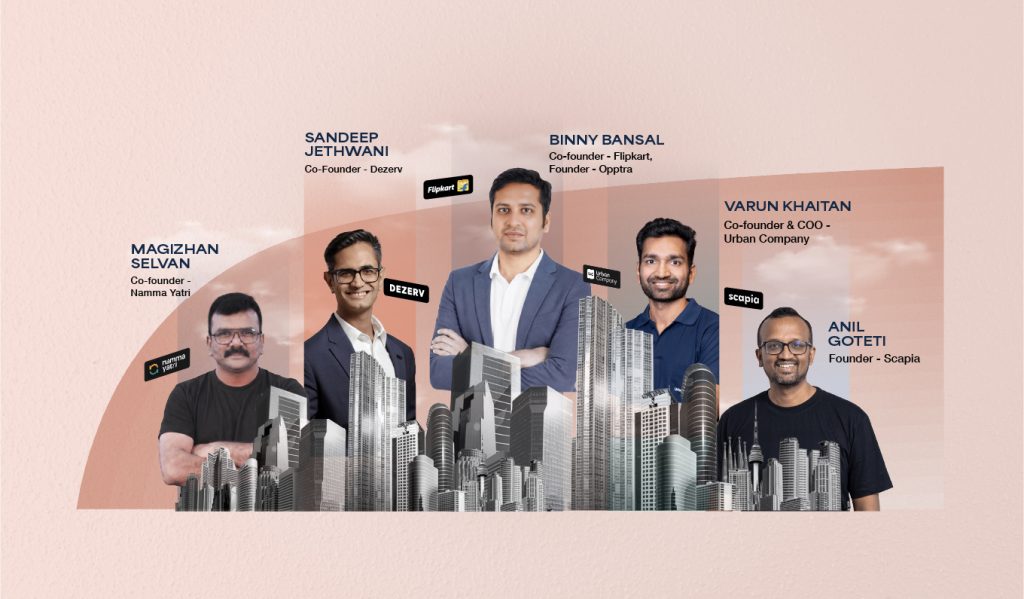
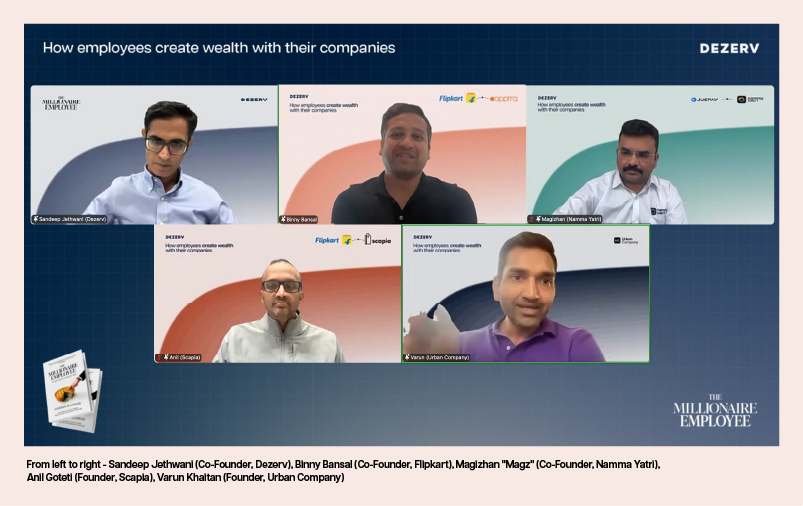
Yesterday, we hosted the founders behind each of those stories, Binny Bansal of Flipkart, Magizhan Selvan of Namma Yatri, Anil Goteti of Scapia, and Varun Khaitan of Urban Company, on our webinar. It turned out to be one of the largest we’ve ever hosted, with over 5,000 people tuning in. In today’s newsletter, I’ll share the best lessons and insights from the session. If you missed the session, consider this your front-row seat. If you joined us live, think of it as the key takeaways worth revisiting.
In this edition:
- How Flipkart hired people before equity had value
- When salary beats equity (and when it doesn’t)
- The right time to take money off the table
- Why selling at the first buyback isn’t always the best move
- What changes after your company goes public
- How one ESOP programme created hundreds of founders
From Zero to Billions: The Journey of an Early Stage Startup
Equity means something very different to a fifth employee than to a five-hundredth. That’s the whole reason we built this webinar as an arc, tracing a company’s journey from its earliest days to a decacorn, one founder per stage.
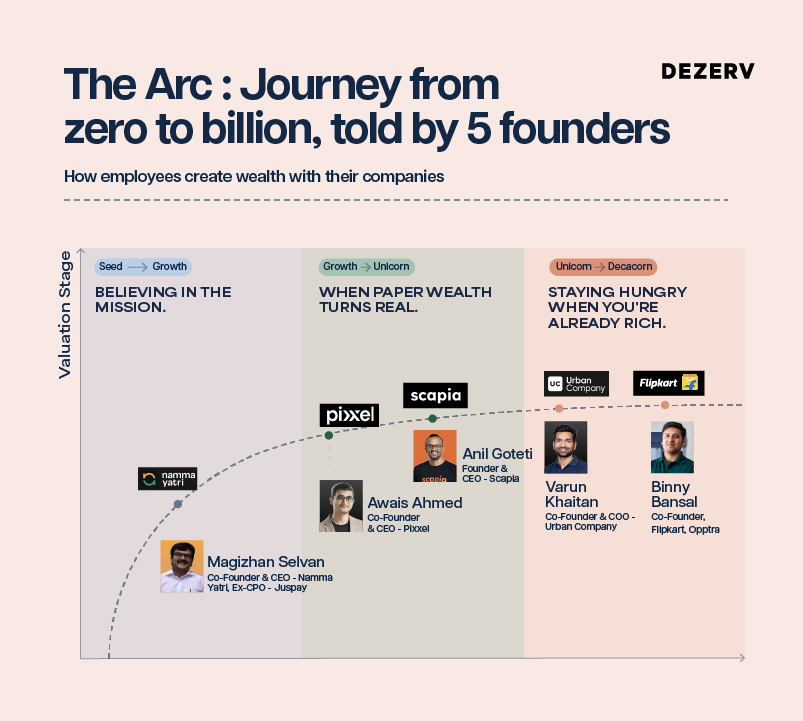
There was no better place to start than with Binny, who has lived that arc himself — from building Flipkart from scratch to now building Opptra.
Flipkart’s story is one every founder in the room had grown up hearing. What doesn’t get talked about enough is what it took to convince people to join before there was anything to believe in. There was no funding in the early years, so there was no salary to speak of. What Binny and Sachin could offer instead was ownership, a promise that if the company worked, everyone who helped build it would share in that outcome.
That reads as obvious now. It wasn’t then. Most people in 2008 didn’t see equity as something with real value, so joining Flipkart meant betting on a currency almost nobody trusted yet. In hindsight, the people who chose equity turned out to be the ones willing to build for the long term. There wasn’t even a formal ESOP policy in those first years, just a promise, a number, and paperwork that came later.
That same instinct — reward belief and not certainty, shaped how Flipkart handled failure. When the company acquired Mime360, a music startup meant to become something like an iTunes for India, the product never found its market. But instead of writing off the team, Flipkart moved most of them into other roles, ESOPs intact. Judge people by why something failed, not by the fact that it failed.
The same logic runs through how Binny thinks about buybacks. There’s no clean, universal schedule, a company runs one when it can afford to, and when doing so reinforces the behaviour it wants to reward. Buybacks should happen when the company is healthy enough to afford them.
What that early philosophy compounded into is worth noting. Flipkart’s ESOP programme has since created roughly ₹12,000 crore of wealth for employees. The more interesting number sits one layer beneath that: former Flipkart employees have gone on to start more than 300 companies. Six have become unicorns. Together, they employ over 40,000 people.
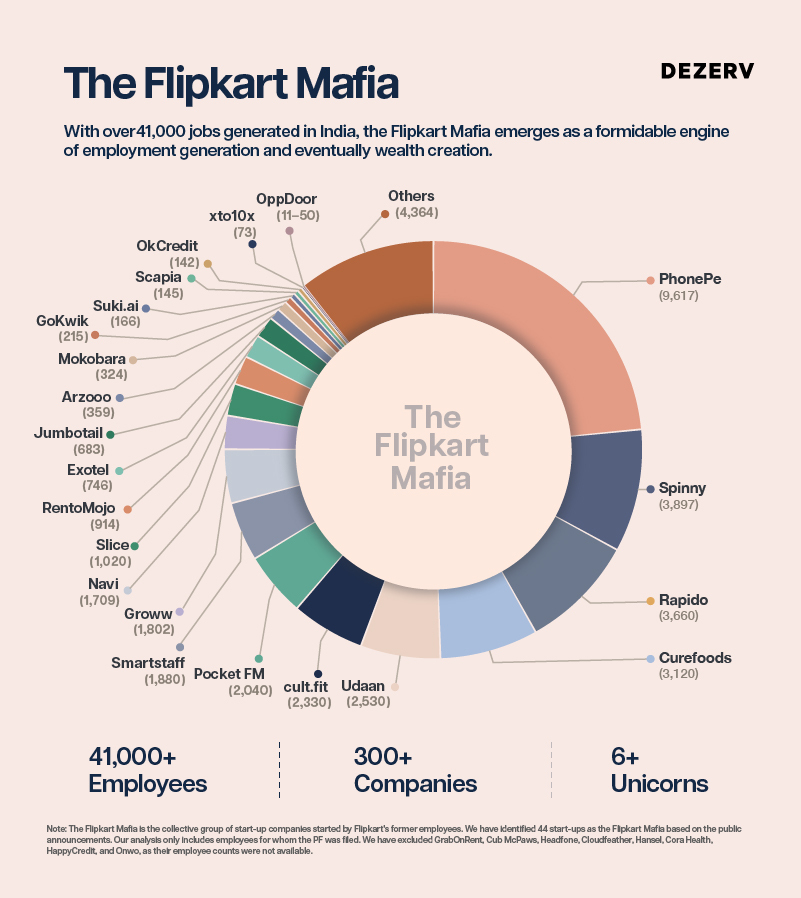
That’s the point where equity stops looking like compensation and starts looking like infrastructure. It doesn’t just create wealth for one generation at one company. It creates founders, who create companies, who create opportunities for thousands more people who never set foot inside the original building.
Seed to Growth: Believing Before There’s Proof
If Flipkart showed us what happens at the end of the journey, Namma Yatri showed us what it looks like at the beginning, when choosing between salary and equity is still a very real decision.
Magizhan Selvan aka Magz thinks about this less like a job decision and more like asset allocation. Salary is the fixed income, it protects the downside and removes financial stress. ESOPs are the upside, reached for only once the downside is covered. The one place this framework breaks from normal investing logic: with equity in your own company, you’re not just holding a position and watching a scorecard. You can move the outcome yourself.
That’s why joining an early-stage startup is not just a financial decision. When Magz joined Namma Yatri, he considered taking his entire compensation as ESOPs. But instead, he kept a small salary to cover his living expenses. The logic was simple: you can believe completely in the company and still need enough cash to wait for that belief to pay off.
The instinct to leave equity alone once granted follows the same logic. Magz didn’t track the ESOPs from his previous company for two years — not something he’d recommend, read your grant letter — but the behaviour is sound. An ESOP behaves like a seed: you grow it by building the product, not by digging it up to check on it, and let the liquidation event arrive whenever it arrives.
The hardest part comes in the years before the company starts to work. Your friends at larger companies are earning more, while you’re putting in longer hours for less. This is what you call the “zone of frustration”, a phase almost every early employee goes through before the rewards start to catch up and I’ve talked about this in detail in my book, The Millionaire Employee.
Before accepting an offer with a large equity component, Magz suggests doing one thing: get to know the founders and the team. Meet them in person if possible. It’s often the best way to understand what you’re really signing up for.
Growth to Unicorn: When Paper Wealth Turns Real
Anil Goteti has stood on both sides of this stage — first as an early Flipkart employee negotiating his own equity, later as the founder of Scapia, running his company’s first buyback.
He arrived at Flipkart with more equity literacy than most, having worked in the Bay Area, and asked for twice the ESOP he was initially offered. Binny suggested waiting a year or two before revisiting the conversation. In the end, Anil never needed to bring it up again. Flipkart made sure its employees were well rewarded.
The belief that actually reshaped how he thinks about equity came earlier, at Qualcomm, his first job. He held stock for five years, planning to cash it in for an MBA. Then he resigned, and inside his three-month exercise window, a lawsuit hit the company. The stock fell underwater. He walked away with a tenth of what he’d planned on.
Since then, Anil has exercised every ESOP he’s received. His advice is simple: don’t wait for the perfect moment. Sell a little over time instead of trying to time it all at once.
The same discipline shapes how he decides when Scapia should run a buyback: whether the milestones justify it, whether the company can afford it, and who’s actually earned it. Not a founder’s unilateral call, it sits with the founder and the board together.
Unicorn to Decacorn: Staying Hungry After You’re Already Rich
Urban Company’s Varun Khaitan sits at the stage every founder eventually has to reckon with: what happens to ambition once the wealth is no longer theoretical.
When Urban Company went public last year, the IPO didn’t feel like the finish line for Varun. Two days later, the team was back at work, focused on what came next. That was the biggest takeaway for me. Companies that keep growing don’t treat milestones as destinations. They simply move on to the next problem.
What changes after listing isn’t ambition. It’s the emotional texture of the wealth itself. Being told your equity is worth something and watching that number move on a screen every day are two different experiences. On the days it dips, people feel like they’ve “lost” money they could have taken off the table earlier, even though nothing about their underlying ownership changed. Watching your wealth go up and down every day can make even long-term investors think short term.
The mechanical shift underneath is precise: private employees can’t sell even if they want to, so a founder’s job before listing is mostly narrative, to get people to believe in the destination. Public employees can sell whenever the market allows, and no founder can stop that. So the job afterward becomes coaching people to think in four- or five-year horizons instead of daily price movements.
Urban Company has lived this directly, with its own stock swinging 20 to 30% at points, and the actual day-to-day work is keeping longtime employees calm through cycles they’ve already lived through once, and getting newer employees to stop checking the price altogether.
In Summary
Underneath all of it sits one requirement that hasn’t changed at any stage of this arc: the equity only makes sense if you believe in where the company is headed years out, not where it trades today. That’s the one thing every founder here, from a startup with no funding to a public company with a ticker, was actually asking their people to do. Believe first and the wealth will follow.
More from the session, dissected in detail, find the full breakdown here.