

In 1969, an Ahmedabad chemist named Karsanbhai Patel began selling a detergent powder called Nirma at ₹3.50 a kilo, at a time when HUL’s Surf cost ₹13. He didn’t invent detergent, but by making it affordable to almost every household, he changed who could use it. Within fifteen years, Nirma was a familiar name in Indian homes.
Almost fifty years later, another Gujarati company did the same with the internet, and went much further. In early 2016, a gigabyte of mobile data cost Indians about ₹228, which is why most of us saved our videos for the office Wi-Fi. Jio launched that September with free calls and data, and by 2025 that cost had fallen to ₹7.9. Today, ₹228 buys about 29 GB, more than the average Indian uses in a month.
Where Nirma stayed the affordable choice, Jio has done what few businesses built on low prices rarely manage: raised prices while adding customers.
It now serves 52 crore Indians, carries 60% of the country’s mobile data and earned ₹30,049 crore in net profit in FY26.
On 21 October, the people who made that possible will finally get to own a piece of it, at ₹1,065-1,119 a share. At ₹30,213 crore, it is set to be India’s largest IPO. Unusually, no existing shareholder is selling. Meta, Google and the other investors who bought in at ₹488 a share during the 2020 lockdown are staying put.
Almost every reader of this newsletter has a Jio number in the family. But how many have looked at the business behind it? With the IPO days away, let’s examine what Jio owns, how it makes money, what the price implies and the risks to weigh before bidding.
In this edition
- What exactly is Jio Platforms?
- How did Jio turn a price war into a profit machine?
- Why is Jio raising money if it’s already profitable?
- What are you really paying for: a telco or a tech platform?
- What to weigh before you bid
What exactly is Jio Platforms?
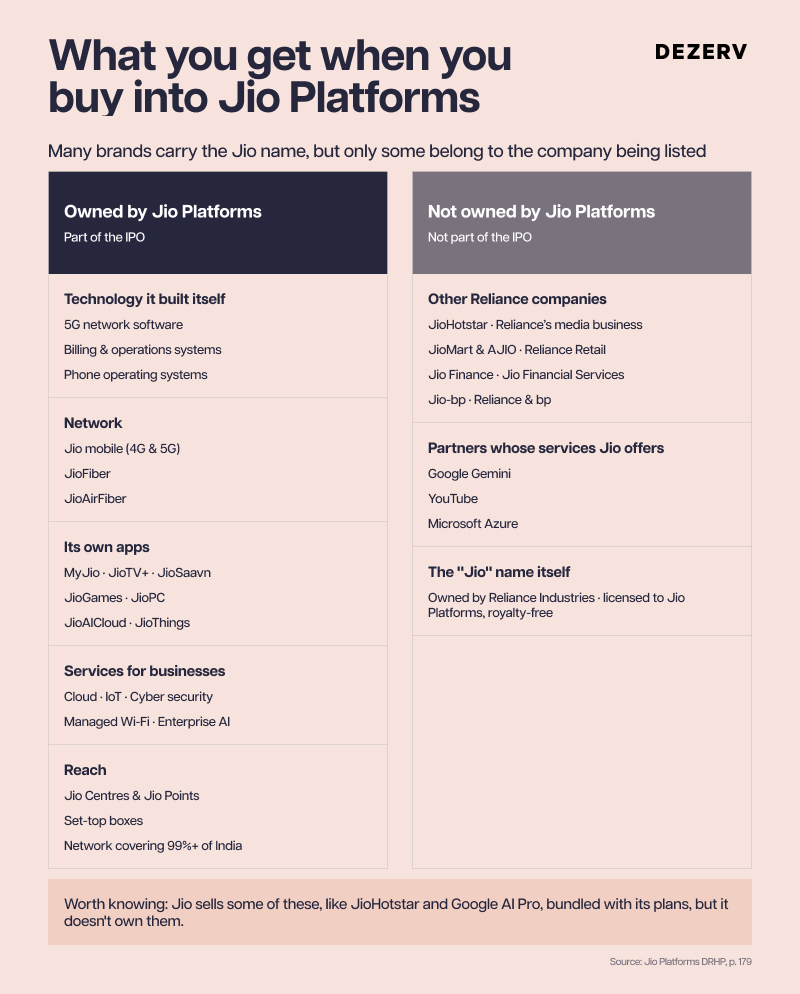
Most of us encounter Jio several times a day. We recharge on MyJio, watch cricket on JioHotstar, order groceries on JioMart and fill up at a Jio-bp pump, so it is natural to assume this IPO lets you buy into all of it.
Most of these, however, belong to other parts of the Reliance group: JioMart is run by Reliance Retail, JioHotstar by Reliance’s media business, and Jio Finance is already listed separately. Jio’s own offer document lists JioHotstar and Jio Financial Services as “third-party” services alongside Google and Microsoft, and even the Jio name belongs to RIL, which licenses it to Jio Platforms royalty-free.
What Jio Platforms owns is everything underneath. At its base is technology it built itself, from the network to the software running it. On top sits the connectivity we know: 52.4 crore mobile customers (26.9 crore on 5G) and home broadband reaching 2.7 crore homes, more than any other provider. It also earns beyond the SIM through MyJio, JioSaavn, JioTV+ and cloud, IoT and security services for businesses.
The shareholder list shows how many large global investors have already backed this business. Reliance owns 66.43% of Jio Platforms. Meta and Google hold close to 18% together, with the rest spread across KKR, Silver Lake, Saudi Arabia’s PIF, ADIA, Mubadala and other global funds that invested in 2020.
Behind every mobile network is telecom spectrum: the radio frequencies that carry phone signals. Your home Wi-Fi works the same way. Most routers use 2.4 GHz and 5 GHz frequencies. One reaches the far bedroom; the other is faster but struggles through a wall or two.
Mobile networks face the same trade-off. Some frequencies travel farther and pass through walls but carry less data; others carry more over shorter distances. The government owns this spectrum and leases it to telecom companies through auctions, usually for 20 years, and they pay for it in instalments, much like an EMI.
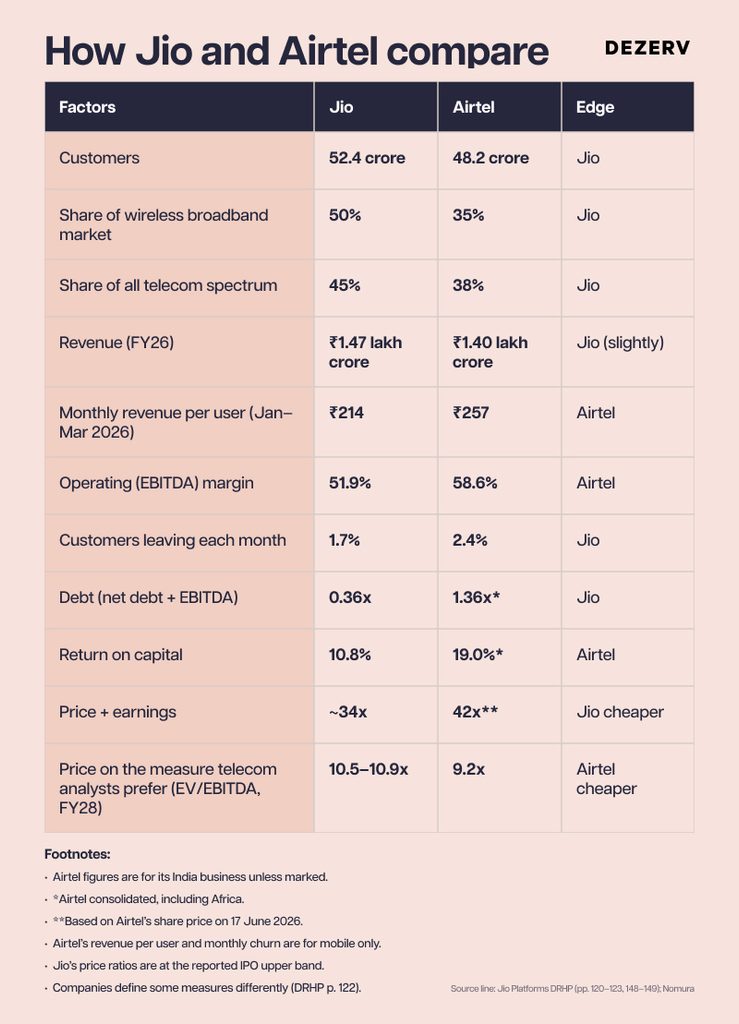
Jio holds about 45% of all spectrum held by India’s telecom operators, against Airtel’s 38%. It leads in three of the four frequency ranges, and its leases still have 16 years left on average.
Customers can switch networks within days, but no rival can quickly match that much spectrum or a network built over ten years. Buying into this IPO is like buying a toll road on India’s mobile traffic with sixteen years left on the lease.
How did Jio turn a price war into a profit machine?
In March 2016, India had about ten mobile operators fighting over the same customers. Within three years, most had disappeared: Reliance Communications, Aircel and Videocon went into insolvency; Telenor and Tata Teleservices sold to Airtel; and Vodafone and Idea merged to survive. Today, just four operators remain, with three holding almost the entire market.
That matters more than any single number in Jio’s accounts. In a market with ten players, the company that raises prices first hands customers to its rivals. In a market with three, a price hike is usually matched within days, which is exactly what happened in July 2024 when Jio raised tariffs and Airtel and Vodafone Idea followed. The price war made later price hikes possible.
All of this has made Jio one of the largest businesses in the country. In FY26, it earned ₹1.47 lakh crore in revenue and ₹30,049 crore in profit, keeping about ₹20 of every ₹100 billed. The company says no Indian business has reached this scale within ten years of starting out, despite competing with two established rivals.
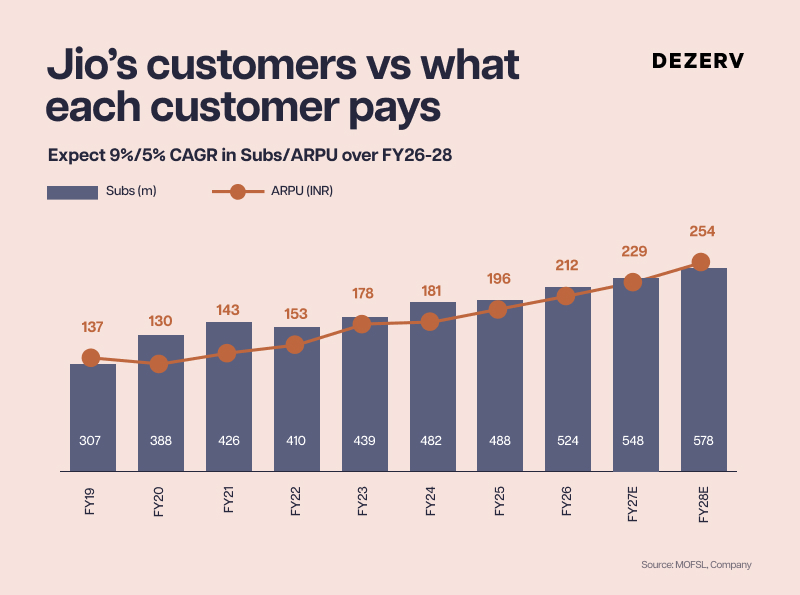
The average Jio customer now pays nearly a fifth more each month than two years ago. Yet Jio added 3.6 crore customers in the same period. Mobile data has become as essential as electricity: a bill people grumble about but keep paying. Warren Buffett calls pricing power the most important thing to look for in a business, and the last two years are Jio’s clearest evidence that it has some.
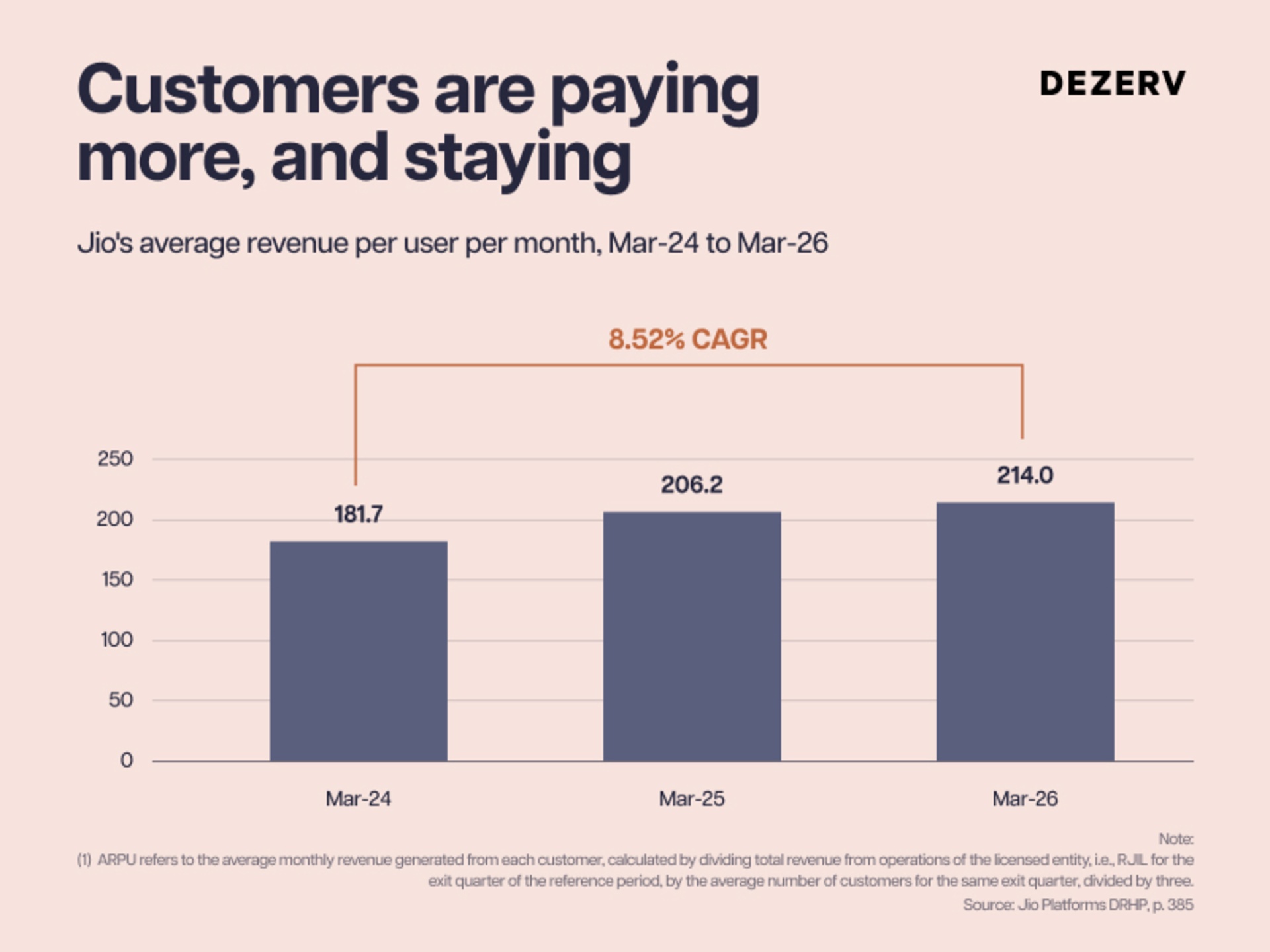
The picture isn’t entirely one-sided, though. In the nine months after the July 2024 hike, Airtel’s customer base grew about 2%, while Jio’s slipped slightly. Airtel also earns ₹257 per customer each month, against Jio’s ₹214, suggesting that users willing to pay more for quality have tended to choose Airtel.
The second change is how much cash Jio keeps after building its network. A telecom network is a lot like the toll road: the years of construction swallow money, and the returns only arrive once the road is open. Jio spent much of the last decade building 4G and then 5G. Two years ago, it kept less than ₹3 of every ₹100 in operating profit after network spending. Today, it keeps about ₹55.
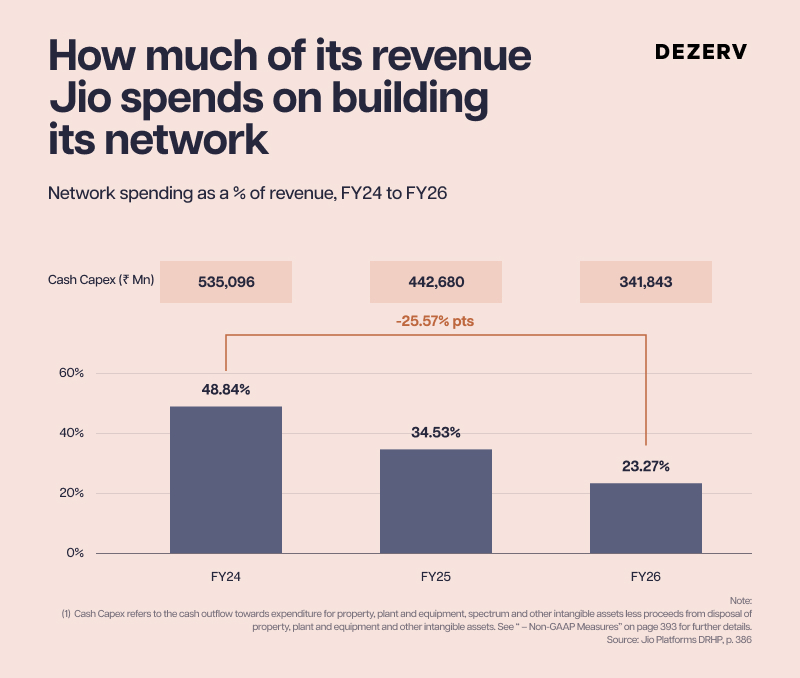
That shift turns a profitable company into a cash-generating one, and it is the main reason Jio can now cut debt, invest in AI and list from a position of strength. The one caution is that telecom harvests rarely last forever. The move from 4G to 5G came within six years, and the next cycle, whether 6G or the data centres AI will need, will eventually ask for another round of construction.
Why is Jio raising money if it’s already profitable?
India’s two largest IPOs before Jio had something in common. When Hyundai listed its Indian business in October 2024, every rupee of the ₹27,870 crore it raised went to its parent in Seoul. LG Electronics did the same a year later. LIC’s IPO involved the government selling its stake, while Paytm and Tata Capital, the other two in the top five, also involved existing owners selling shares.
Jio’s IPO works differently. No existing shareholder is selling, including Meta, Google and KKR, which invested at ₹488 a share in 2020 and stand to more than double their money at the IPO price. Jio is issuing 27 crore new shares, about 3% of the company, with almost all proceeds going towards debt repayment.
Those loans are in US dollars and Japanese yen, borrowed at interest rates as low as 1.4%. Repaying cheap money early saves very little interest. What it mostly does is reduce currency risk, since the rupee has weakened from about 83 to 95 against the dollar in two years, and every fall makes these loans costlier to repay.
Jio’s IPO is less about raising money and more about unlocking value for Reliance. Jio makes up nearly half of RIL’s worth, but that value isn’t fully reflected in RIL’s share price. A separate listing makes Jio’s value visible and gives Meta, Google and other investors a way to sell their stakes.
Whether the price is fair depends on the yardstick. Jio trades at about 34 times last year’s earnings, against Airtel’s 42. But on the measure that also accounts for debt and spectrum dues, Jio is more expensive. Nomura and Motilal Oswal argue that Airtel, with higher revenue per customer and better returns on capital, deserves no discount to Jio.Several brokerages do value Jio a little above the IPO price, but their numbers rely on tariffs rising again soon.
Then there is supply. With only 3% on offer, shares could be scarce initially, potentially lifting the listing price. That changes six months later, when the pre-IPO investors, who together own about a third of the company, are free to sell. They may well hold on, but anyone bidding should know that the small float doesn’t last.
What are you really paying for: a telco or a tech platform?
In 1920, Henry Ford ruled the American car market. His Model T was cheap, reliable and available in more or less one design. Ford kept cutting prices to make it affordable to more families. Over at General Motors, Alfred Sloan took a different approach, offering “a car for every purse and purpose,” from basic models to stylish ones for buyers willing to pay more. In 1927, GM overtook Ford and stayed ahead for most of the next century.
Making cars cheap got America on the road. Ford’s mistake was assuming customers would always want the cheapest option. Once most families owned a car, growth came from those willing to pay for something better.
Jio has reached a similar point. Its customer base is expected to grow about 5% a year, while revenue per customer is expected to grow nearly twice as fast. Indians pay ~₹7.9 a gigabyte against roughly ₹240 in the US, leaving room for prices to rise. Almost all of Jio’s future growth depends on earning more from customers it has already signed up.
Three things could drive that growth. About 26 crore Indians still use basic 2G phones, and upgrading to smartphones brings higher spending. Only one in five Indian homes has fixed broadband, leaving room for Jio to expand its lead. Then there are the apps, cloud and AI tools that could make Jio a technology platform rather than just a phone company.
That last part is where I would be most careful. Prepaid mobile plans alone bring in 77% of Jio’s revenue, and most of its digital services are bundled into them to keep customers loyal. Google AI Pro, for example, is free for 18 months on Jio’s 5G plans, and streaming comes with recharges. These make plans more attractive but don’t yet generate a separate revenue stream.
AI, which features heavily in Jio’s pitch, works the same way. Jio’s own AI mostly runs behind the scenes, keeping the network cheaper to operate. Customer-facing AI, such as Google’s assistant and the business tools Reliance is building with Meta, comes through another group company, Reliance Intelligence, with Jio as distributor. For now, AI is something Jio delivers rather than owns.
At today’s price, the market is valuing Jio as a technology platform while it still earns like a telecom company. It must retain its mass market while getting customers to spend more. If it succeeds, today’s price could look reasonable in hindsight. If digital services never become a meaningful business, investors will have paid a technology price for a telecom company.
What should you weigh before bidding for Jio?
In November 1996, Germany sold shares in its state telephone company, Deutsche Telekom, to the public. Marketed as the Volksaktie, or “people’s share,” the issue was oversubscribed five times.
By March 2000, the shares had climbed sevenfold, and many families bought more at four times the original price in a later offering. Then the dot-com bubble burst, and by 2001 the shares had fallen below where they started. For many Germans, it was a lasting lesson: knowing a company as a customer is different from knowing it as an investor.
Jio is not Deutsche Telekom. It is profitable, it leads its market, and it isn’t listing at the top of a bubble. But the lesson stands: familiarity can make us skip the homework. These are the risks I’d weigh before bidding.
- It depends heavily on Reliance. Reliance Retail sells the prepaid plans that generate most of Jio’s revenue, while Reliance also builds much of its network and runs its data centres. RIL owns the Jio name and can withdraw it if it loses control, leaving minority shareholders dependent on decisions made elsewhere in the group.
- It owes more than the headline debt suggests. Jio still owes the government about ₹1 lakh crore in spectrum instalments, separate from the debt figure it highlights.
- Recent profits are flattered in places. Interest costs nearly doubled last year as 5G began being charged to the accounts, while returns on capital slipped. Motilal Oswal also points out that part of last year’s cash came from paying almost no tax, which won’t continue indefinitely.
- Its future depends on the government. The state auctions spectrum, Jio’s telecom licence comes up for renewal in 2033, and regulators can constrain future tariff increases.
- It pays no dividends. Jio has never paid one, so shareholder returns depend entirely on the share price.
Jio may well turn out to be a very good investment. It deserves the same scrutiny you would give any business you had never heard of, and perhaps a little more, precisely because it feels so familiar.
Disclaimer: Investment in the securities market is subject to market risks, read all the related documents carefully before investing. The information contained in this document is for general purposes only and is not a complete disclosure of every material fact, terms and conditions. The information provided herein is intended solely for educational purposes. All trademarks, logos, and brand names mentioned are used for identification purposes only. In the preparation of this document, Dezerv has used publicly available information and other sources believed to be reliable. While reasonable care has been taken to present reliable data in this document, Dezerv does not guarantee the accuracy or completeness of the data. Distribution services are offered through Dezerv Distribution Services Private Limited vide AMFI registration no. 248439 and APMI registration no. 00615.