


In 1998, a midsize American manufacturing company invited its employees to meet a retirement consultant, one at a time. The company still asks to remain anonymous. The consultant gave everyone the same message: you are not saving enough, and here is the amount you should be saving instead.
Of the 286 employees who sat down with him, 79 (28%) agreed to raise their savings immediately. The other 207 gave the answer that most of us would give, which was to try again some other time.
The consultant then made those 207 employees a different offer. They did not have to change anything that day. The next time they received a pay rise, 3 percentage points of their salary would go into their retirement account, and the same would happen at each rise after that until they reached the limit of the plan.
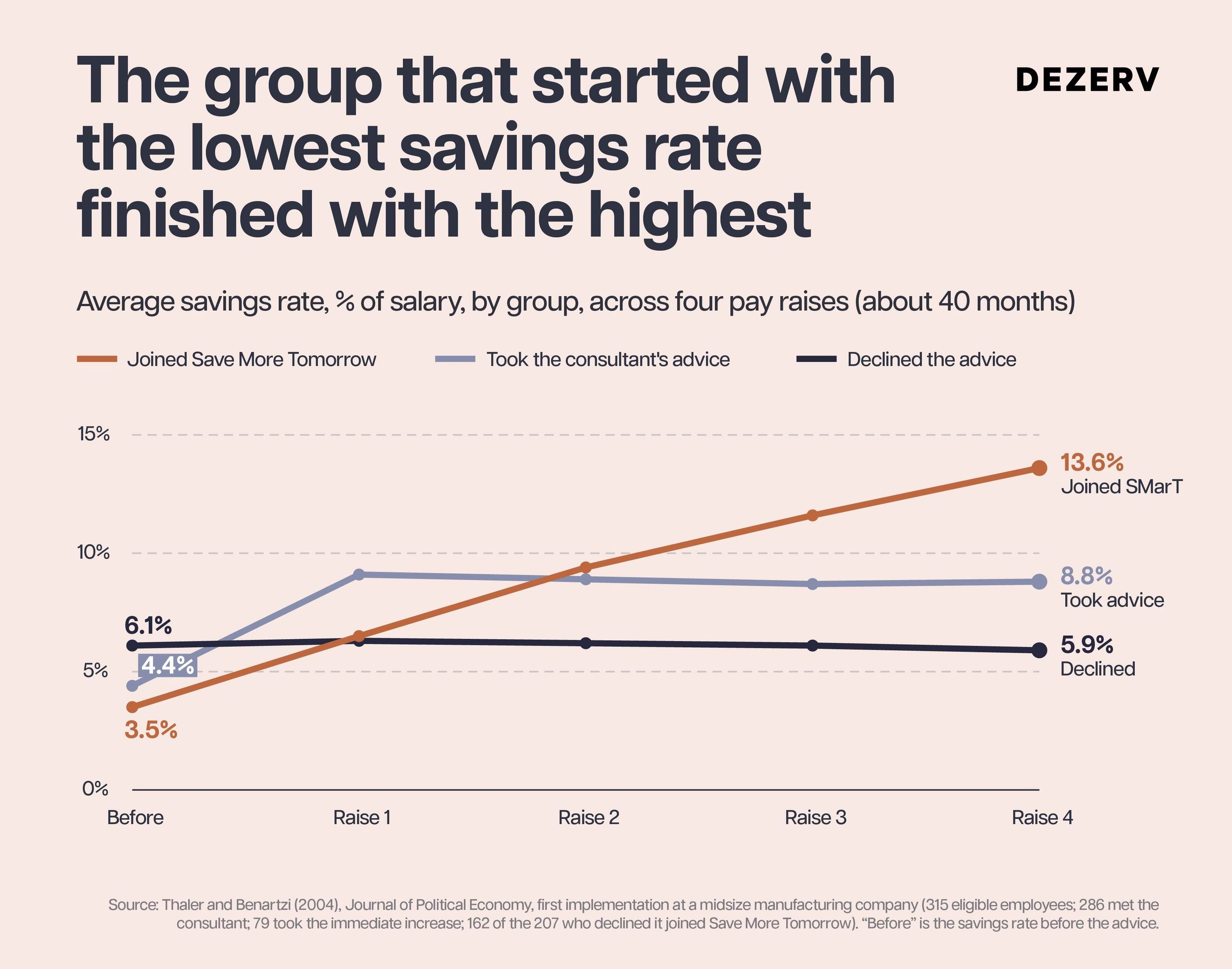
Of the 207, 162 (78%) accepted, even though they had just refused to save more. Forty months and four pay rises later, their average savings rate had climbed from 3.5% to 13.6%. The 79 who had agreed to save more at once began at 4.4%, jumped to 9.1%, and finished at 8.8%.
The economists behind the offer, Richard Thaler (Nobel laureate, 2017) and Shlomo Benartzi, called it Save More Tomorrow. It is usually filed under nudges, but I think it is better understood as an older and simpler idea, the if-then plan. If I receive a pay rise, then 3 percentage points of my salary go towards my future. Nobody needed willpower on payday, because the decision had been made earlier, on a calm day.
Most investors I meet begin with excellent intentions. They want to put their capital to work sensibly, to be patient with it, and to avoid the mistakes they have watched others make. The intention is rarely the problem. The trouble begins when the intention meets a real market, and the mind starts to interfere.
Behavioural economists have named the main culprits. Loss aversion makes a fall in value feel heavier than an equivalent gain feels pleasant. Recency bias persuades us that whatever happened over the last year will carry on happening. Present bias makes later feel cheaper than now, which is why 207 employees said some other time. Overconfidence convinces us that we can tell a temporary dip from a genuine problem. None of these reflects a lack of intelligence, and each of them tends to appear when a decision has to be made under stress.
The SIP is India’s most popular attempt to work around this problem. It automates the intention, because the money leaves the account every month without anyone having to decide. It automates only the start, however. Nothing in a SIP says what to do on the day the intention weakens, and this edition is about writing that missing rule.
In this edition
- Why a SIP automates the start but not the staying
- Two leaks: quitting in a lull and arriving after a rally
- What an if-then plan is, and where its limits lie
- RULES: five if-then plans you can write this week
A SIP automates the start, but staying is still up to you
In April 2026, for every 100 new SIPs registered, about 101 were stopped or had run their course. That figure is the SIP stoppage ratio, calculated from AMFI’s monthly data, and it stood at 101.14%. Even so, SIP contributions that month were ₹31,115 crore, close to the record.
Both facts can be true because the money comes from a large base of investors who carry on, while a layer of churn beneath them keeps opening and closing accounts. The ratio was 74.8% in January 2026, touched 101.1% in April 2026, and had fallen back to 81.1% by August 2026. Meanwhile the Nifty 50 made little progress: Business Today reported on 8 September that its returns had been flat for two years, and DSP’s Sahil Kapoor said the flat stretch “has largely been a time correction”.
There is one caution. The ratio also counts SIPs that reached the end of their tenure, so it overstates outright quitting, and it is better treated as a gauge of mood than as a headcount of panic. Still, the direction is telling, because the ratio rose and fell while the index itself made no progress.
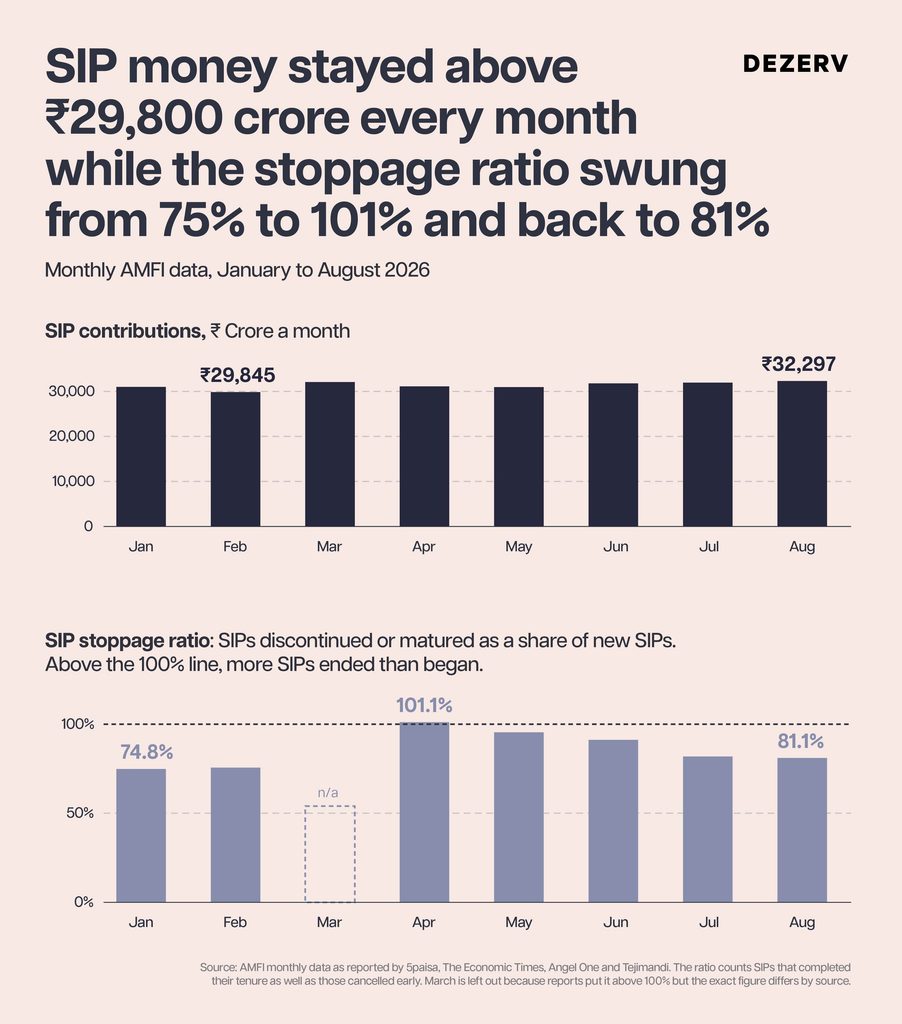
If you have ever opened your app during a market fall and hovered over the pause button, you have met the missing rule. A SIP automates the decision to invest, but the decision to stop remains one click away, and it tends to be asked on the worst possible day. Half of the decision is automated, and the harder half is left to your mood.
Two leaks, one cause
Investors lose money in two places that look like opposites. One is quitting during a lull, and the other is arriving after a rally. A bias sits behind each of them.
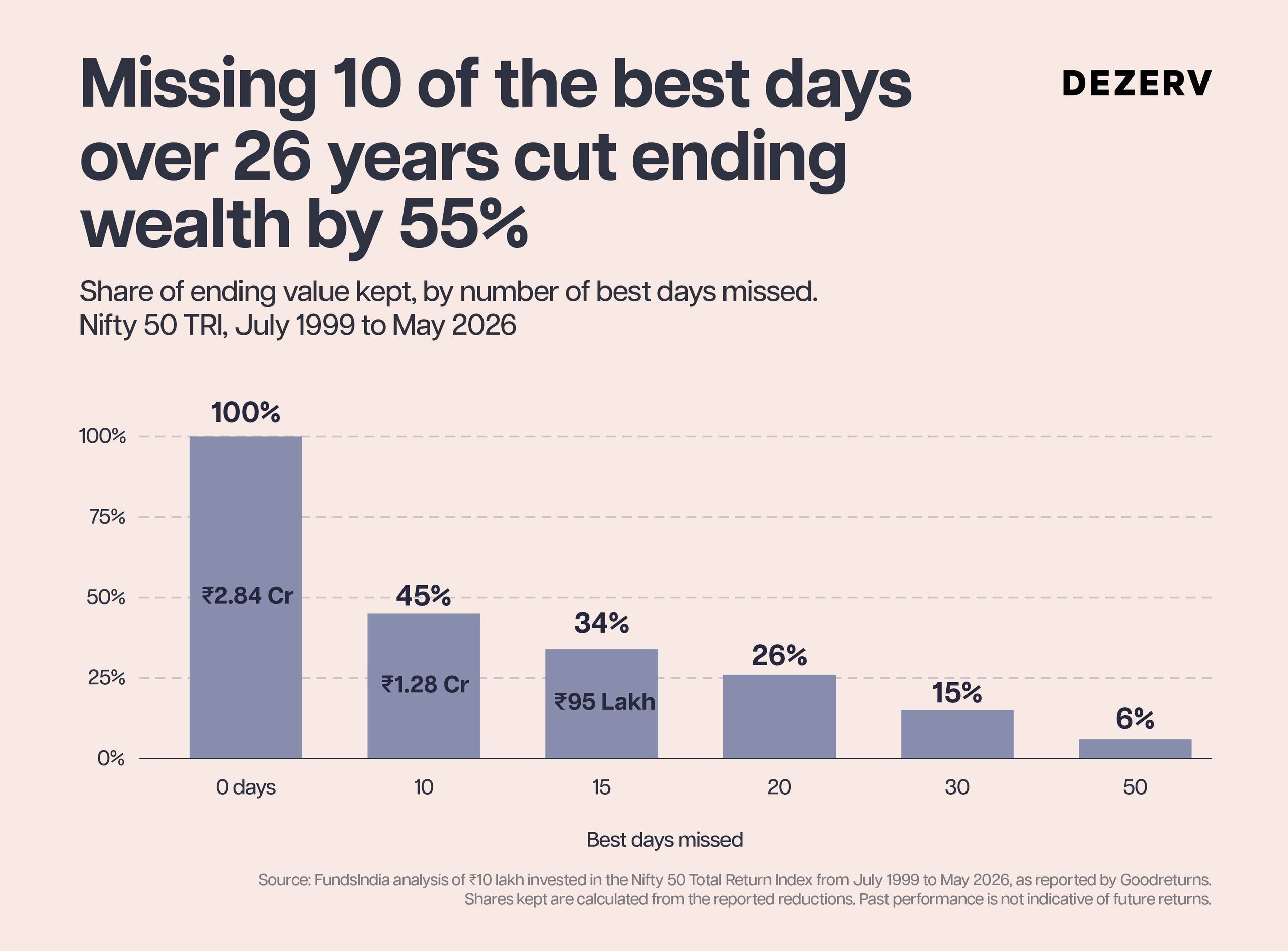
The first leak is costly because of where the best days fall. FundsIndia analysed the Nifty 50 Total Return Index from July 1999 to May 2026. An investment of ₹10 lakh left untouched grew to ₹2.84 crore. Missing only the 10 best days cut the final value by 55%, to ₹1.28 crore, and missing the 15 best days left ₹95 lakh. Those 15 days were a tiny fraction of more than 6,000 trading days.
Timing makes matters worse. Seven of the Nifty’s 10 best days came within two weeks of its 10 worst days. Everyone would like to avoid the worst days, but almost nobody manages to avoid only those, because the recovery does not wait for the investor to feel better. This is loss aversion at work. A SIP also buys more units when prices are lower, so the months in which you most want to cancel are the months in which it is working hardest.
The second leak is the mirror image, and recency bias is behind it. In Dezerv Research on the most popular equity funds, 71% of the money arrived only after the fund had already had its best year, and for sector funds the figure was over 80%. Fear explains the first leak, and envy explains the second. Both show up in the results: about 53% of investor portfolios reviewed on the Dezerv app have underperformed their benchmark.
Neither leak says much about intelligence. Most of the investors I meet run businesses or large teams, and they would never let a hiring decision depend on who happened to be in the room that day, yet their portfolios often run on exactly that basis. Both leaks are reactions to the last few months. The goal that most of us carry, to invest for the long run, gives no instruction to either. A goal names a destination, but it says nothing about what to do at the junction where you will be tempted to turn.
What an if-then plan is, and where its limits lie
In 1997, the psychologists Peter Gollwitzer and Verena Brandstätter asked students to write, within two days of Christmas Eve, a report on how they had spent it. Some of the students were also asked to decide exactly when and where they would write the report. About three quarters of that group finished it, compared with about a third of the students who had made no plan.
Gollwitzer calls this an implementation intention. A goal says, “I intend to reach X.” An implementation intention says, “When situation X arises, I will do Y.” It ties a specific cue to a specific response, so that the response begins with far less deliberation when the cue appears. The decision moves from the moment of stress to a day when you are calm. Airline pilots work the same way: they do not improvise after an engine failure, because the checklist begins with a cue and the response is already written.
Now apply that to your portfolio. “I will stay invested for the long run” is the Christmas report without a time and place. “If the Nifty falls 10% from its peak, I will change nothing for 30 days” is the same intention with both.
Save More Tomorrow fits the mould exactly. The cue is a pay rise, and the response is a rise of 3 percentage points in the savings rate. Because each increase was tied to a pay rise, the pay that people received never went down, and nobody had to decide anything on payday, when the extra money already feels like theirs. The chart shows what followed: the group that began with the lowest savings rate finished with the highest.
The research has limits, and they are worth knowing. The effect is moderate, and it is strongest when the person already wants the goal and has rehearsed the plan. Most of the evidence comes from health, study habits and everyday tasks, and I am not aware of a test on Indian SIP investors, so the fit is an informed bet.
RULES: five if-then plans for an investor
Each letter of RULES marks a moment that tends to go wrong: Rally, Underperformer, Lull, Extra cash, and Shock. Every rule has four parts: a cue that can be checked, a single action, one exception that is named in advance, and the bias that the rule is designed to counter. The thresholds below are examples, so replace them with numbers that suit your portfolio and your temperament.
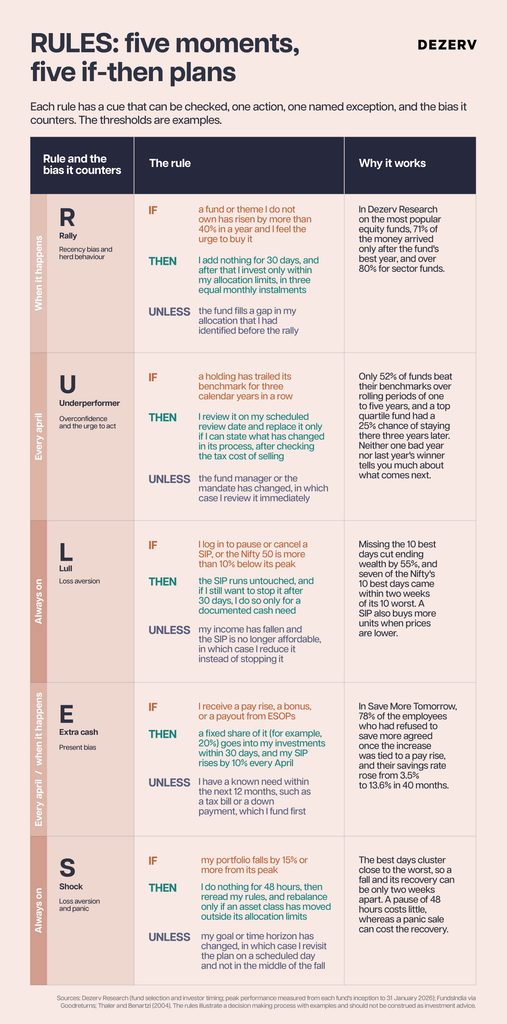
The rules do not all fire at the same time. Lull and Shock stay on throughout the year, Underperformer and the SIP step-up in Extra cash arrive with the new financial year, and Rally and any windfall wait for an event. Writing down when each one fires tells you when to look at it and, just as usefully, when to leave it alone.
Rule E has the most measurable payoff, so here is the arithmetic. A SIP of ₹50,000 a month for 15 years, at an assumed return of 12% a year, grows to about ₹2.36 crore from ₹90 lakh invested. If the SIP rises by 10% every April, the same assumption gives about ₹4.10 crore from ₹1.91 crore invested. April marks the start of the financial year, so the cue arrives on its own.
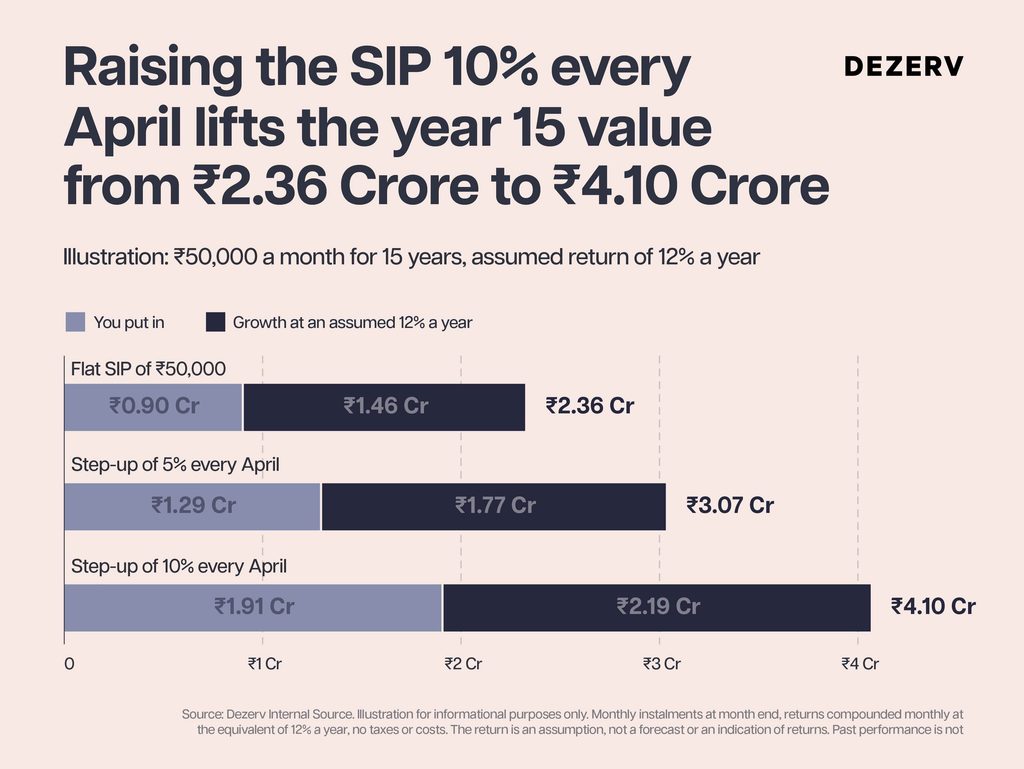
There is, however, a catch. The step-up asks for more money, and by year 15 the SIP would be about ₹1.9 lakh a month, so check that the increase fits your income before you commit to it. A rule that you cannot afford will be the first one you break.
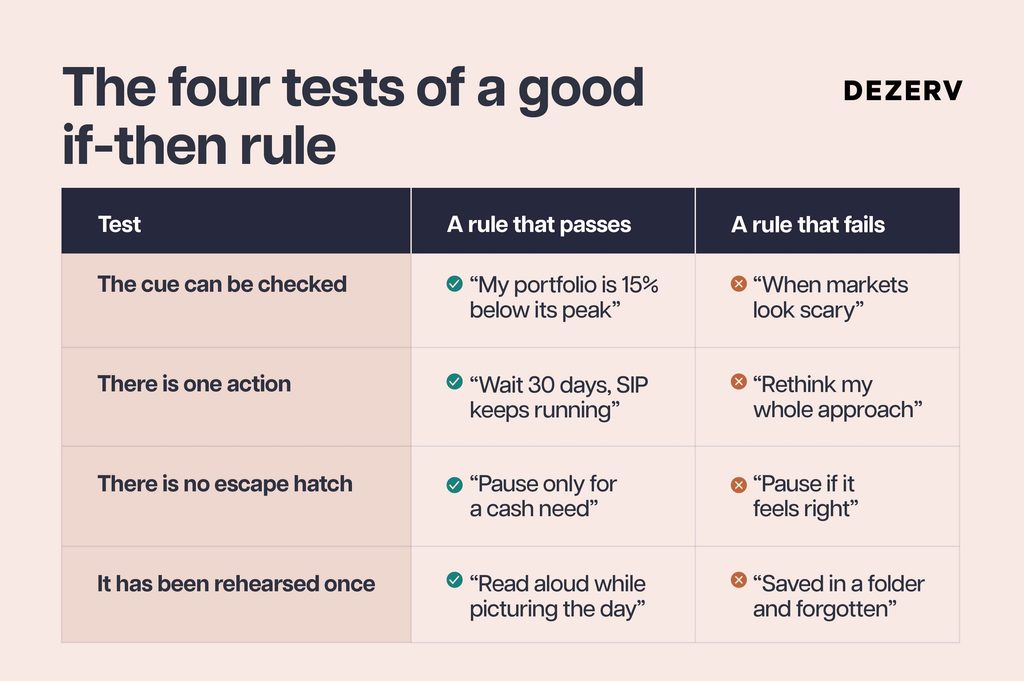
A rule is only as good as its wording, so test each one against four questions before you adopt it.
When you are ready, put the rules on one page. The sheet below has room for a cue, an action, an exception, and a rehearsal date, and it is worth showing to one other person, such as a partner, a chartered accountant, or your portfolio manager, so that somebody can ask whether today is a rule day.
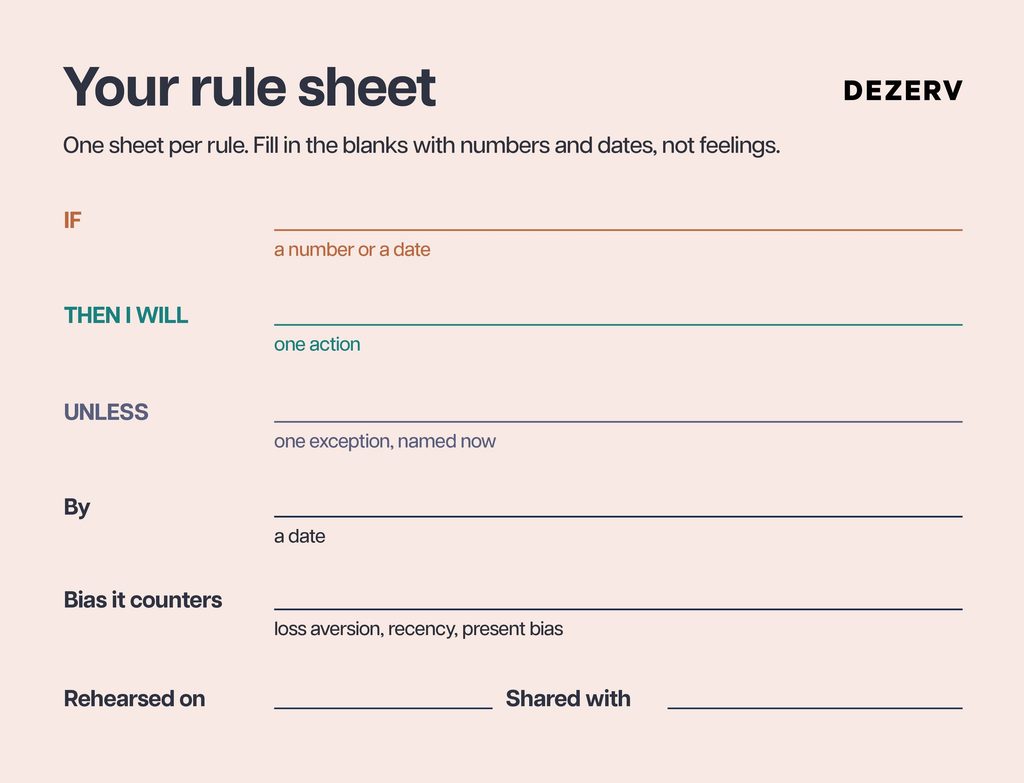
Do not write all five rules in one sitting. Pick the leak that has cost you most over the last two years, write one rule for it, and rehearse it once. To rehearse, read the rule aloud while picturing the day it triggers: the red screen, the family WhatsApp group, and the colleague who has just sold. Then say the response. Add the next rule only after the first has survived a bad month, and review the whole set once a year on a date fixed in advance. Rules will occasionally be broken. When that happens, record what triggered it and restart at the next review date. A rule that you rewrite in the middle of a fall has become a mood.
Go back to 1998. The 162 employees who joined Save More Tomorrow did not become more disciplined people between the meeting and the fourth pay rise. Someone asked them, on a calm day, what they wanted their future selves to do on payday, and they agreed on an answer.
You will not be the same person on the day the market falls. On that day you will be more anxious than you are now, and just as sure that you are being sensible. Write the instructions while you are calm.
Following a rule on the day you would rather not is the hard part, and it is also a large part of the job that a portfolio manager does for clients.
Disclaimer:
Investment in the securities market is subject to market risks. Read all related documents carefully before investing. The information provided herein is intended solely for educational purposes and should not be construed as solicitation, advertising, investment advice, financial advice, or an offer to buy or sell any financial instruments. The information contained herein is for general purposes only and is not a complete disclosure of every material fact, terms and conditions. Past performance is not indicative of future returns. Data from public sources is believed to be reliable but has not been independently verified by Dezerv.
Distribution services are offered through Dezerv Distribution Services Private Limited, a wholly owned subsidiary of Dezerv Investments Private Limited (collectively referred to as “Dezerv”) vide AMFI Registration No. (ARN)- 248439 and APMI registration no. (APRN)- 00615.