


In 1964, an Indian who wanted to own a piece of the stock market without picking shares had exactly one place to go. The Unit Trust of India, set up in 1963, launched its first scheme, Unit Scheme 1964 or US-64, in 1964, and for more than two decades UTI was the country’s only mutual fund house.
As more fund houses arrived from the late 1980s, distributors took mutual funds to investors, town by town. They made investing accessible, but the model had two limits: investors paid commissions, and their choices depended on what their local distributor offered. An investor in Banaras or Madurai in the early 2000s could only choose from the funds available through that distributor, often shaped by what paid the distributor best.
SEBI introduced direct plans in 2013, and within a few years investing apps had put them in everyone’s pocket. That solved both problems at once. The investor in Madurai could now buy any fund in the country from his phone, without paying a commission.
It also created a new problem. With 2,000+ schemes a tap away, choosing became harder, and many investors either froze or ended up owning far more funds than they needed. A solution existed, but only for a few. With ₹50 lakh, you could hand your portfolio to a professional portfolio manager, an option used by just over 2 lakh clients in a country with crores of mutual fund investors. For a young, fast-growing country where most people will fund their own retirement, that never made much sense.
On 24 September 2026, SEBI took the next step in a journey that began with US-64. Its board approved PRIM (Portfolio Managers’ Route for Investing in Mutual Fund Units), allowing portfolio managers to manage portfolios made up only of direct mutual fund plans, with the minimum investment halved to ₹25 lakh.
This is deeply personal to me. When we launched our first mutual fund-focused strategy in 2022, the question we heard most was why anyone would pay a portfolio manager to buy funds they could buy themselves. For four years, answering it took a long conversation, and SEBI has now answered it for all of us. PRIM feels like one of the most important steps since US-64, and in this edition, I’ll use facts and data to show why it matters for investors who have built serious wealth through mutual funds.
In this edition:
- Why do investors need PRIM today?
- Why picking the right fund is harder than it looks
- What SEBI has changed
- Why the extra fee can be worth it
Why do investors need PRIM today?
Think about how much work mutual funds have taken off investors’ plates over the last decade. Picking individual stocks means reading annual reports, tracking management and knowing when a business no longer deserves your money. A mutual fund hands all of that to a professional, and Indians have taken to the arrangement with remarkable enthusiasm.
Monthly SIP inflows grew from about ₹3,600 crore in 2017 to a record ₹32,297 crore in August 2026, contributing SIP accounts crossed 10 crore, and mutual fund folios now stand at 28.35 crore. For millions of households, a SIP now leaves the bank account every month with the same regularity as the electricity bill.
Getting mutual fund investing right comes down to four things: access to the right funds, choosing the right ones, deciding how much to invest in each, and rebalancing when needed. Over the last ten years, access to funds has been solved. Choosing them, timing them and staying invested remain the harder parts.
This pattern isn’t unique to investing. When industries break things apart, they often bring them back together in a new way. Music went from albums to individual songs, then back to subscriptions that bundle music with recommendations. Software went from CD suites to separate apps, and now to integrated workspaces.
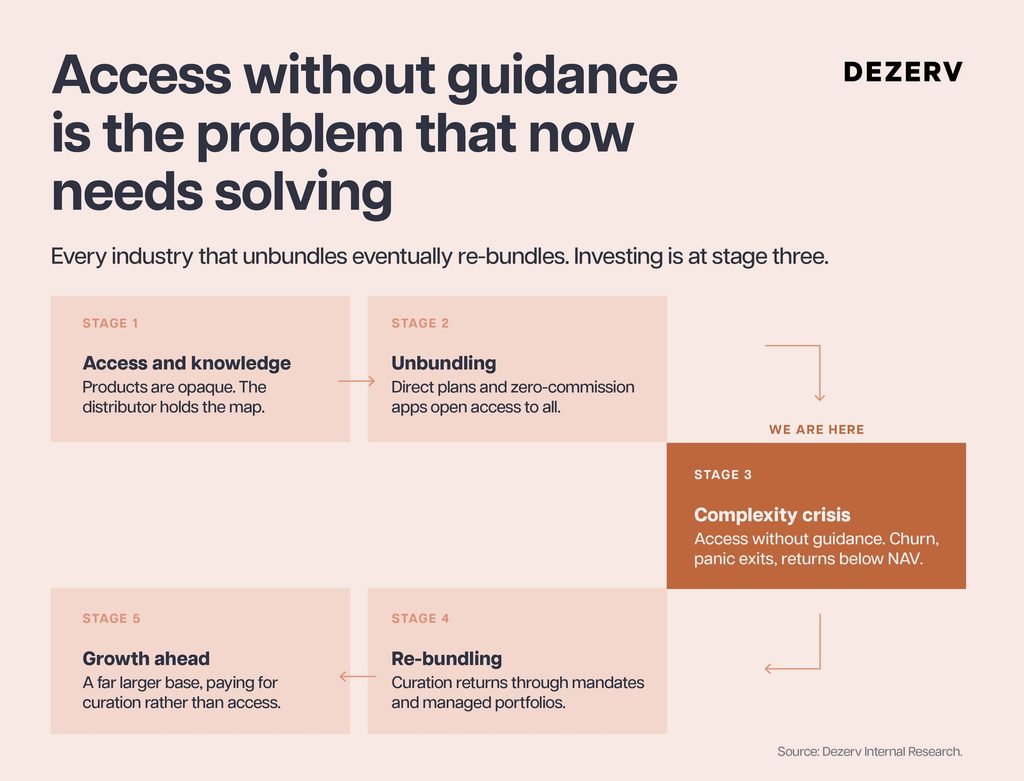
Investing is somewhere in the middle of that loop. Distributors once controlled access and made products easier to navigate. Then direct plans and apps opened access to everyone. Now, the challenge is deciding what to own, how much to own and when to change course. The cost shows up in churn, panic selling and returns that fall short of what the funds actually earned.
The next step is bringing curation back, and that is what PRIM is designed to do. The last decade made access to funds almost free. The next could be about paying for better management. For investors with large mutual fund portfolios, that shift could matter most.
Why fund picking is harder than it looks
Many investors we meet run businesses or large teams. They can dissect a P&L, challenge a forecast and spot a weak assumption in minutes. Yet many haven’t reviewed their own mutual fund portfolio in over a year, and the funds were often picked because they topped the returns table at the time. It feels sensible to expect a fund that did well for three years to keep delivering, but the data tells a different tale.
As per our research, 1.3 million+ daily observations across fund categories show that only 52% of funds beat their respective benchmarks over rolling one- to five-year periods, barely better than a coin toss. A fund that ranked in the top quartile had only a 25% chance of staying there three years later.
Part of the reason is that the market keeps changing what it rewards. Large caps lead one year, small caps the next and mid caps some other year, so a fund that looked brilliant was often simply in the right segment at the right time. Picking last year’s winning fund usually means betting on last year’s market.
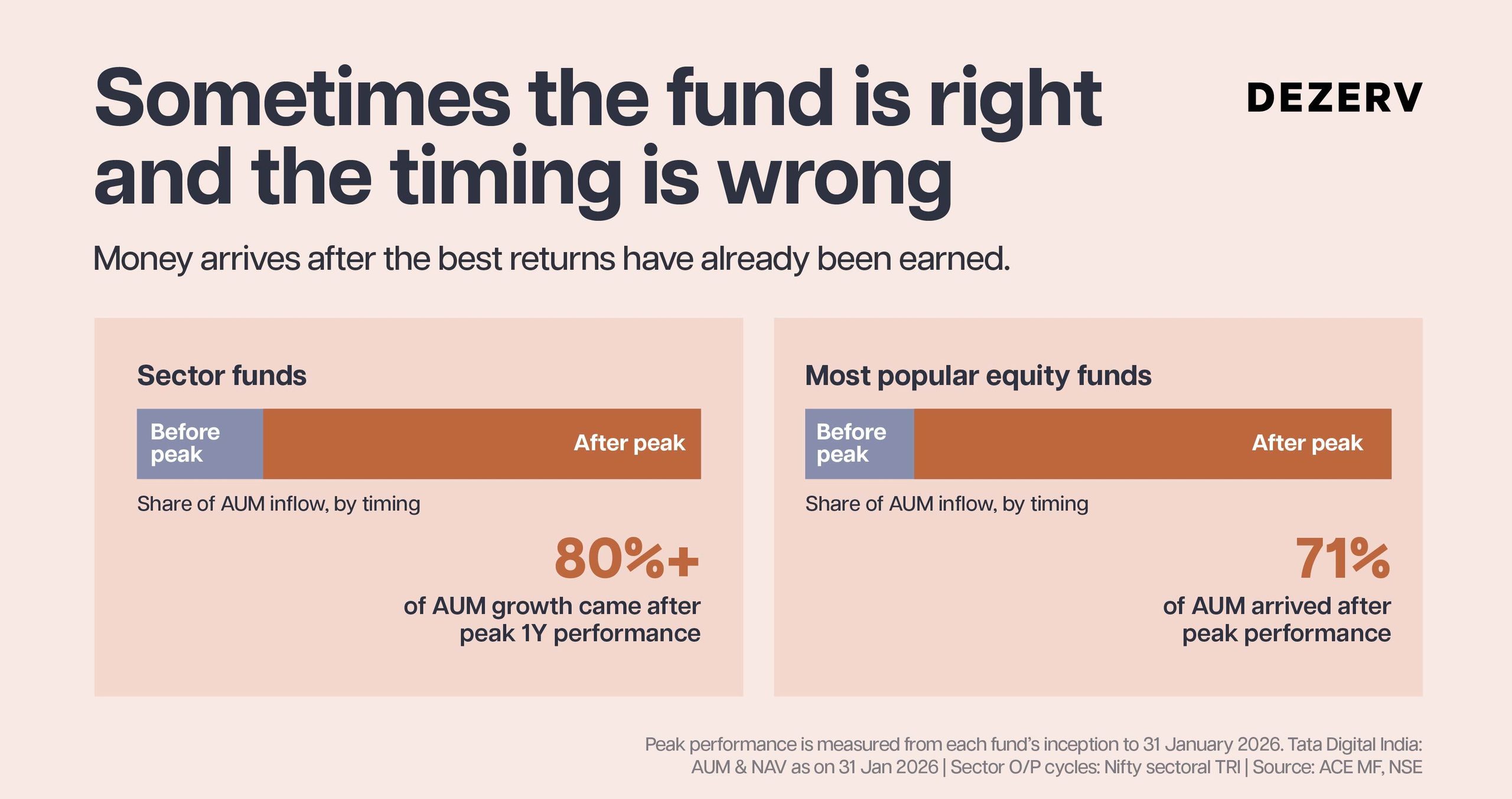
And even a good fund can disappoint if you invest at the wrong time. In the most popular equity funds, 71% of the money was invested only after the fund had delivered its best one-year return. Investors saw those strong past returns and invested, but by then, the big gains had already happened. For sector funds, that figure was over 80%.
Put the two together, and the outcome shouldn’t be surprising. About 53% of investor portfolios reviewed on the Dezerv app have underperformed their benchmark. At ₹25 lakh, these mistakes carry real weight. None of this says much about intelligence. Investors often do what seems rational: buy what has already worked, after it has worked. Avoiding that takes a process that looks beyond last year’s returns, and the time to stick to it, which most successful professionals simply don’t have.
What SEBI has changed
SEBI has always drawn a firm line around portfolio management services, and for good reason. Many PMS strategies invest directly in a concentrated set of 20 to 25 stocks, which can swing far more than a diversified mutual fund. The ₹50 lakh minimum was meant to keep those swings for investors who could absorb them.
A portfolio built entirely from mutual funds carries a very different kind of risk, since each fund is already diversified, run by a regulated AMC and required to disclose its holdings every month. The proposed SEBI (Portfolio Managers) Regulations, 2026, which will replace the 2020 regulations once notified, recognise this through PRIM, a dedicated route with rules suited to that risk rather than rules written for concentrated equity.
This is the kind of thoughtful regulation that makes me proud of India’s markets. Instead of lowering the ₹50 lakh threshold across the board, SEBI surveyed portfolio managers, took public comments on its July draft, and built a route suited to how Indians actually invest today.
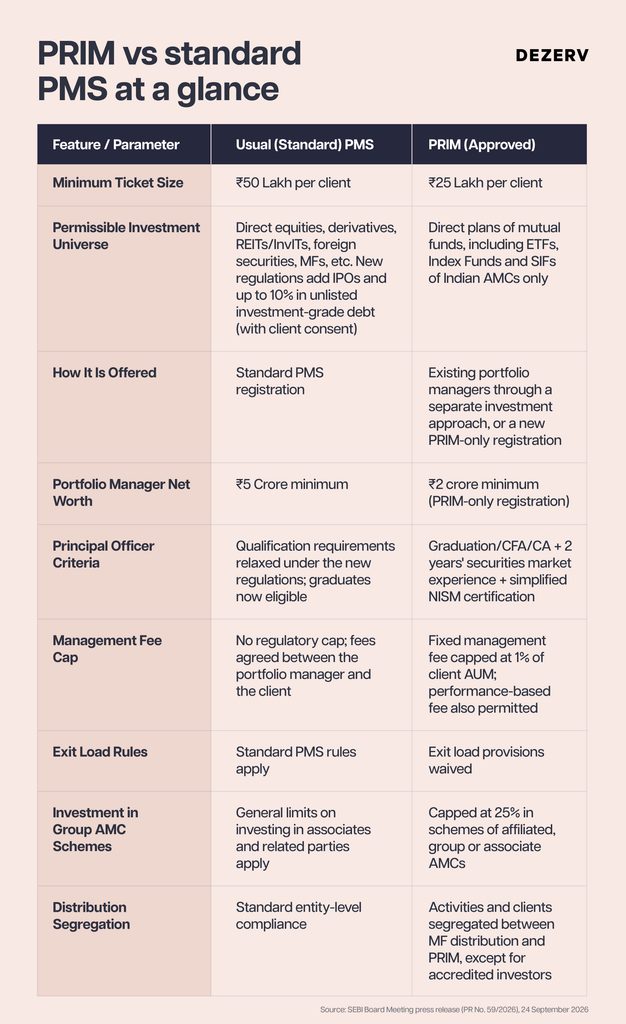
PRIM portfolios hold only direct plans, so no distributor commission is built into any fund you own. The fixed management fee is capped at 1% of AUM, though a performance-based fee is also allowed, so ask how a provider’s fees are structured. Exit load provisions are waived, and no more than 25% of your money can go into funds from the manager’s own group, which limits the pull towards in-house products.
SEBI has also made it easier for existing portfolio managers and new entrants, including smaller advisory firms, to offer PRIM. More managers should mean more choice for investors and greater competition on process and results. The separation rules keep that competition clean, since a firm that also distributes mutual funds can’t pitch a commission-based product and a managed portfolio to the same client, unless that client is an accredited investor.
Few regulatory changes benefit every side, but this one comes close. Investors get professional management at direct-plan costs, AMCs keep assets invested for longer, and advisers get a regulated way to be paid for allocation, behaviour and outcomes
The lower ticket size will get the headlines, but the more lasting change is in what a portfolio manager is now paid for. Under PRIM, the fee comes from managing your money well, and no longer from selling you a product. SEBI deserves real credit for getting that incentive right.
Why the extra fee can be worth it
Most people who hire a personal trainer already own running shoes and know how to use a treadmill. What they pay for is someone who builds the right routine, adjusts it as they progress, and makes sure they turn up on the mornings they’d rather stay in bed.
A mutual fund portfolio works the same way, which raises the obvious question: if every fund already charges an expense ratio, why pay a portfolio manager on top?
The answer starts with how much fund choice matters. Invest ₹1 crore in a top-performing fund and, after seven years, it could grow to about ₹3.91 crore. Put it in a poorly performing fund, and you’d have about ₹2.40 crore. Even after a 1% annual fee on the better outcome, you’d still have about ₹3.69 crore, roughly ₹1.29 crore more.
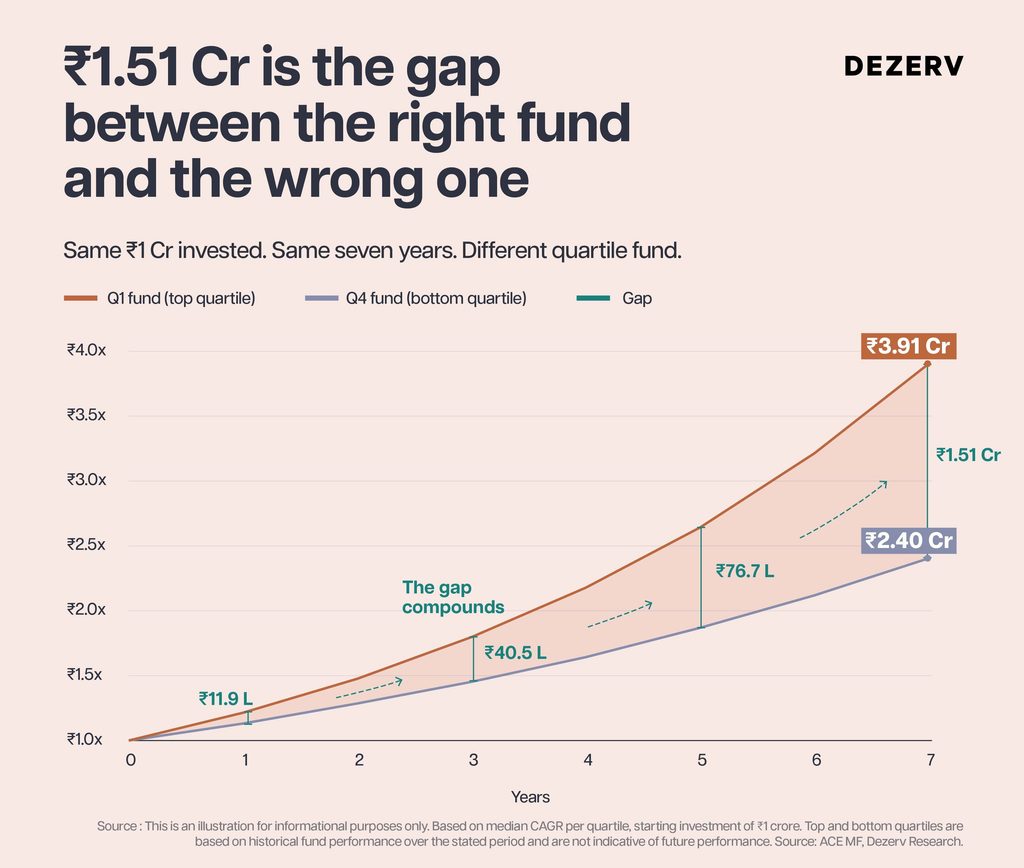
So what does the fee actually pay for? The work that decides your outcome: picking the right funds, setting the right mix for your goals, and knowing when to act or stay put, especially in bad years. Someone has to do that work, whether it’s you, a distributor, an adviser or a portfolio manager, and each route handles it differently.
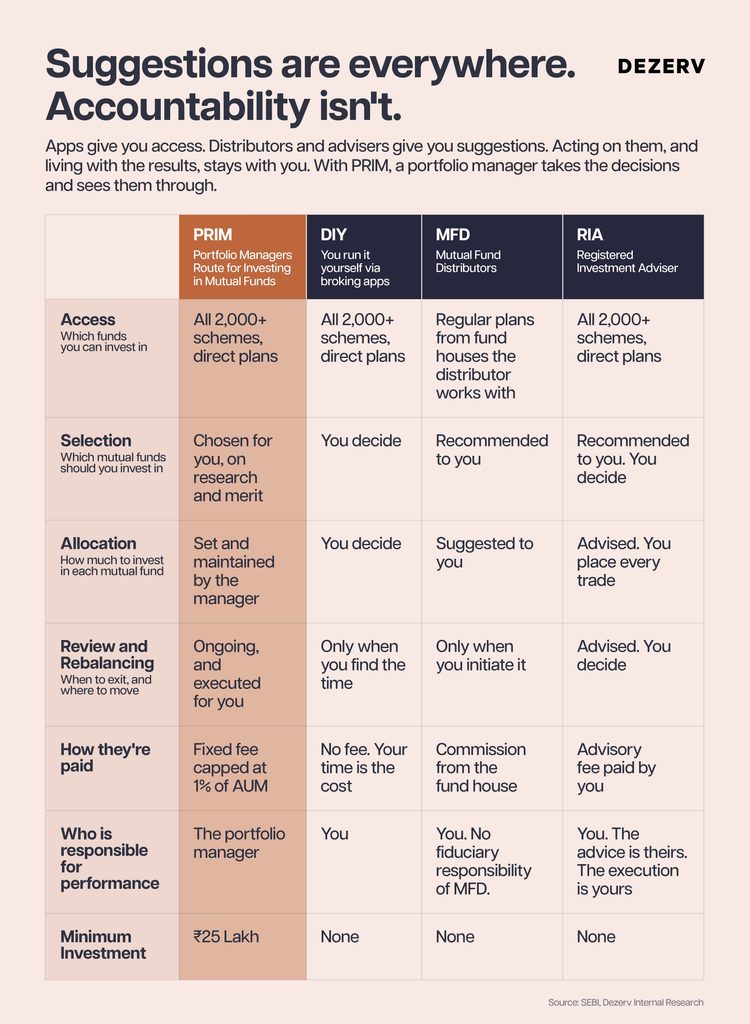
Good guidance goes beyond recommending funds. PRIM lets a manager do all three through low-cost direct plans, for a fixed fee capped at 1% of AUM. For investors moving from regular plans, that broadly replaces the 0.75-1% distributor commission they already pay, with GST and some operating charges on top, except it now goes to someone accountable for the whole portfolio. Managers may also charge a performance fee, so ask how a provider’s fees are structured.
No portfolio manager can promise top performers, and we’ve seen how rarely last year’s winners repeat, which is why a consistent process matters more than a lucky pick. Every investor pays for mistakes eventually, through a fund that falls behind, a purchase at the peak or a sale in panic. A management fee is the one version of that cost you can see, compare and question upfront
In summary
A decade ago, apps made mutual funds accessible to everyone. With PRIM, professional management now starts at ₹25 lakh, with someone to choose your funds, size the portfolio and rebalance it over time.
At Dezerv, we’ve spent four years evaluating 2,000+ funds every month across 156 variables, holding only 4-9, allocating them around each investor’s goals, risk and time horizon, and rebalancing when needed. It brings discipline to the part of investing that is hardest to do consistently on your own.
The last decade of mutual fund investing was about getting Indians started. The next will be about keeping them invested in the right funds, and for lakhs of investors who have built wealth through SIPs, that is about to get much easier.
Disclaimer: Investment in the securities market is subject to market risks, read all the related documents carefully before investing. The information provided herein is intended solely for educational purposes and should not be construed as solicitation, advertising, or providing any financial or investment advice or an offer to buy or sell any financial instruments. The information contained in this document is for general purposes only and is not a complete disclosure of every material fact, terms and conditions. The information provided herein is intended solely for educational purposes. The information relating to PRIM (Portfolio Managers’ Route for Investing in Mutual Fund Units) is based on the press release on Key decisions taken in the SEBI Board Meeting dated 24th September, 2026 and is yet to be notified. Dezerv Investments Private Limited (DIPL) is a Portfolio Manager with SEBI Registration no. INP000007377. Distribution services are provided by Dezerv Distribution Services Private Limited vide ARN – 248439 and APRN – 00615.