


A few nights ago, three of my friends nearly got into an argument over dinner.
One, a die-hard Delhi loyalist, went on about the winters, the food, the sheer scale of the city, and how everything important in the country eventually passes through it. Another, who’s spent her career in Mumbai, talked about the sea, the energy, the hustle, and how every other Indian city feels slower by comparison. The third, a Bengaluru transplant like me, had his own case: the weather, the pubs, the tech money, and the feeling that the city still feels young and full of possibility.
I grew up in Mumbai and moved to Bengaluru a few years ago, one of several cities Dezerv is based in, because that’s where I chose to lead from. It wasn’t necessarily the weather that brought me here. It was the work, the talent, and the energy of building something new.
The thing about “which city is better” debates is that nobody is really wrong. Each of my friends was optimising for something real: the Delhi fan for scale and centrality, the Mumbai friend for pace and ambition, and the Bengaluru guy for opportunity and youthful energy. They were simply choosing differently.
But personal preference only takes you so far. To know how well a city actually works, you need a different lens. Every year, the Economist Intelligence Unit ranks 173 cities on healthcare, education, infrastructure, stability and everyday life. No Indian city comes close to the top: Delhi ranks 120th, with Mumbai, Chennai and Bengaluru trailing behind. Given the wealth, talent and ambition concentrated in these cities, that deserves a closer look.
So this week, we’re asking a different question: not which city is best to build a career or wealth in, but which is best to live in, once you strip away reputation, opportunity, and loyalty, and just look at the numbers.
In this edition:
- What actually makes a city “liveable”
- Beyond jobs and salaries: India’s most liveable cities
- What this means for your next big location decision
- How a few Indian cities and villages are already cracking it
What actually makes a city “liveable”
Strip away the GDP numbers and skyline photographs, and every city is judged on five things: Stability (25%), Culture & Environment (25%), Healthcare (20%), Infrastructure (20%), and Education (10%). Together, these cover everything from safety and air quality to healthcare, transport, housing, and schools. Each is weighted differently, and together they produce a single score out of 100.
Copenhagen leads the 2026 index with 98.2, posting perfect 100s in education, infrastructure, and stability.
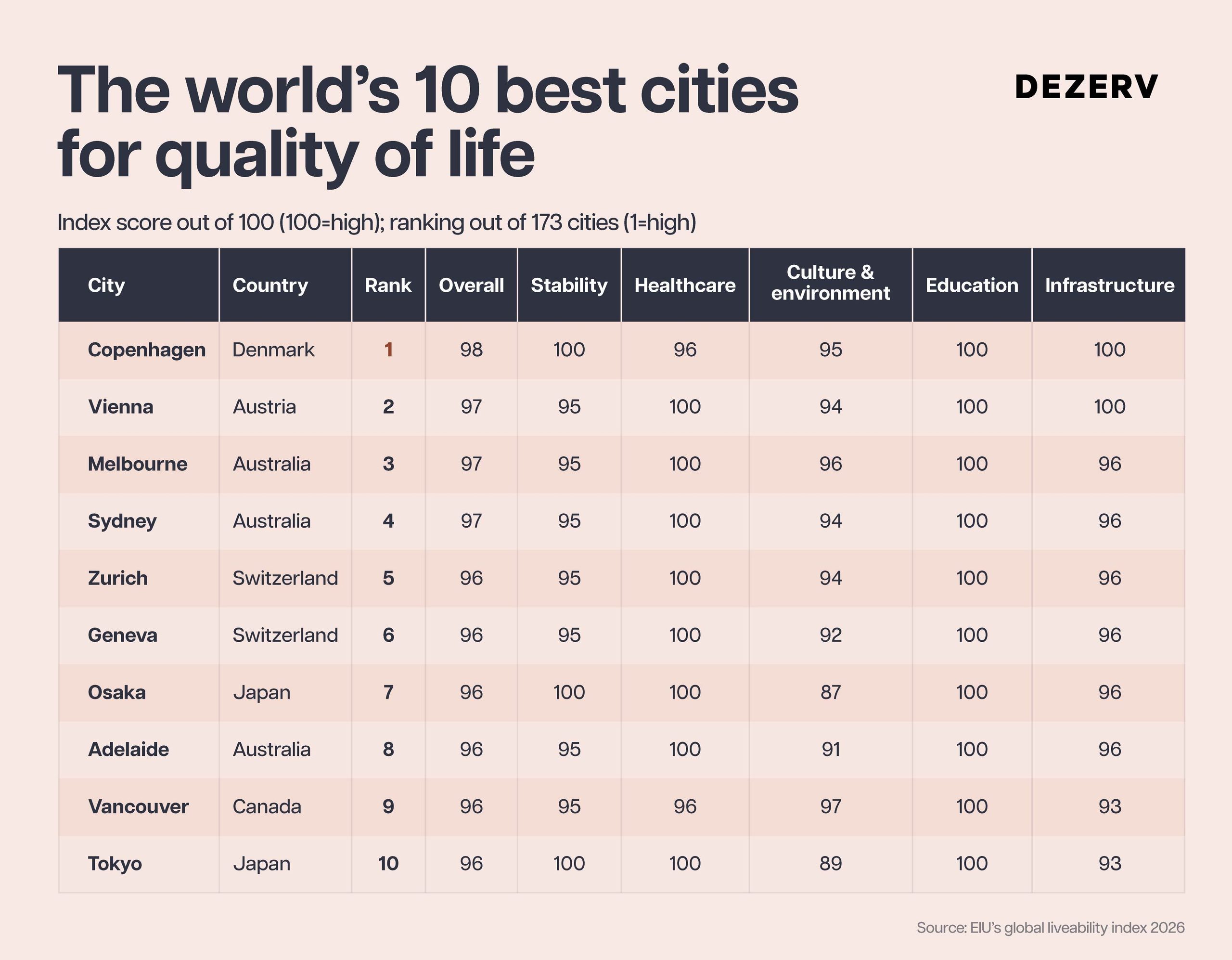
Now, the real difference between Copenhagen and Delhi isn’t money. It’s who is responsible for getting things done. Copenhagen has one empowered local authority overseeing transport, land use and infrastructure. That makes long-term projects, like its 400 km network of protected cycling lanes, easier to plan and actually complete.
Delhi has no equivalent authority. Roads, water, transport and planning are split across the MCD, NDMC, DDA, PWD, Delhi Jal Board and Delhi Traffic Police, with different agencies reporting to the Centre or the Delhi government. No one owns the outcome.
Yet Delhi scores 58.9 for infrastructure, largely because of the Metro, which worked because it was built through a single, insulated authority. Mumbai scores just 51.8 despite one of the world’s busiest urban rail systems, because its railways operate largely separately from the city’s roads, buses and housing authorities. Improving one system doesn’t necessarily improve the others.
Healthcare runs into the same problem. Copenhagen, Zurich and Geneva treat it as a universal system, with broad access and consistent standards. Delhi and Mumbai both score just 41.7. Both have some of India’s best private hospitals, but the EIU measures whether ordinary people can access and afford care, not whether excellent care exists for those who can pay. That makes this less a hospital problem than a system problem.
Culture & Environment is where India’s biggest cities struggle most. Delhi scores 35.4 and Mumbai 33.3, far below the global average. That’s striking for cities celebrated for their food, festivals, architecture and diversity. But the EIU’s environment score comes down to basics: air quality, waste and drainage. In Delhi, courts repeatedly step in over pollution and flooding because no single civic authority owns the problem.
Education is where both cities fare better. Delhi scores 66.7 and Mumbai 58.3, their strongest scores apart from stability. That’s partly because education has fewer overlapping authorities: state departments and school boards largely run the system.
The contrast is telling: when responsibility is clear, cities perform better; when it is split across agencies, performance suffers.
Beyond jobs and salaries: India’s most liveable cities
Every year, a Bengaluru techie complains about traffic, a Delhi executive about the air, and a Mumbai banker about rent. Yet all three stay. That loyalty says something: people put up with expensive, difficult cities because that’s where the money and opportunity are.
But step outside that emotional pull, and 23 Indian cities purely on the data, and a different set of winners emerges – cities largely absent from those group-chat rants. A cost-of-living versus quality-of-life map of 23 Indian cities makes the split clear, sorting them into four categories: Bad Value, Best Value, Premium Life, and Budget Living. And India’s biggest economic powerhouses cluster heavily in Bad Value.
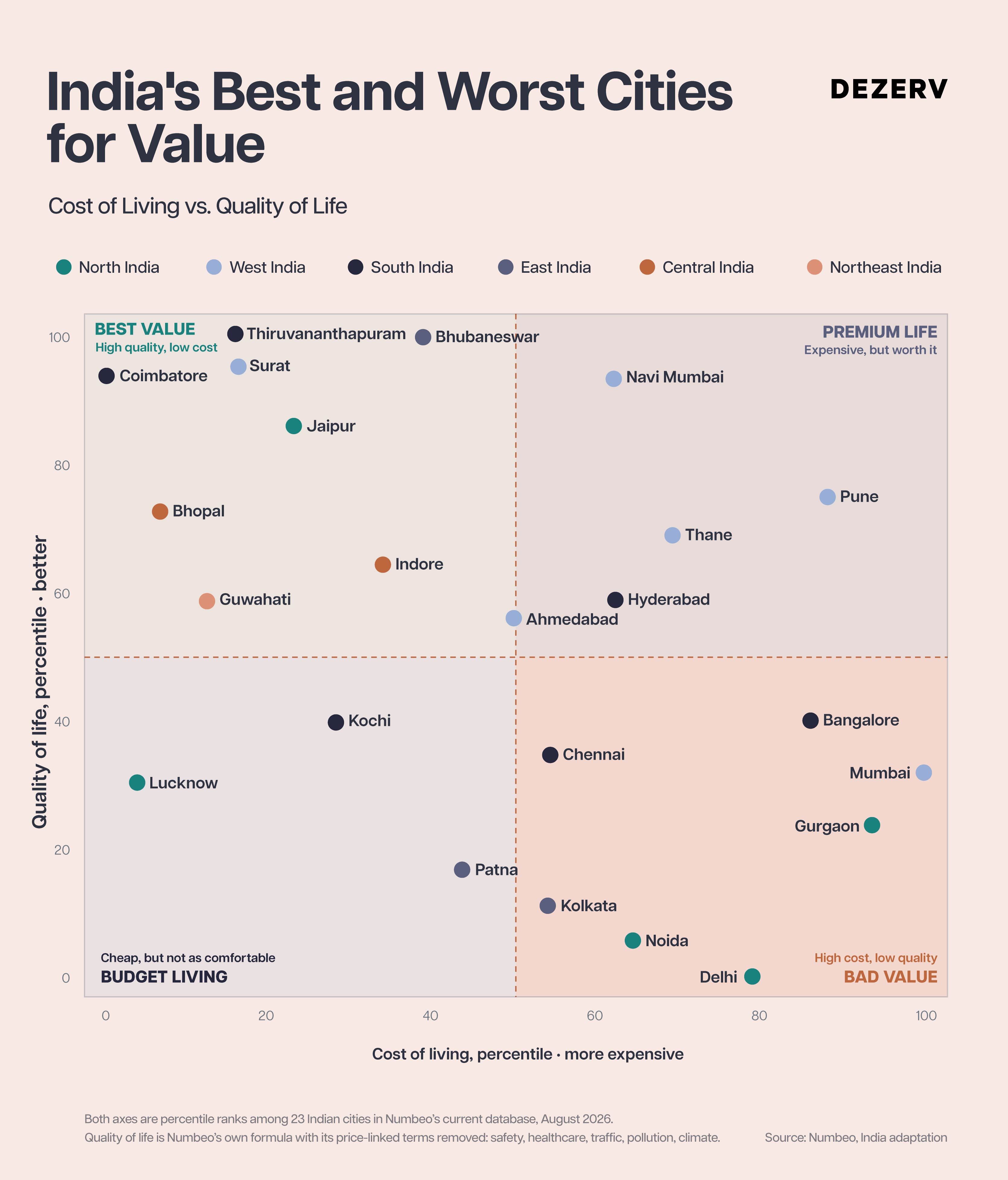
It isn’t that these cities aren’t building. India has gotten genuinely good at infrastructure that gets ribbon-cuttings and headlines: metros, airports, expressways and digital payments, all at remarkable speed. It is far worse at the unglamorous, recurring work that rarely makes headlines: collecting trash, treating sewage, maintaining drains, keeping things clean after the cameras leave. The first is visible and politically rewarding. The second is invisible until it fails, and thankless even when it works.
Mumbai epitomises this divide. The city just opened the Aqua Line, an impressive metro extension that would be a point of pride in most global cities. Yet Mumbai is surrounded on three sides by water, with beaches lined with garbage and a coastline largely unusable because sewage and waste aren’t properly collected or treated. The same mismatch shows up in what residents pay versus what they get. Take property prices, for instance.
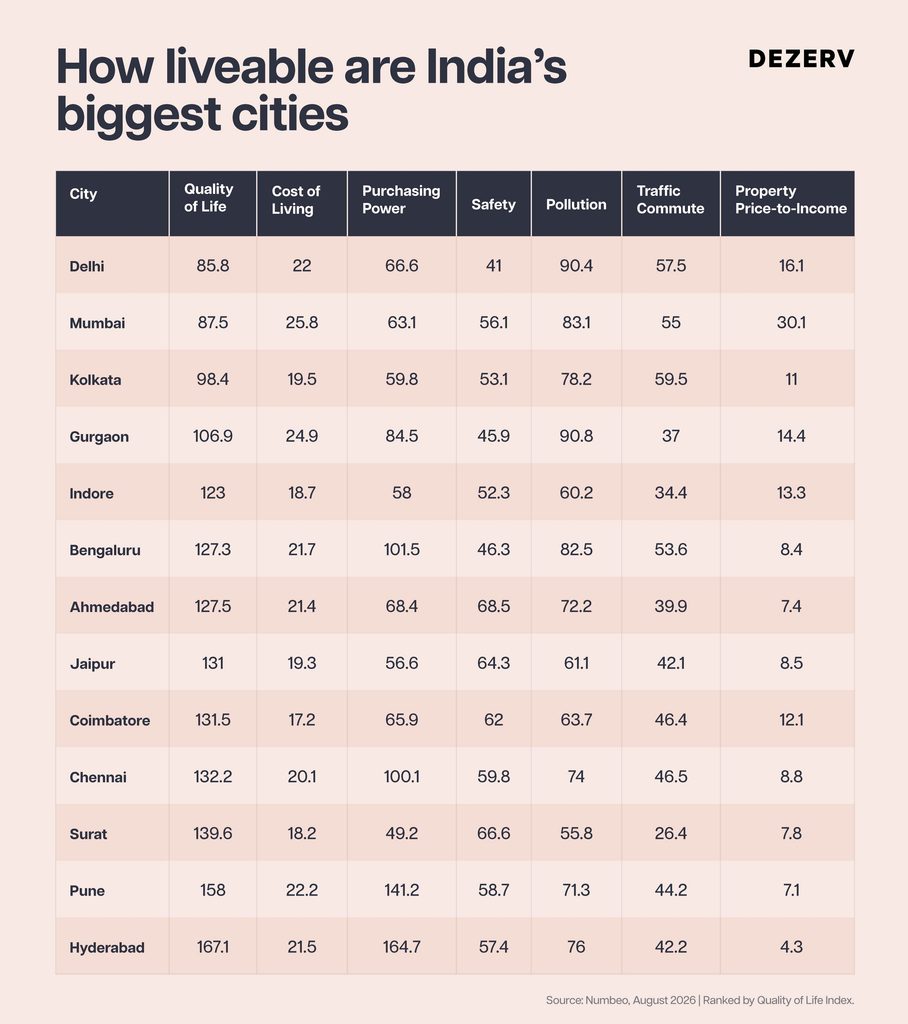
Mumbai’s Property Price-to-Income ratio, 30.1, is the highest of any city by a wide margin, nearly double Delhi’s and more than six times Hyderabad’s. It captures what the Cost of Living index misses: groceries and transport aren’t dramatically more expensive, but buying a home takes years of income that few other Indian cities demand.
Residents pay that premium for economic opportunity and improving transit. What they get back, a Pollution score of 83.1 and Traffic Commute score of 55.0, both among the worst here, is the daily cost of living in the city.
Delhi carries the same imbalance differently. Its Property Price-to-Income ratio of 16 is high but far below Mumbai’s, while its Purchasing Power is stronger than Kolkata’s and Jaipur’s. What drags it to the bottom is Pollution and Safety, both the worst in the country. Neither of those improves by building something new. They require the less glamorous work of controlling emissions, maintaining drainage and enforcing traffic rules, consistently.
Bengaluru is almost the inverse story. Its incomes are among the strongest in the country, proof that its economic engine works. But traffic and pollution are close to Delhi’s because civic investment hasn’t kept pace with its growth. The city grew faster than its roads, drainage and basic infrastructure could handle.
Hyderabad has one of the healthiest Property Price-to-Income ratios, partly because it hasn’t yet seen the population surge that overwhelmed Delhi and Mumbai. That’s an advantage today, but also a warning: many cities now in “Bad Value” once looked like this, before population outpaced infrastructure.
Coimbatore, Jaipur and Surat benefit from the same mathematics of scale. Smaller populations mean less pressure on traffic, waste and water systems, making it easier to stay clean and safe. Some are genuinely well run, but part of their advantage is simply having fewer people to serve.
What this means for your next big location decision
Everything in this newsletter has been building toward one question: given all of this, what should you actually do with it? The honest answer is that no single city is “the best.” The right one depends on what you’re optimising for right now, and that changes with age, family, career and how much wealth you’ve already built.
Here’s a simple framework to help you make that choice.
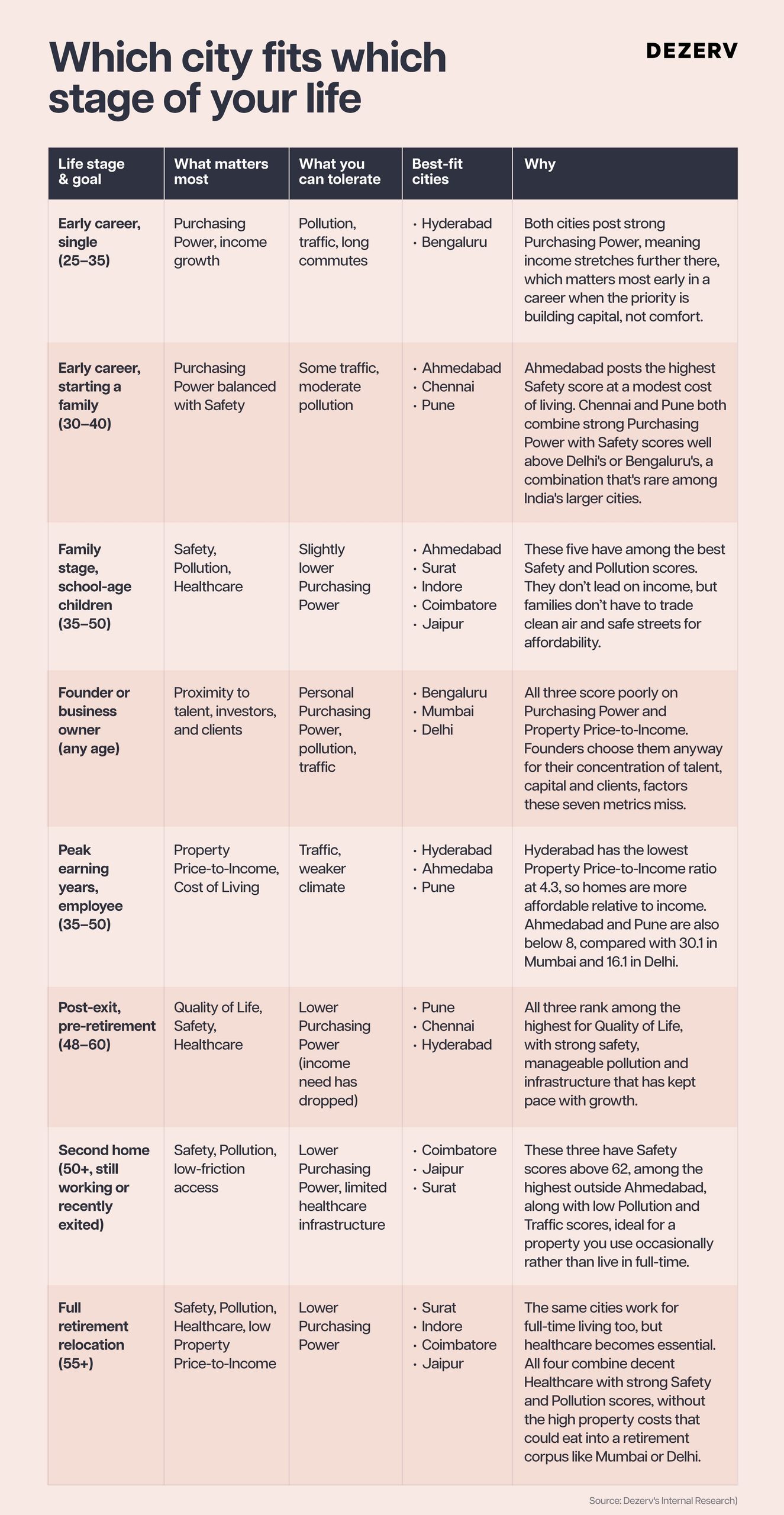
If your city doesn’t fit your current stage, that’s not automatically a problem. Just be clear about what you’re trading for it, and whether that trade still makes sense. This table covers only 13 cities, and there are many more worth comparing. If yours isn’t here, you can run the same comparison yourself in under a minute: search for your city’s Quality of Life page and compare it with another city here
How a few Indian cities and villages are already cracking it
None of this means India needs to import someone else’s model of how a city should run. It already has working examples at home, many of them overlooked. Indore has been India’s cleanest city for eight straight years, not through a foreign template but through door-to-door waste collection, strict source segregation, and citizens who actually participate in the system rather than merely tolerating it.
Mawlynnong, in Meghalaya, has long been known as Asia’s cleanest village, sustained largely through community discipline rather than government enforcement. Punsari, in Gujarat, gave residents streetlights, CCTV, Wi-Fi and clean water years before many Indian towns, funded through local revenue rather than waiting for state or central grants.
The pattern across all three isn’t budget size. It’s that administration, funding and citizen behaviour reinforce each other instead of working against one another. The lesson is simple: better cities don’t always need more money. They need all three to work together, with discipline, consistency and citizens willing to play their part.
Disclaimer : The information provided herein is intended solely for educational and informational purposes. The information contained in this document is for general purposes only and is not a complete disclosure of every material fact, term or condition. In the preparation of this document, Dezerv has used publicly available information and other sources believed to be reliable. The information provided in this document has not been independently verified by Dezerv and are subject to change.