

In December 1966, a shipment of wheat sat somewhere in the Atlantic, and an Indian official in Washington was waiting on a phone call to find out if it would be released. This wasn’t unusual. It happened most months that year. Two droughts back to back had wiped out India’s harvest, and the country was surviving on grain shipped in from abroad under a food aid deal signed over a decade earlier. Three ships a day were docking at Indian ports. The wheat inside them was being distributed and eaten within days of arriving, because there was nothing left in reserve to fall back on. People called it a “ship-to-mouth” existence. You ate what showed up that week. Nothing more.
Fast forward to today, and the same country is the largest rice exporter on earth, over $11.5 billion worth a year, off roughly the same land, at nearly four times the output. It’s a remarkable transformation, but it rarely gets talked about.
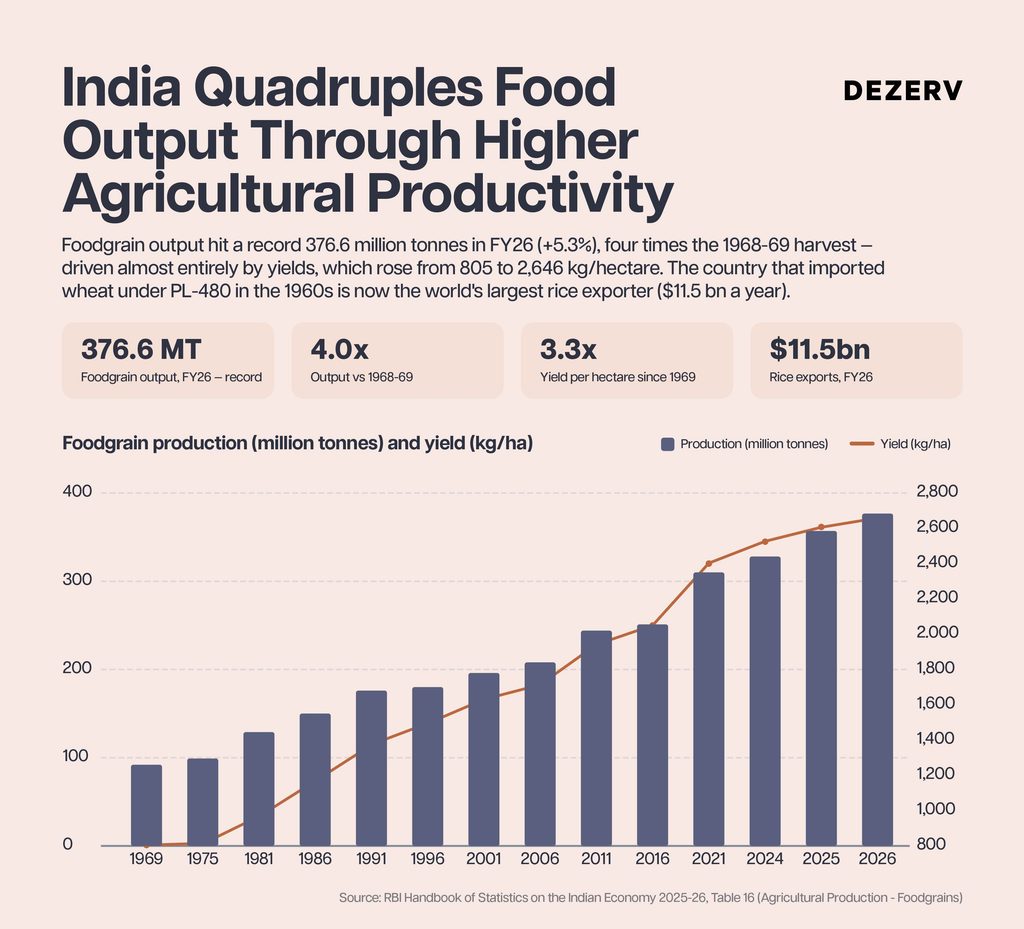
That change matters beyond agriculture. A country that can feed itself has more stable food prices. Stable food prices help keep inflation down. And lower inflation, over time, gives the RBI more room to cut interest rates. Which brings us to where Indian money is headed next.
The RBI puts out a comprehensive annual report covering the economy, banks, savings, investments and markets. We already know the big parts of the India story: GDP is growing, UPI is booming and more money is moving into financial markets. So, in this week’s edition, I went through the report looking for what’s happening beyond those familiar stories, the changes that don’t get as much attention, but matter just as much.
Let’s begin.
A ₹2.2 lakh crore credit economy built on women’s collectives
Walk into a bank without collateral or a credit history, and getting a loan is difficult. A bank needs some reason to believe you’ll repay, and usually, that means having something it can take if you don’t.
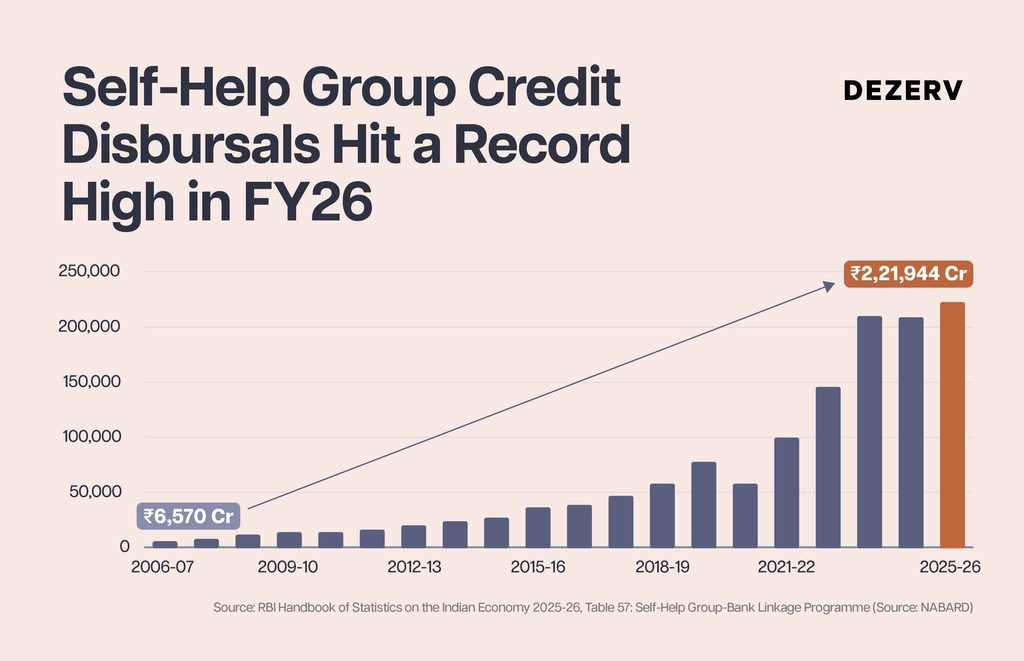
For millions of rural women, that problem was solved in a much simpler way: they started lending to each other. Since the 1990s, small groups of people, mostly rural women, have been forming what are called Self-Help Groups. Around ten to fifteen women in a group save a small amount together every month and lend it to each other, informally, no paperwork most banks would recognise.
Once a group proves it can save and repay reliably as a unit, banks start lending to the group directly, backed by nothing but that shared track record. It’s a version of an idea economists have studied for years, that when a bank can’t verify any one borrower’s honesty, a group that vouches for its own members, and stands to lose access for everyone if one person defaults, can end up more reliable than a stranger with a salary slip. Peer pressure turns out to be a decent substitute for collateral.
In 2006-07, banks lent these groups a combined ₹6,570 crore. This year, that number is ₹2.2 lakh crore. Over 53 lakh groups were financed this year alone. That’s a 34x increase in under two decades. It grew slowly, one group at a time, as banks saw these groups save and repay reliably and became more willing to lend to them.
Electronics have become a bigger export than gems, pharma, and petroleum combined once were
For most of India’s modern history, the list of things India sold to the world was pretty much the same: petroleum, gems and jewellery, textiles, and other raw materials. Things pulled out of the ground, cut, polished, or stitched.
That list has changed a lot in just five years. Electronics exports jumped from $11 billion to $48 billion, a 4.3x increase, overtaking petroleum, gems and jewellery, pharma and chemicals. Global electronics companies are also setting up manufacturing in India as they look for alternatives to China, helped by India’s incentive schemes.
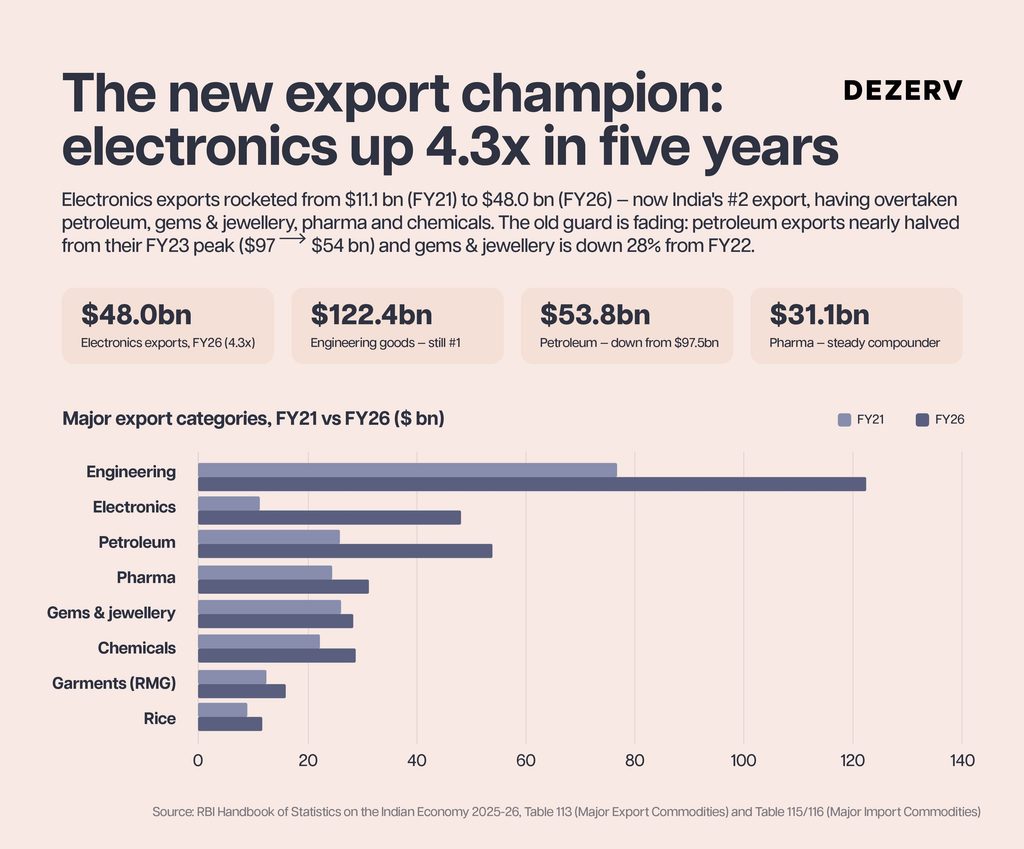
But there’s another side to the story. Over the same period, India’s electronics imports rose from $54 billion to $116 billion — more than twice the value of exports, and growing even faster. India is selling far more electronics to the world, but it is also buying much more from it. The gap is now close to $68 billion.
A large share of what gets assembled and exported from India still runs on chips, displays, and components made somewhere else first. The finished phone leaving an Indian factory carries an Indian export number, but a lot of what’s inside it never was Indian to begin with.
India has built real assembly capability, at real scale, faster than almost anyone expected.What India hasn’t built yet is the deeper supply chain, the components that go into these products. The import numbers show just how much of that gap remains.
Why India’s factory boom is happening in villages, not cities
There’s a version of India’s industrial story almost everyone carries in their head. Small towns emptying out. Young men boarding trains for the nearest big city, chasing factory jobs that pay better than the family farm ever did. It’s the story that played out in China, and the assumption has always been that India would follow the same script. The numbers in this year’s report tell a different geography entirely.
In 1991, close to two out of every three working Indians were in agriculture. Today, it’s fewer than one in two. So people are moving out of agriculture. But they’re not necessarily moving to big cities. Since 2000, the share of rural men working in manufacturing, construction and mining has roughly doubled, from 14% to nearly 28%. In cities, the same number has barely changed. Urban male employment in manufacturing and construction was around 36% in 2000. Today, it’s about 34%. So where did urban workers go? Services.
Employment in trade, transport, IT and other services rose from 58% to more than 60% among urban men. Among urban women, the share rose from 52% to nearly 62%. India’s cities largely skipped the factory-town phase and moved into services. Meanwhile, more of the country’s industrial work has been happening in villages and small towns.
That changes how you think about the electronics boom too. India is building manufacturing capacity quickly, but the workers behind it may increasingly be outside the cities most people associate with industry. And while more Indian workers are moving into new kinds of work, the Indian capital is doing something interesting too.
Indian companies are betting on the rest of the world while retail investors bet everything on India
This year, Indian companies sent a record $33.8 billion of their own money into investments abroad, the highest that figure has ever been. These aren’t foreign fund managers guessing about India from a desk somewhere else. These are the businesses that actually run India’s growth story, choosing to put more of their own capital outside the country than ever before. In the very same year, Indian households put a record $84 billion into domestic mutual funds, nine times the size of what foreign investors pulled out of India.
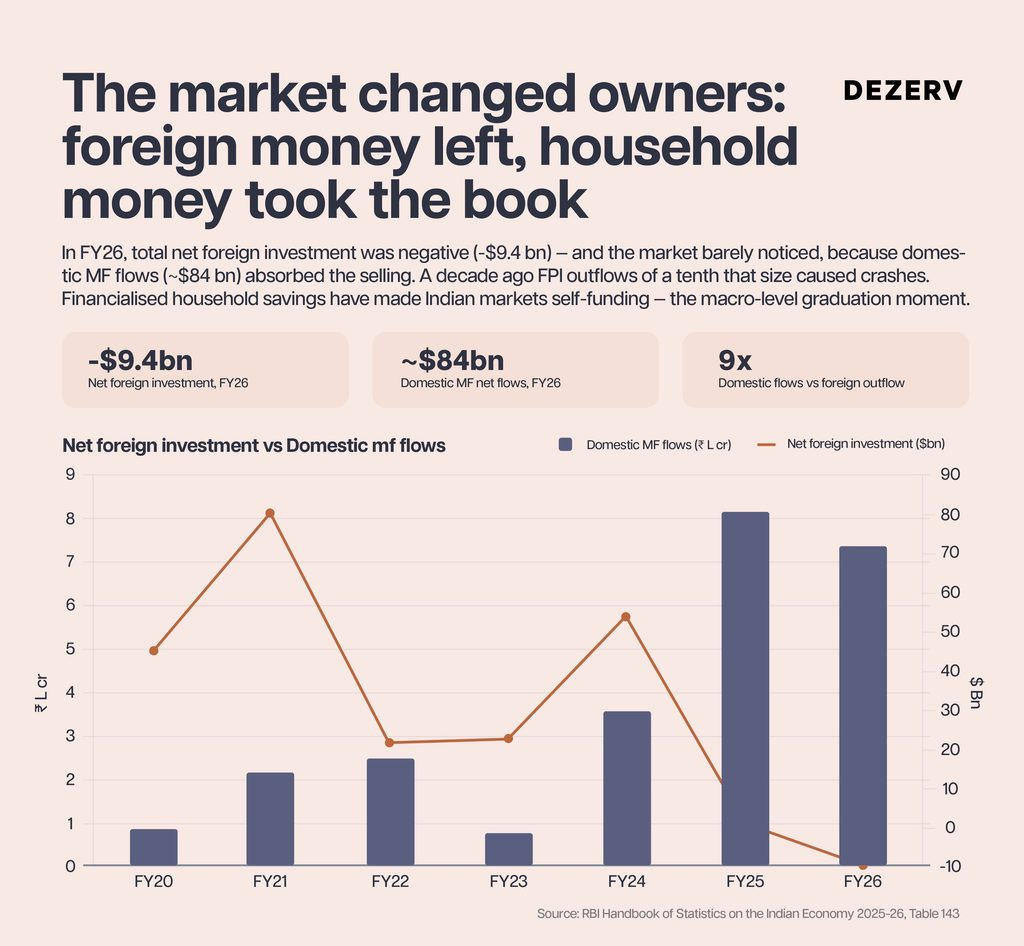
It’s tempting to put these two numbers side by side and treat them as a verdict, as if companies are losing confidence in India while households are becoming more bullish on it. But the numbers don’t tell us that.
An Indian company deciding where to deploy its next dollar has a genuinely global set of choices. It can build in India, enter a new market, acquire a company overseas, or invest elsewhere. When more corporate capital flows abroad, it reflects a decision made from a relatively wide menu of options.
The average Indian household doesn’t have the same menu. Investing overseas involves regulatory limits, paperwork, currency considerations and fewer familiar platforms. For most savers, putting money into Indian assets isn’t necessarily a decision made after weighing every market in the world. It’s simply the easiest and most accessible option available.
That makes the two numbers much harder to compare than they first appear.
A record amount of corporate money leaving India tells us something about where businesses see opportunities relative to the alternatives available to them. A record amount of household savings staying in India tells us something about where households are putting their money — but also about the limited set of alternatives they can realistically access.
India lost more banks than it gained this year, and it’s accelerating
The last one is about something that’s been happening for over two decades, and just picked up speed.
The number of banks registered under India’s deposit insurance system has been shrinking since the early 2000s, mostly small cooperative banks getting absorbed, shut down, or occasionally failing outright. This year had the sharpest one-year drop yet: 43 banks de-registered against just 11 newly registered, a net loss of 32 in twelve months. Some of those closures involved deposit insurance actually stepping in to pay out account holders.
This isn’t unique to India, and it’s worth knowing how the same story played out elsewhere. The United States had close to 14,500 community banks in the mid-1980s. Today it has fewer than 5,000, a two-thirds decline over about four decades, driven mostly by two things: bigger banks absorbing smaller ones, and small banks finding it harder every year to afford the compliance and technology costs that come with running a bank at all.
Interestingly, researchers who’ve studied this consolidation in the US found the effect on local lending wasn’t as bad as feared, post-merger banks often ended up bigger and more capable of writing larger loans, even as the number of standalone institutions kept falling.
India’s version of this story is still early, running at a fraction of the American pace, concentrated almost entirely in the smallest cooperative tier of banking. But the direction is the same, and this year’s data shows it’s no longer a slow drift. It’s accelerating.
The India story is changing in the details
A farmer’s group becoming a bankable borrower is one small change. A factory being built closer to a village is another. A phone assembled in India, even if its most valuable components still come from elsewhere, is another. An Indian company investing overseas is another sign that Indian businesses increasingly think beyond the domestic market. None of these tells the India story on its own. But together, they point to something bigger: India is becoming a country with more ways to move money, make things, find work and participate in the economy.
Even fewer small banks can be part of the same story: an economy getting larger often changes the institutions that once served it. None of these shifts makes for a single dramatic headline. That may be exactly why they are easy to miss. But economies rarely transform in one big leap. They change when millions of small decisions start becoming possible that weren’t possible before.
That may be the more interesting India story hiding inside the numbers: not that the economy is simply getting bigger, but that the menu of things Indians can do with their money, work and businesses is getting wider.
Disclaimer: The information provided herein is intended solely for educational purposes. Investment in the securities market is subject to market risks, read all the related documents carefully before investing. The information contained in this document is for general purposes only and is not a complete disclosure of every material fact, terms and conditions. In the preparation of this material, Dezerv has used publicly available information and other sources believed to be reliable. While reasonable care has been taken to present reliable data in this document, Dezerv does not guarantee the accuracy or completeness of the data.