
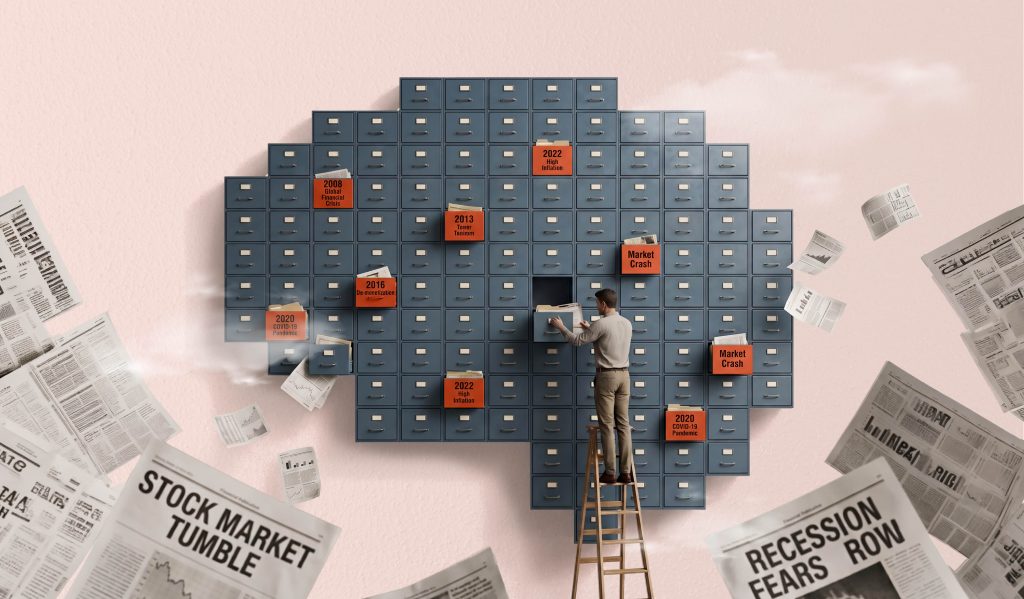

Sandeep Pai sells fire extinguishers for a living in Mumbai. In 2007, at the peak of a roaring bull market, he put a good part of his savings into a basket of mid-cap stocks. When the crash came the following year, he didn’t sell. He bought more on the way down, convinced the fall was a temporary dip before the next leg up. It wasn’t, at least not on any timeline he could have planned for, and five years later some of those same stocks were still trading at a 40 to 60% discount to what he’d paid. Pai was so shaken by the experience that he decided not to return to the stock market until he had recovered what he had lost.
Twelve years later, the market gave investors another crash to respond to. In March 2020, the Nifty fell ~38% in under six weeks, one of the sharpest crashes Indian markets have ever seen.
The reactions were strikingly different. India’s SIP closure ratio jumped to 70% that month, meaning roughly two existing SIPs were being stopped for every three new ones being started. But at the very same time, new demat account openings hit a record 4.9 million that financial year, as a fresh wave of investors treated the crash as their entry point.
Two groups of investors, watching the same kind of collapse in the same country, developed very different instincts about what a falling market actually means. Neither group was being careless. They were looking at the same crash, but their past experiences had taught them to interpret it differently. And that influence can overpower our judgement when we’re making crucial decisions.
There’s a name for this effect. In this week’s newsletter, I want to unpack where it comes from, how it shapes our decisions, and why you may start noticing it in almost every financial decision you make.
In this edition:
- What behavioral economist calls this, and why It behaves differently from every other bias
- Why fear leaves a deeper mark than facts, and why so many Indian households still trust gold over the market
- What years of market crashes have taught our instincts
- A framework for managing a bias you cannot simply think your way out of
- Why this matters more in an AI-driven market
What behavioral economist calls this, and why It behaves differently from every other bias
Most of what we know about money mistakes comes down to a fairly simple idea, that people don’t process information perfectly. We anchor on the first number we’re shown, we feel the pain of a loss more sharply than the pleasure of an equivalent gain, and we assume tomorrow will look roughly like yesterday. These are the biases behavioral economics has spent decades cataloguing, and the fix for most of them is straightforward in theory. Learn to recognize the pattern, and you can correct it.
What happened to Pai doesn’t follow that rule. Researchers call this the Experience Effect: two people can look at the same information and develop very different financial instincts simply because of what they have personally experienced.
To see how powerful this can be, let’s look at the case of Henry Wallich. In 1974, Wallich joined the board of the US Federal Reserve. He wasn’t an ordinary appointee. He had a PhD from Harvard, a professorship at Yale, and decades of experience studying economies at the highest level. If anyone in that room could be trusted to read the data correctly, it was him.
For the next twelve years, every time the Fed’s committee met to set interest rates, Wallich was looking at the same forecasts and the same models as every other governor in the room. And yet he dissented 27 times, a record that still stands, almost always pushing the same way, for higher rates, even when his colleagues, staring at identical numbers, were convinced it was safe to ease.
When researchers later studied the voting records of every Fed governor going back to 1951, the same pattern turned up again and again. People who had personally lived through high inflation stayed cautious about it for the rest of their careers, no matter what the data in front of them said in any given meeting. Wallich had lived through Germany’s hyperinflation as a child, watching prices double in a day and his family’s savings turn worthless.
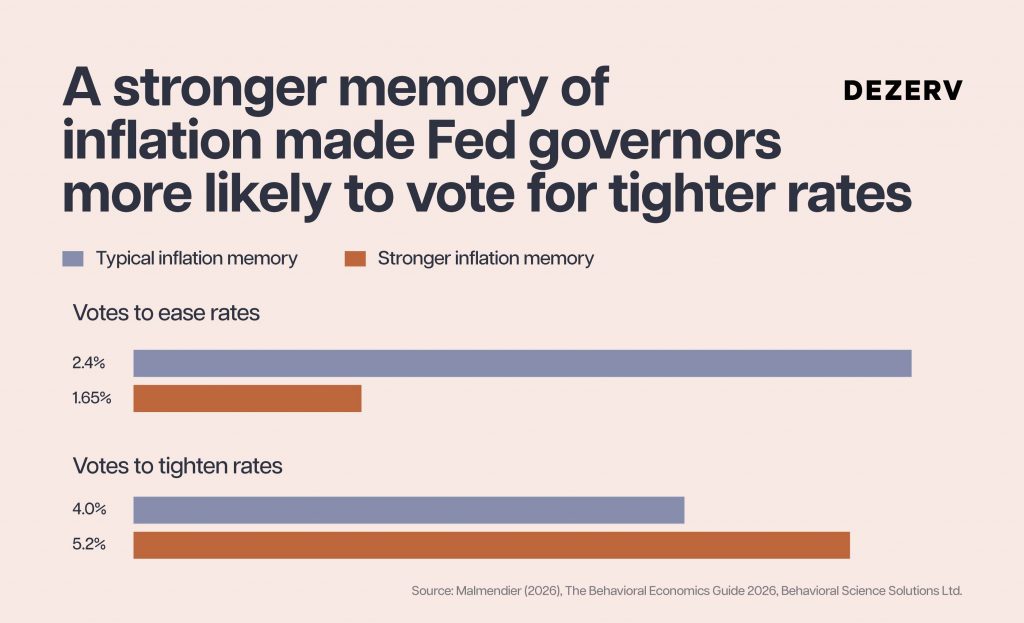
Pai had lived through five years of a portfolio that refused to recover. The decades and the currencies were different, but the mechanism underneath was the same one, and it’s what sets experience effects apart from every other bias behavioral economics has documented. Most biases weaken the moment you learn to spot them in yourself. This one doesn’t, because simply knowing about it isn’t enough to switch it off.
Why fear leaves a deeper mark than facts, and why so many Indian households still trust gold over the market
Walk into almost any Indian household built by a parent or grandparent who came of age before the 1990s, and you’ll usually find the same split, a locker full of gold, a stack of fixed deposit receipts, and a noticeable discomfort with anything resembling equity. Ask why, and there’s often a story behind it: a bank that failed, a business that collapsed, or a period when keeping money in cash felt like the safest thing to do.
That instinct becomes much easier to see when you look at the numbers. Indian households hold an estimated 30,000-35,000 tonnes of gold, worth around ₹450 lakh crore, more than the country’s entire GDP. Even within financial assets, the preference for safety is clear. Of the ₹353 lakh crore in household financial assets, ₹153 lakh crore is in bank deposits and just ₹41 lakh crore is in mutual funds. Only 5.3% of household savings goes into financial products. Much of the rest remains in gold, property and deposits, assets that have felt familiar and safe for generations.
That instinct isn’t stubbornness, and it isn’t really about intelligence either. It comes down to how the brain stores an experience in the first place. When you learn a fact from a book or an advisor, your brain files it away as information, useful, but essentially inert.
When you live through something frightening instead, watching a family’s savings shrink or a business go under, the brain does something different. It tags that memory with the fear that came alongside it. Neuroscientists call this emotional tagging, and fear-tagged memories are both easier to recall and quicker to resurface than ordinary facts, especially when something even loosely similar happens again. Every repeat brush with that fear strengthens the pathway a little further.
The fingerprint of this shows up clearly in the data on investing behavior. One study compared people who had lived through strong stock market returns over their lifetimes with people who had lived through consistently weaker ones, holding the information available to both groups constant, and found the first group was 14 percentage points more likely to invest in stocks at all, against an average market participation rate of just 37%.
The same pattern turns up among people whose entire job is supposed to be rational about money. Fund managers who lived through a bubble tend to carry that bubble’s shadow into every market cycle that follows. CEOs who led companies through severe downturns were found, using photo-based aging analysis, to visibly age faster than peers who hadn’t. An entire generation of Americans who grew up during the high-inflation 1970s kept avoiding cheaper adjustable-rate mortgages decades later, purely because the fear had never fully left them, a habit that cost that generation of borrowers a combined $22 billion in unnecessary interest.
None of this reflects a failure of intelligence in any of these people. It’s memory doing precisely what memory evolved to do, protecting them from something that, by the time the decision actually gets made, has usually already stopped being a real threat.
What years of market crashes have taught our instincts
The Sensex fell nearly 53% in less than a year during 2008. Across the country, investors pulled back from equity funds almost entirely. Net investment in equity mutual funds fell to just ₹1,056 crore in 2008-09, and dropped further to ₹595 crore the following year.
By September 2010, the Sensex had climbed back above 20,000, close to its pre-crash highs. Household savings in gold more than doubled in the years after, from 1.3% of GDP in 2008-09 to 2.8% by 2011-12, as investors moved money out of markets and into something that felt safer.
And by fiscal year 2010-11, Indian investors withdrew ~₹13,500 crore more from equity mutual funds than they invested. Even though the market had already recovered, the memory of 2008 was still fresh. The numbers said it was a reasonable time to stay invested. What people remembered said otherwise, and across the country, memory won.
Demonetisation in 2016 did something a little different but closely related. It made cash itself, the most trusted asset in most Indian households, feel unreliable overnight.
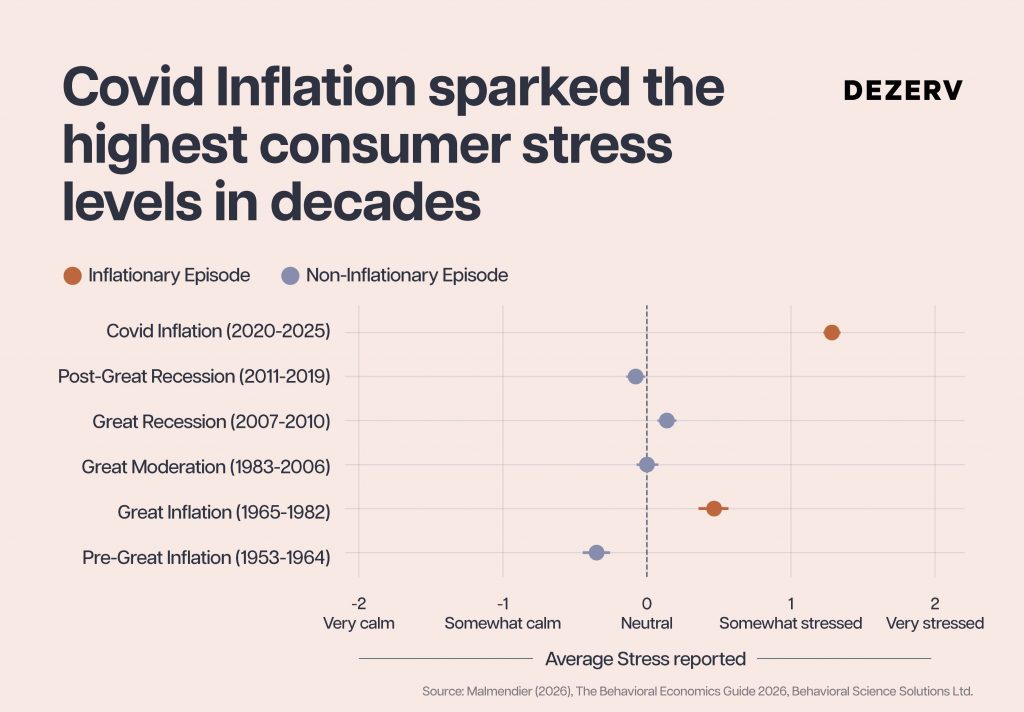
Covid period added a different kind of shock, and this one was felt worldwide. It wasn’t just the market fall, but the stress that came with it. Researchers measuring reported stress across seventy years of inflationary periods found Covid-era inflation produced stress levels roughly three times higher than any period on record, higher than the Great Inflation of the 1970s, higher than 2008 itself.
Then came the global rate-hike cycle in 2022. As central banks raised rates sharply, investors became less willing to pay high valuations for companies whose profits were still years away. And richly valued growth stocks fell hard within months.
These experiences don’t simply vanish when the market recovers. Behavioral research shows that lived experiences physically alter how our neural pathways process future choices, a mechanism known as long-term potentiation. The trauma of a market crash leaves a lasting biological trace that shapes our basic instincts around risk.
How to manage a bias you cannot simply think your way out of
None of this means the instinct is a flaw to be argued away, because you cannot lecture a brain out of a biological memory. No amount of spreadsheets or market commentary erases an emotional impulse wired by past stress. Awareness on its own doesn’t fix experience effects. What actually works looks a little different, and it starts before the next shock ever arrives.
Build rules while markets are calm. A portfolio decided ahead of time, with clear triggers for when to rebalance, is far less likely to be driven by fear once markets actually turn. The goal is to decide what you’ll do before emotion gets a vote in the matter.
Separate the decision from the moment. The worst financial calls tend to get made exactly when fear or excitement is at its peak. A short pause between a market event and a portfolio decision can be the difference between reacting to something and actually responding to it.
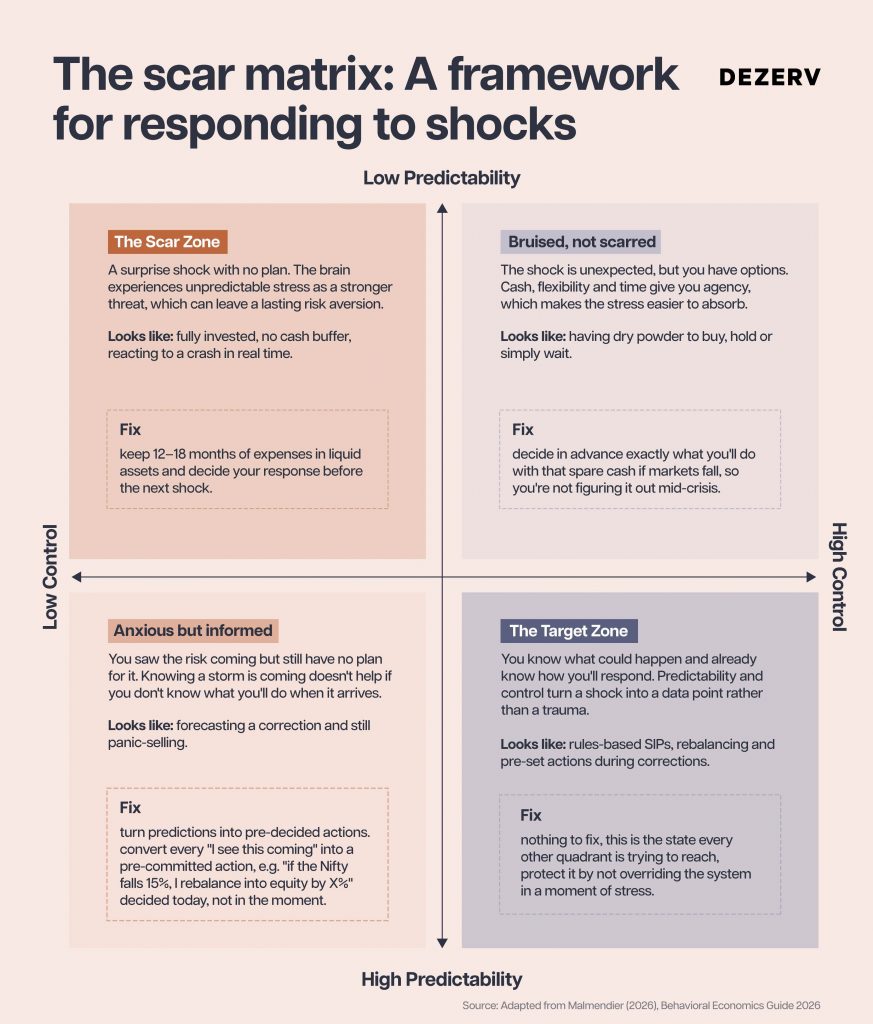
Whether a shock leaves a lasting mark also comes down to two things: how much you saw it coming, and how much control you had over your own response to it.
The matrix below maps out what that looks like in practice, and what moves you toward safer ground.
Bring in a perspective that doesn’t share your scars. You may not always see how your past is influencing a decision. Someone who didn’t live through your 2008 or your 2020 may look at the same numbers without the same emotional baggage, and spot something you can’t.
Your instincts aren’t necessarily wrong. They’re shaped by what you’ve lived through. The best defence is to have a system and another perspective that can challenge those instincts when they start driving the decision.
Why this matters more in an AI-driven market
Two people looking at the exact same stock today can pull up nearly identical research within seconds, earnings transcripts, analyst notes, sentiment scores, all surfaced by the same AI tools within minutes of each other. Whatever edge used to come from knowing something first is disappearing at the exact pace AI keeps improving.
What isn’t disappearing is the part of investing that was never really about information to begin with.
Every investor carries instincts shaped by what they’ve personally lived through, and no model can read those instincts for you, because you often can’t fully read them yourself. AI gets better at analysis every quarter. It gets no better at knowing whether your own conviction about a stock is coming from research, or from the year you happened to start investing.
This is why behavioural edges can last longer than informational or analytical ones. They don’t depend on having better data or faster models. AI may make information, analysis, and even sophisticated tools available to everyone. What it can’t easily equalise is how each person responds to uncertainty, fear, and opportunity. The real advantage lies in knowing when you’re making a considered financial decision, and when an old experience is making it for you.
Disclaimer: Investment in the securities market is subject to market risks, read all the related documents carefully before investing. The information provided herein is intended solely for educational purposes and should not be construed as solicitation, advertising, or providing any financial or investment advice or an offer to buy or sell any financial instruments. Readers are advised to consult with their financial advisor before making investment decisions based on the information provided herein. In this material, Dezerv has utilized information through publicly available sources, and other data deemed to be reliable. While reasonable care has been made to present reliable data in this article, Dezerv does not guarantee the accuracy or completeness of the data. Dezerv, along with its directors, employees, or partners or any of its affiliates, shall not be held liable for any loss, damage, or liability arising from the use of this document.