


Peter Lynch took over Fidelity’s Magellan Fund in 1977, when it was a small, obscure fund most people had never heard of. By the time he left in 1990, he’d turned it into the best performing mutual fund in the world, averaging close to 29% a year for thirteen straight years. Ten thousand dollars invested with him on day one would have grown into more than a quarter of a million by the time he walked away.
Fidelity later looked at how its actual investors had done over those same thirteen years, and found something strange. The average investor in Magellan had lost money.
Somewhere during that thirteen-year run, thousands of investors watched the fund soar, grew confident, and invested near the peak. Then came an inevitable rough patch. The fund fell, they panicked, and sold, only to watch it recover without them. Many eventually bought back in, but only after it felt safe again, paying higher prices for the same fund they had just abandoned. Lynch never had a bad year that broke the fund. His investors kept breaking their own returns by reacting to every wobble along the way.
This isn’t unique to one fund or one country. It shows up wherever markets meet human nature, and Indian mutual fund investors are not immune to it either. SIPs get paused the moment markets wobble, and withdrawals often happen right when patience matters most.
So, on 23rd July 2026, SEBI released a consultation paper that seems to be built around exactly this problem, less about chasing better returns, more about helping people hold on to the ones already available to them.
The new consultation paper proposes to introduce a ‘MF only PMS’ framework wherein it proposes to reduce the minimum investment for portfolio management services from ₹50 lakh to ₹25 lakh, provided the client investments are done only in direct plan of mutual fund schemes, ETFs, and SIFs. This could make professional portfolio management accessible to many more investors.
So how will this actually work? Why did SEBI decide to do this now? And what does it mean for investors, and everyone else sitting in this ecosystem? That’s what today’s newsletter is about.
In this edition, we’ll cover:
- Why SEBI felt the need to introduce a new MF-PMS framework
- Who has SEBI actually built this for?
- What exactly did SEBI propose?
- How does Dezerv see this playing out and what does this mean for investors?
- The real value of a portfolio manager
Why SEBI felt the need to introduce a new MF-PMS framework
Professional portfolio management reaches a tiny slice of India’s investing public. SEBI’s own consultation paper puts the number of PMS clients at roughly 2.19 lakh, up from 1.5 lakh in April 2019. Against a base of crores of Indian investors, that’s a strikingly small number. The main reason is the ₹50 lakh minimum investment. Interestingly, that threshold hasn’t always been the same.
When PMS regulations were first introduced in 1993, the minimum investment was ₹5 lakh. SEBI raised it to ₹25 lakh in 2012, where it remained for nearly eight years. Then, in 2020, the minimum investment was increased again to ₹50 lakh.
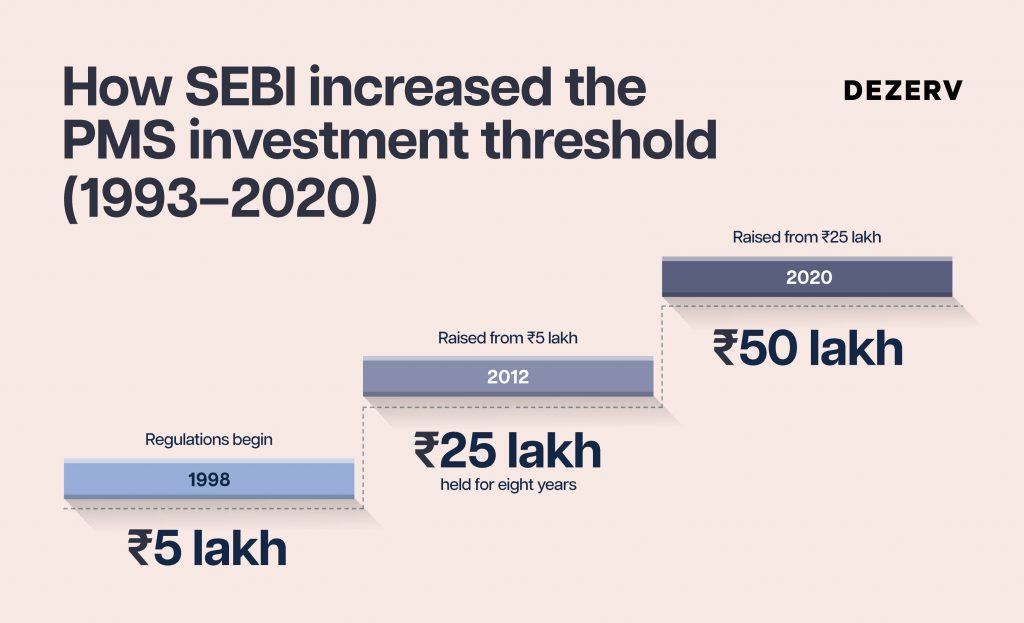
At the same time, the minimum net worth required to run a PMS was raised from ₹2 crore to ₹5 crore. The reasoning was straightforward. Traditionally, PMS has been associated with direct equity, with many strategies built around concentrated bets on individual stocks. That can make them more volatile than a diversified mutual fund. SEBI has therefore viewed PMS as a product better suited to investors with a higher risk appetite and the financial capacity to absorb losses. That’s the thinking that kept the ₹50 lakh minimum investment in place for so long.
But not every PMS follows that approach. Some portfolio managers build portfolios entirely using mutual funds. Since these portfolios invest only in mutual funds, and not individual stocks, they carry a very different risk profile. Recognising this difference, SEBI has proposed a separate category with a lower minimum investment of ₹25 lakh. The idea is simple: if the investment universe is more restricted and diversified, the entry barrier can also be lower.
Who has SEBI actually built this for?
There’s a sizeable population of Indians who have built meaningful wealth through mutual funds and SIPs, managing their own investments as their portfolios grew over time.
But managing it alone gets harder over time. Mutual funds were built to make investing simpler than picking individual stocks. Yet India now has roughly 2,000 mutual fund schemes chasing about 500 investible stocks. The tool designed to remove a hard decision has slowly turned into a hard decision of its own, and until now, there hasn’t been a formal way for this segment to hand that decision and execution to an external expert to make it.
When regulated wealth management isn’t accessible, people often turn to other sources of advice. A CFA Institute study found that only about 6% of India’s financial influencers are registered with SEBI, up from just 2% a year earlier. Yet a third of them still give specific investment recommendations. Around 8% of investors surveyed said they had lost money after acting on advice from someone who wasn’t regulated.
SEBI’s new consultation paper aims to make regulated portfolio management available to more investors.
What exactly did SEBI propose?
The new structure is called MF-PMS, short for Mutual Fund only Portfolio Management Services. A regular PMS can invest in stocks, bonds, REITs, foreign securities, and more. MF-PMS strips that down to just one thing: Direct Plan mutual funds, ETFs, and a category called Specialized Investment Funds. Nothing else. That’s a deliberate choice. A portfolio manager under this structure gets discretionary control over the money, meaning they can buy and sell without checking with the client every time. But they can only do it using the same mutual funds any investor could buy on their own.
Two numbers make this proposal work. The minimum investment for a standard PMS is ₹50 lakh. For MF-PMS, it drops to ₹25 lakh. And the net worth a portfolio manager needs to even offer this service drops too, from ₹5 crore to ₹2 crore.
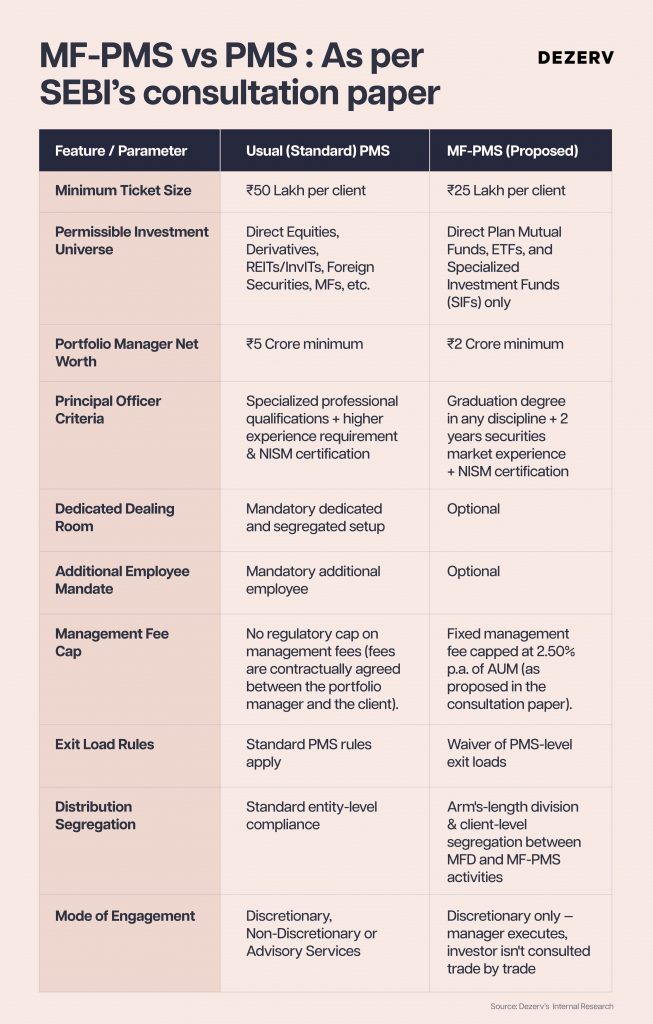
When it comes to switching portfolio managers, whether under Standard PMS or MF-PMS, it doesn’t mean liquidating everything and triggering a tax event. Demat portability with in-specie transfer lets an investor move the portfolio to a new manager without a forced sale.
How does Dezerv see this playing out and what does this mean for investors?
When we launched our mutual fund PMS in 2022, the idea wasn’t easy for people to understand. Competitors, other wealth managers, and even prospective clients would ask the same question: Why would anyone pay a PMS to invest in mutual funds when they could just do it themselves? SEBI’s proposal answers that question. Instead of lowering the minimum investment across all PMS categories, it lowers it only for mutual fund-only PMS, recognising it as a separate category.
We’ve had prospective clients who wanted professional portfolio management but couldn’t access it because they hadn’t crossed the ₹50 lakh minimum. Often, they already had substantial mutual fund portfolios and simply had to wait. A ₹25 lakh threshold changes that.
It also changes how the industry evolves. As more investors become eligible, portfolio managers will have to earn trust through their investment process and long-term performance, not just by offering access. Lower compliance requirements could also encourage more registered investment advisors to become portfolio managers, giving investors more choice.
For investors, the portfolio continues to stay entirely in Direct Plan mutual funds, ETFs and SIFs. A licensed portfolio manager handles asset allocation, fund selection and rebalancing, while investors continue to benefit from the lower costs of direct plans without paying distributor commissions. The investor also gets two layers of oversight instead of one, mutual fund rules at the product level, PMS rules at the portfolio level. And If they decide to switch managers, the portfolio can move without forcing a sale and creating an unnecessary tax event.
The consultation paper also expands what a standard PMS can invest in by allowing international securities and unlisted debt. Investors who want a broader mandate get more flexibility, while MF-PMS offers a simpler option for those who want to build wealth through mutual funds.
Overall, this proposal makes professional portfolio management available to many more investors while giving them more choice in how they want their money to be managed.
The real value of a portfolio manager
Ask most people what a good portfolio manager does, and they’ll probably say picking the right funds. But a recent study by ET Wealth and Crisil suggests that staying invested may matter even more. The study analysed SIP returns across 120 diversified equity mutual funds between January 2011 and March 2026, and found that the probability of losing money fell from 22.7% after one year to 2.3% after five years, and to zero after ten years. It also found that returns became much more consistent the longer an investor stayed invested.
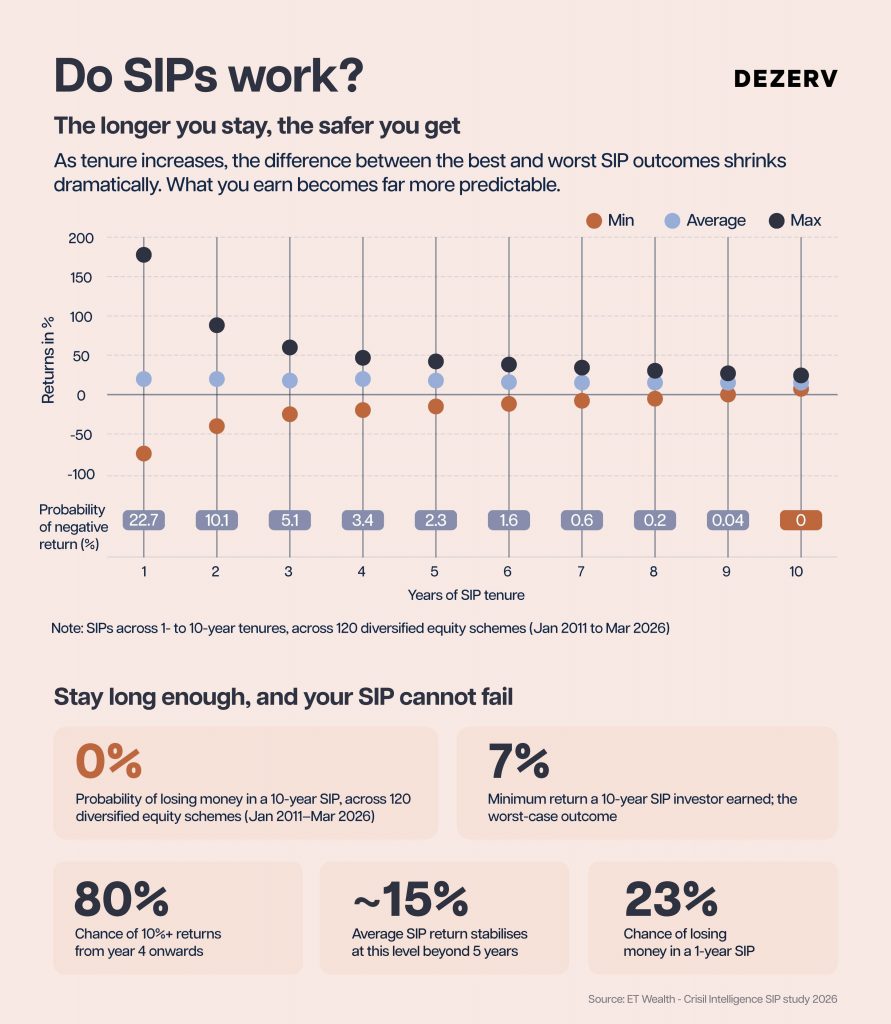
The challenge is that many investors don’t stay invested long enough. When markets fall, it’s easy to stop SIPs or redeem investments. But those periods are often when patience matters the most. This is where an MF-PMS can help. A portfolio manager isn’t just there to choose mutual funds. They can rebalance the portfolio when needed and help investors stay invested through market ups and downs, giving them a better chance of earning the returns that long-term investing has historically delivered.
In summary
For years, mutual funds have become the preferred way for millions of Indians to build wealth. This proposal focuses on what happens after that, how those investments are managed as portfolios grow larger.
The framework is deliberately simple. Investments remain in Direct Plans, fees are capped, and the investment universe is limited to mutual funds, ETFs and SIFs. At the same time, it gives experienced advisors an easier path to become portfolio managers and offers investors with ₹25 lakh a regulated way to access professional portfolio management.
If implemented, it could help fill a gap that has existed for years. Investors who have outgrown managing their own portfolios but don’t yet qualify for a traditional PMS would finally have an option designed for them. In many ways, this is the next step in the evolution of India’s mutual fund industry. The focus is no longer just on making investing accessible, but also on making professional portfolio management accessible.
Disclaimer: This newsletter is intended solely for informational and educational purposes and should not be construed as investment, legal, tax, regulatory or financial advice, or as a recommendation, solicitation or offer to buy or sell any securities or investment products. The views expressed are based on publicly available information believed to be reliable as of the date of publication and are subject to change without notice. References to the SEBI Consultation Paper relate to proposed regulatory changes that are subject to public consultation and final approval by SEBI and should not be construed as the prevailing regulatory framework. Any historical data, illustrations, studies or third-party statistics referred to herein are for informational purposes only and are not indicative of future performance or outcomes. Investment in the securities market is subject to market risks, read all the related documents carefully before investing. The information contained in this document is for general purposes only and is not a complete disclosure of every material fact, terms and conditions. All trademarks, logos, and brand names mentioned are used for identification purposes only. Dezerv Investments Private Limited is a Portfolio Manager with SEBI Registration no. INP000007377