

In 1962, a small team led by Vikram Sarabhai set up shop in Thumba, a fishing village near Thiruvananthapuram, it sat almost exactly on the magnetic equator, ideal for the atmospheric research they wanted to do. There was no facility to speak of, so they made do with what the village had. A church became their workshop, its altar room used to assemble rocket parts. The bishop’s house next door became their office and design space. There was no proper road to move equipment, so components travelled around town on the backs of bicycles and bullock carts, then got carried the final stretch to the launch site by hand.
A country that had been independent for barely fifteen years, still counted among the poorest in the world, decided to build a space program out of a church – one that would eventually become ISRO. The scientists were mocked in the streets for it.
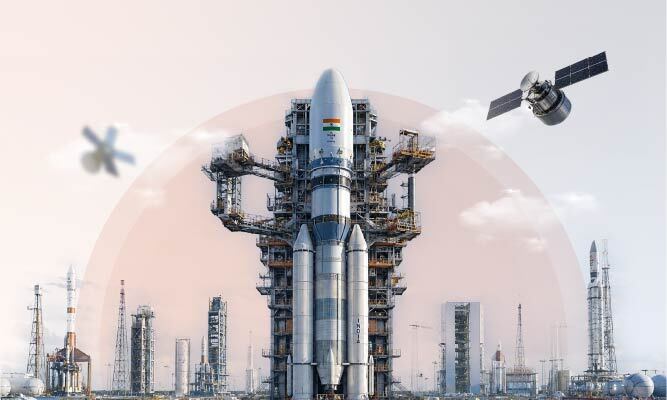
Sixty-four years later, on the evening of July 18, 2026, people gathered on a coastline not far from that same stretch of India, this time at Sriharikota, watching a very different kind of rocket lift off. It was called Vikram-1. And unlike everything that had launched from Indian soil before it, this one wasn’t built by the government.
It worked on the first try. The payload settled into a stable 450-kilometre orbit exactly as planned. The mission was named Aagaman – arrival. With that single flight, India became only the third country in the world, after the United States and China, where a private company has independently put a satellite into orbit.
The visionaries behind it were two former ISRO engineers, Pawan Chandana and Bharath Daka, who quit their jobs to start Skyroot, the company that built the rocket. At the time, what they were attempting wasn’t just difficult, it was illegal. There was no policy in India that allowed a private company to launch anything into space. They spent years designing a rocket before there was even a legal way to fly it.
This week’s newsletter tells the story of Skyroot, explores India’s private space industry, explains how a rocket business makes money, and asks whether India can build its own SpaceX.
In this edition:
- How 400 space startups appeared in 12 years
- How two ISRO engineers with no capital talked their way into ₹10 crore
- How a rocket company actually makes money
- Can Skyroot become the SpaceX of India?
- Is a successful launch the same as a successful business?
- As a wealth creator how should you look at it?
The rise of India’s private space-tech industry
In 2014, there was exactly one organisation in India doing meaningful space work: ISRO. By March 2026, that number had crossed 400 private space startups.
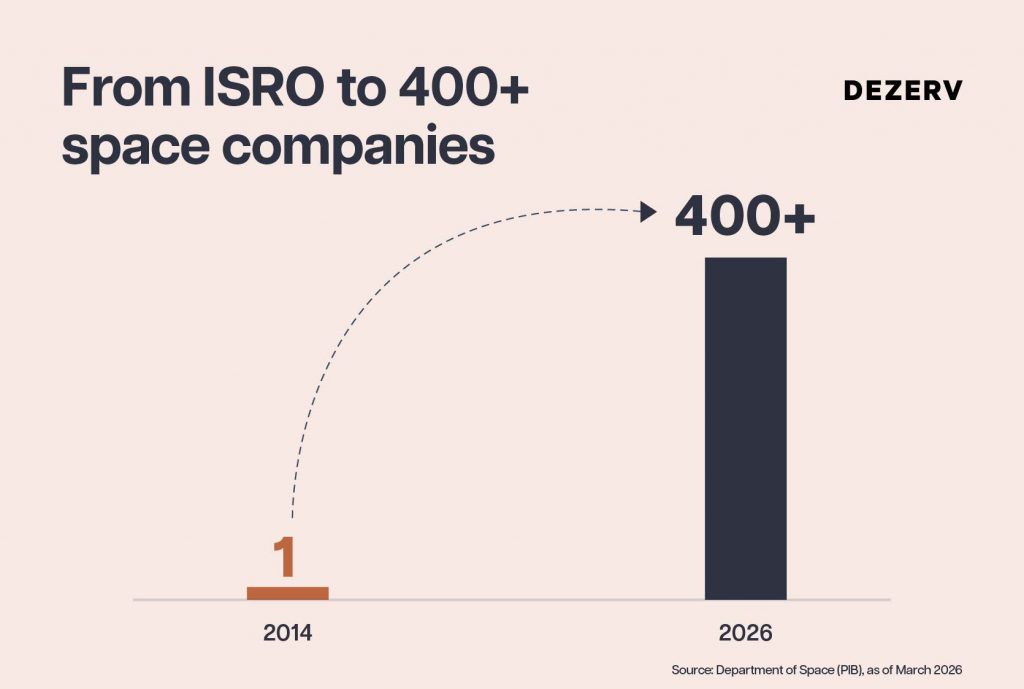
That jump didn’t happen on its own. In 2023, the Indian Space Policy opened the entire space value chain – manufacturing, launch, applications, everything downstream – to private companies for the first time. A new regulator called IN-SPACe was set up as a single window for approvals, instead of forcing startups to navigate multiple government departments. As of mid-2026, it has registered over 4,500 organisations and cleared 133 launch and operating authorisations.
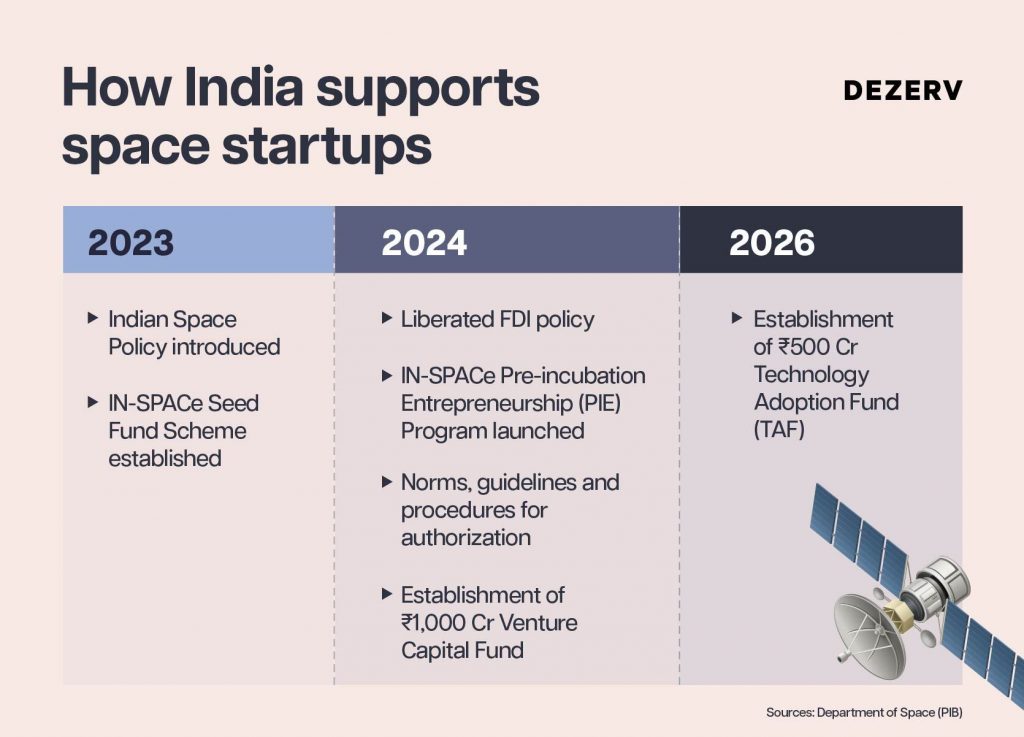
The government has also built capital specifically for this sector. There’s a seed fund offering grants of up to ₹1 crore. A ₹1,000 crore venture fund, deploying ₹100-250 crore a year through 2030 and a separate ₹500 crore fund covering up to 60% of a startup’s technology costs.
On the private side, Speciale Invest and Starburst are the most active investors in Indian space tech by deal count. Speciale Invest recently raised a ₹1,400 crore deep-tech fund. Strategic investors are joining in too, with Reliance backing Digantara and HDFC Bank investing in Agnikul Cosmos. Global investors are already here as well, with GIC backing Skyroot and Google investing in Pixxel.
With more than 400 startups and billions of rupees flowing into the sector, it’s worth looking at where the money has gone so far. Not all of these companies do the same thing. Some, like Skyroot and Agnikul, build rockets. Others, like Pixxel and Dhruva Space, build satellites and space applications. Across the ecosystem, Skyroot has raised the most funding so far.
How big is this opportunity, really?
India’s space economy was worth $8.4 Bn in 2022. That’s about 2% of the global market. The government wants to grow it to $44 Bn by 2033, taking India’s share to 8%. To get there, the industry needs to grow at 16% a year for the next decade.
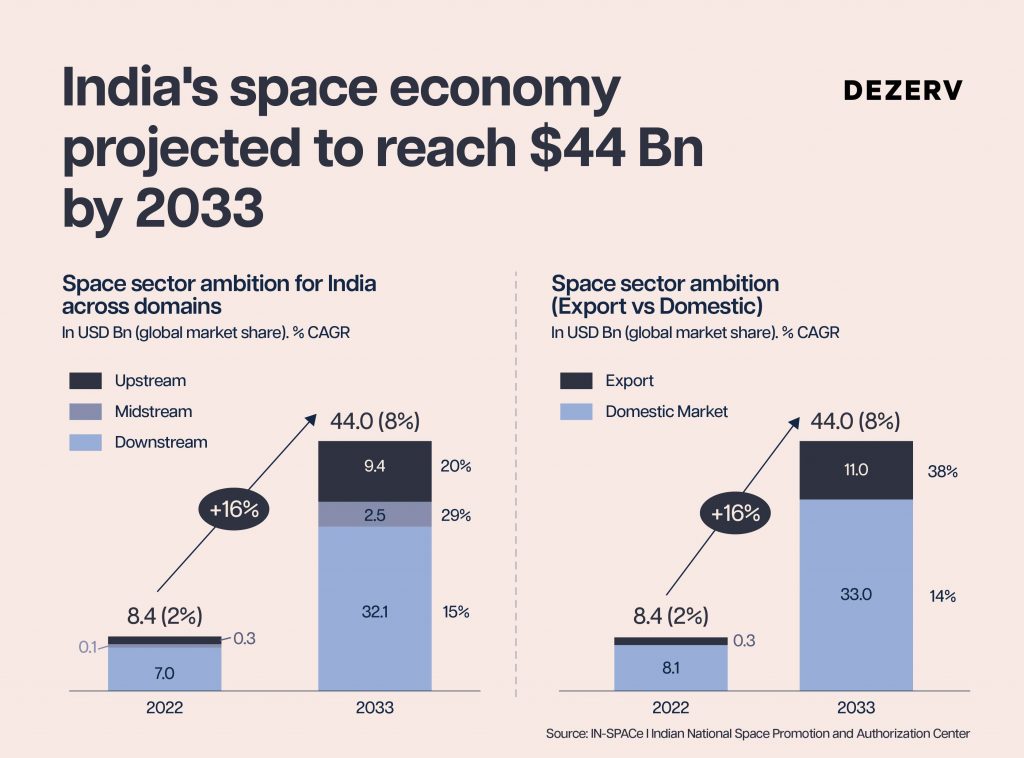
And the opportunity goes far beyond rockets.The government splits the space economy into three broad buckets, and launch, the business Skyroot is in, is actually one of the smaller ones by value, growing from $0.72 Bn to $3.5 Bn by 2033. That doesn’t make rockets any less important. Nothing else in the space industry works without them. But the bigger opportunity isn’t the rocket itself. It’s everything that happens after a satellite reaches orbit.
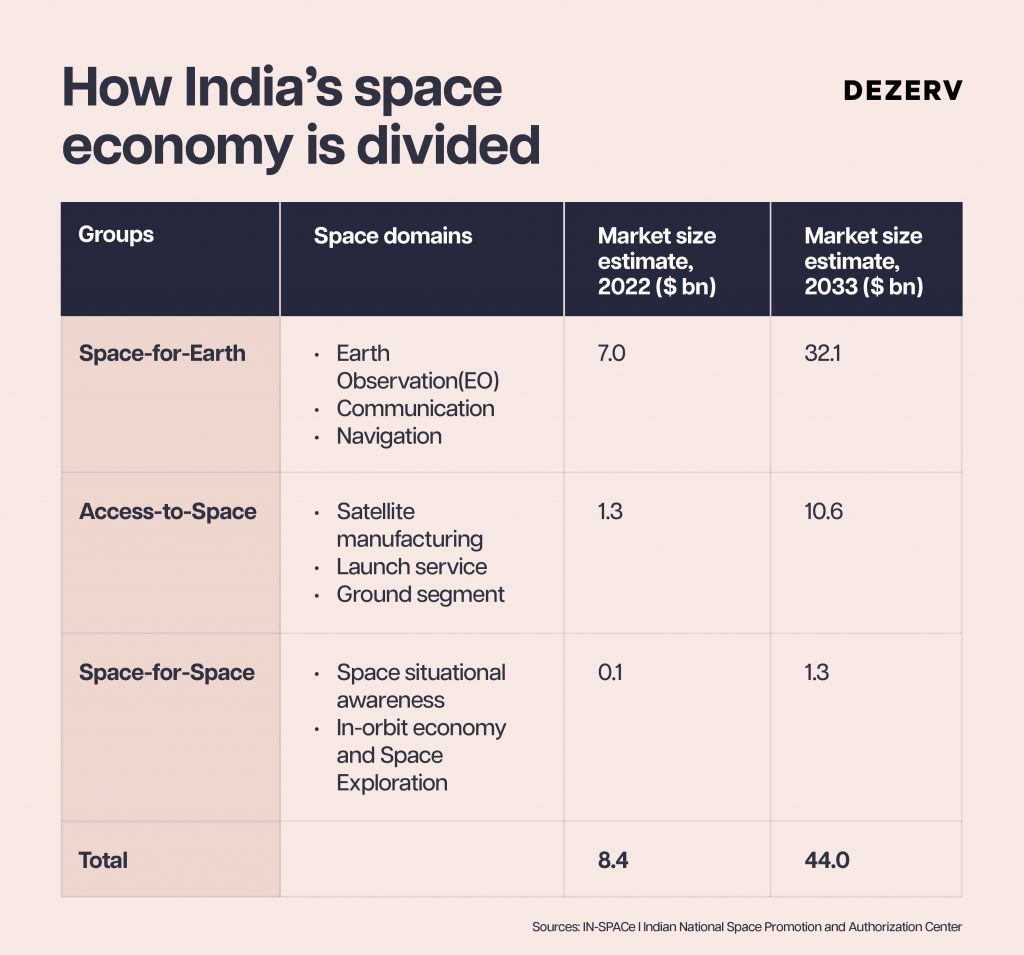
That’s where private companies like Skyroot Aerospace, Pixxel, Dhruva Space, Digantara, and SatSure come in, each building a different part of India’s space ecosystem.
Private investment in Indian space reached about $111 million in 2022, with most of the money going into early-stage startups building rockets and satellites. The next push is to bring in more venture capital, private equity, angel funding, and easier bank financing as these companies grow.
The model is simple. ISRO develops the technology, shares its infrastructure and expertise, while IN-SPACe creates the policies and approvals. Private companies then take that technology and turn it into sustainable businesses.
How two engineers with no capital built a rocket company
Chandana studied mechanical engineering at IIT Kharagpur and joined ISRO in 2012 at a starting salary of ₹35,000 a month. He worked on the LVM3, India’s largest rocket, which later carried Chandrayaan missions toward the Moon. His flatmate, Naga Bharath Daka, his flatmate and now co-founder, was an electronics engineer. From the start, Chandana focused on propulsion and structures, while Daka handled electronics and software.
In 2018, they left ISRO to start Skyroot Aerospace. They had no fundraising experience. Chandana has said they had to Google terms like “what is fundraising” and “what is a term sheet” before meeting investors. They didn’t even have a pitch deck or a website. A friend sent a LinkedIn message to Mukesh Bansal, the founder of Myntra and Cure.fit. Bansal responded, flew down, and committed to invest within an hour of meeting them.
That first cheque brought in around ₹10 crore, one of India’s largest deep-tech seed rounds at the time and gave Skyroot nearly 2.5 years of runway. The founding team had just 15 people, most with no ISRO background. They came from aviation, manufacturing, and fresh engineering colleges, joining largely through word of mouth.
After Vikram-S succeeded in 2022, GIC, Singapore’s sovereign wealth fund, backed a $50 million round, the largest the Indian space sector had seen. Skyroot has since crossed unicorn status, one of India’s fastest deep-tech companies to get there.
How does a rocket company actually make money?
Think of Skyroot as a logistics company for space. Companies that own satellites pay Skyroot to carry them into orbit, much like businesses pay a shipping company to transport cargo.
Why do they pay for this? Because their businesses rely on satellites for two things: communication and Earth observation.
Communication covers internet, phone, and broadcast services in places where fibre networks can’t reach. Earth observation involves satellites capturing images and data that help farmers monitor crops, governments respond to floods and wildfires, businesses plan infrastructure, and weather agencies improve forecasts.
A single Skyroot launch costs around ₹100 crore. At 20 launches a year, that could translate into ~₹2,000 crore in annual revenue. The opportunity exists because satellites have become much smaller. Today, over 90% of satellites launched weigh under 300 kg, creating demand for smaller, dedicated rockets instead of giant ones.
That’s where Skyroot fits in. Vikram-1 is Skyroot’s biggest proof so far. It can carry payloads of up to 350 kg, uses an all-carbon composite structure and a 3D-printed engine, and reached orbit on its very first attempt.
Building it cost under $30 million, compared with the roughly $1 billion historically spent on similar global programs. Skyroot expects 70-80% of demand to come from international customers, and its factory can produce one Vikram-1 rocket every month.
Can Skyroot become the SpaceX of India?
Skyroot is often compared to SpaceX, but they’re solving different problems. As founder Pawan Chandana puts it, “SpaceX is like a metro. We’re more like a cab.” While SpaceX uses large rockets to carry many satellites to common orbits, Skyroot focuses on taking a smaller number of satellites directly to the exact orbit a customer needs.
The scale is also very different. SpaceX completed around 165 launches last year, generating roughly $5 billion from launches and $12 billion from Starlink. Around 70-80% of those launches were for its own Starlink satellites. A closer comparison could be Rocket Lab, the New Zealand company that built a successful launch business without a national space program. Even then, it took nearly 20 years to reach its current scale.
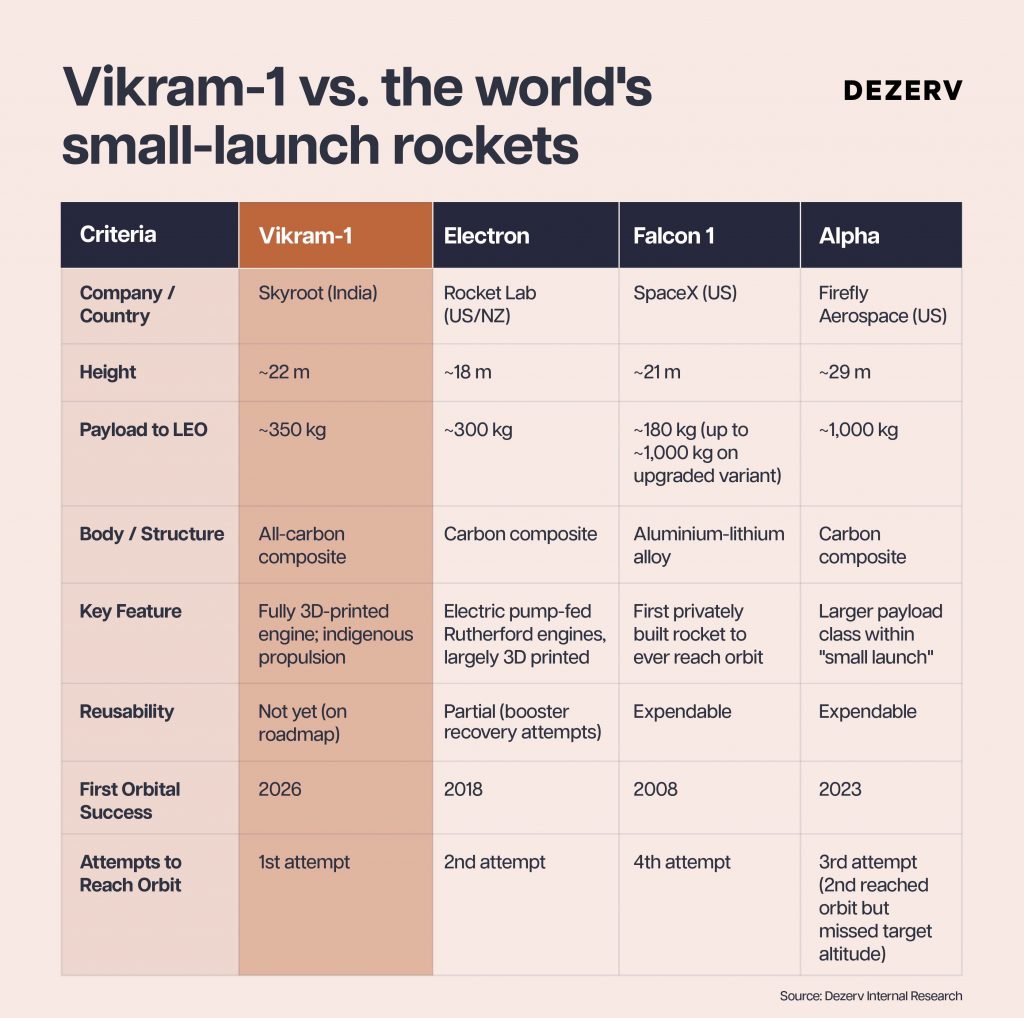
SpaceX’s journey shows just how hard building a rocket company is. Its first rocket, Falcon 1, failed three times before finally reaching orbit on the fourth attempt, nearly pushing the company into bankruptcy.
Skyroot’s start has been very different. Vikram-1 reached orbit on its very first launch, and the company is targeting a growing market by taking satellites directly to the exact orbit customers need.
But calling it “the next SpaceX” has its limits. Much of SpaceX’s success comes from Starlink, which creates steady demand by filling most of its own launches. SpaceX also keeps costs low by reusing rockets. Skyroot plans to build reusable rockets too, but that technology is still being developed.
Reaching orbit puts Skyroot in an exclusive club with fewer than 10 organisations worldwide. Turning that achievement into a profitable, long-lasting business is a much harder journey.
But is a successful launch the same as a successful business?
A successful launch is a huge milestone, but it’s only the beginning. Skyroot needs several more successful missions before customers see it as a reliable launch provider. In this industry, trust is earned one launch at a time.
Demand is another challenge. Its factory can build 12 Vikram-1 rockets a year, but India doesn’t launch that many small satellites, so most of Skyroot’s customers will need to come from overseas.
Competition is intense. In India, it competes with ISRO’s SSLV and PSLV. Globally, it faces players like SpaceX, whose rideshare launches are often cheaper, even if they don’t offer custom orbits. Rocket launches are also a tough business. They require huge amounts of capital, operate under strict safety and space debris rules, and leave little room for error. Unlike ISRO, which serves a national mission, Skyroot also has to build a profitable business.
The investment opportunity in India’s space economy
Skyroot isn’t building India’s space industry alone. Companies like Pixxel, Agnikul Cosmos, GalaxEye, Dhruva Space, and Bellatrix Aerospace are building different parts of the ecosystem, from rockets and satellites to imaging and propulsion.
None of them are listed yet, so you can’t invest in them directly. For most HNIs, the closest option is Alternative Investment Funds (AIFs) that invest in deep-tech startups. Funds like Speciale Invest, which has backed several space startups, are one route, though they typically require a minimum investment of ₹1 crore.
The opportunity also goes beyond rockets. Areas like in-space services (such as removing space debris), satellite services, and space-based computing could generate recurring revenue without having to launch rockets themselves.
Finally, keep an eye on the government’s role. Almost every founder in the sector wants the government to become an early customer, not just a regulator, much like NASA supported SpaceX in its early years. If that happens in India, it could become one of the biggest catalysts for the country’s private space industry.
Disclaimer: This material is intended solely for informational and educational purposes. Investment in the securities market is subject to market risks, read all the related documents carefully before investing. The information contained in this document is for general purposes only and is not a complete disclosure of every material fact, terms and conditions. The views expressed are based on publicly available information believed to be reliable as of the date of publication and are subject to change without notice. All trademarks, logos, and brand names mentioned are used for identification purposes only and does not imply endorsement. Please consult your legal, tax and financial advisors before making any investment decisions.