

In the White Mountains of California, there is a bristlecone pine tree that has been alive for over 5000 years. It was a sapling when the pyramids were being built. It has survived ice ages, centuries of drought, and weather that killed everything growing around it. The living parts of the tree are not impressive to look at, gnarled, sparse, mostly dead wood on the outside. But the cells that are still alive are doing something remarkable: repairing themselves, protecting themselves, and declining at a rate so slow that scientists have struggled to find a meaningful comparison anywhere else in the natural world.
David Sinclair, a professor at Harvard Medical School who has spent thirty years studying why things age, finds trees like this genuinely useful. The genes that allow a bristlecone pine to survive five millennia are not unique to trees. Simpler versions of them exist in yeast, in worms, in mice, and in us. He calls them sirtuins, a family of seven proteins that act like the body’s damage-control team, patrolling the epigenome and keeping the right genes switched on and the wrong ones switched off. When everything is going well, when food is abundant and life is comfortable, the sirtuins go relatively quiet. When things get hard, when food runs scarce, when the body is pushed physically, when temperatures drop, they activate. They repair DNA damage, reduce inflammation, and essentially tell the cell to stop growing and start protecting itself.
In Sinclair’s lab, and in labs across Stanford and MIT, scientists have found ways to activate these mechanisms artificially. In animals, they have partially reversed the aging process, rolling back measurable biological age, regenerating the optic nerve in blind mice, restoring youthful function to old tissues. The top fifty longevity companies have collectively raised over a billion dollars in venture capital. Researchers now seriously discuss whether aging itself, rather than any individual disease, should be the target.
And if aging can be slowed meaningfully, if the diseases that have historically ended lives at 70 are being pushed back by a decade or more, then it is worth asking whether you have a retirement corpus that will last as long as you do? That is what this edition is about.
In this edition:
- Why you may live longer than you think
- The longevity ecosystem: innovations shaping the future
- Why more years don’t mean better quality of life
- What does the future of health look like?
- Rethinking retirement for a longer life
You may live longer than you plan for
For most of human history, the challenge was dying too soon. That problem is beginning to flip. By 2050, 1 in six people worldwide will be over 65, up from 1 in ten today. And India is on a steeper curve. By the mid-2030s, India’s median age will surpass the world’s, due to falling fertility rates and increased life expectancy. Our life expectancy has gone from 47 years at independence to over 71 today.
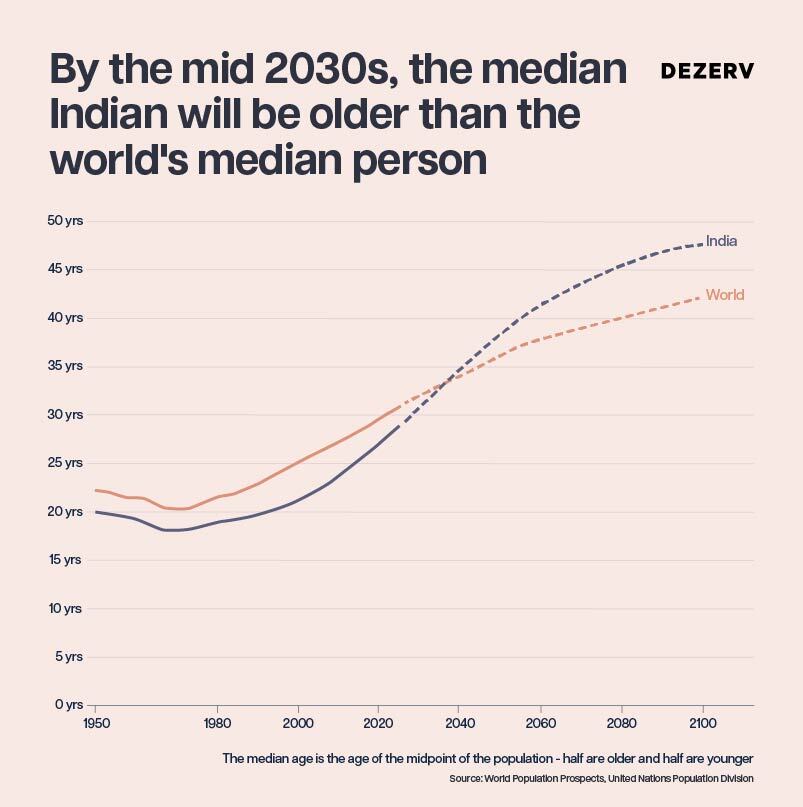
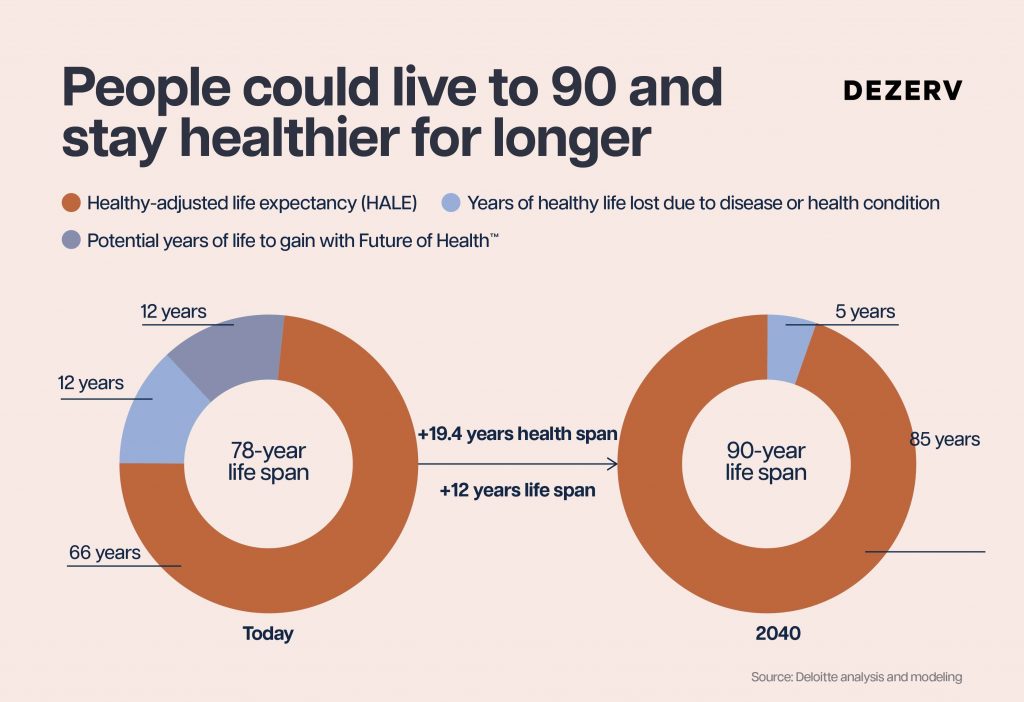
But a longer life only matters if those extra years remain healthy years. Researchers describe this using two measures: lifespan and healthspan. Lifespan is the number of years between birth and death. Healthspan is the number of years spent in good health. The gap between the two is where much of aging happens.
Historically, living longer often meant spending more years managing chronic disease, taking medications, and dealing with physical decline. We added years to life, but not necessarily life to years. That trade-off is beginning to change. Much of modern healthcare is shifting from treating disease after it appears to preventing it, detecting it earlier, and helping people change behavior before serious damage occurs.
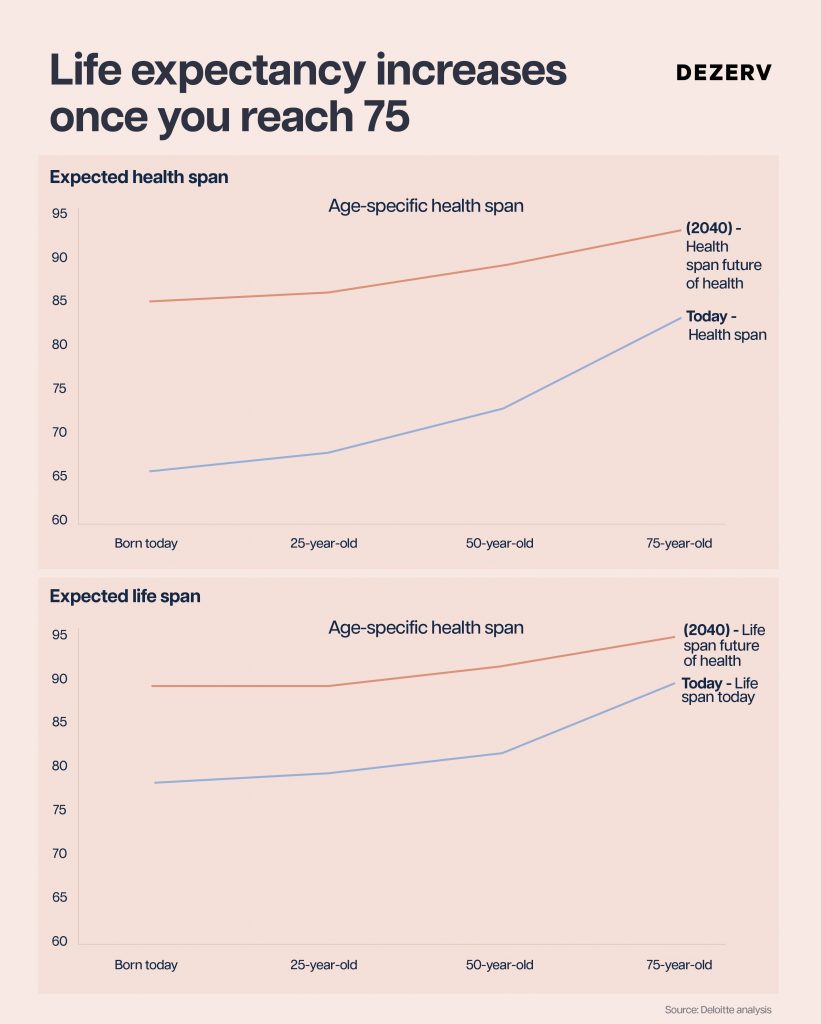
And as medical innovation improves, the average lifespan could reach 90 by 2040, while the share of life spent in good health rises from 85% to 95%. You do not just live longer. You live well for longer, and compress the period of decline into a much shorter window at the very end.
So, for someone who is 45 today and in reasonable health, the realistic retirement planning horizon is no longer 70. It is ninety, and quite possibly beyond.
Can we change how we age? Inside the science of longevity
Steve Horvath, a geneticist at UCLA, built a clock that measures specific patterns in your DNA and tells you how old your cells actually are, not how many birthdays you have had, but how fast your body is aging right now.
The number can be ten years younger than your passport or ten years older, depending entirely on how you have lived. Horvath’s clock can now measure this from a blood sample, and what makes it useful is that the number moves. It responds to what you do. Which means it can go in the wrong direction, and it can go in the right one.
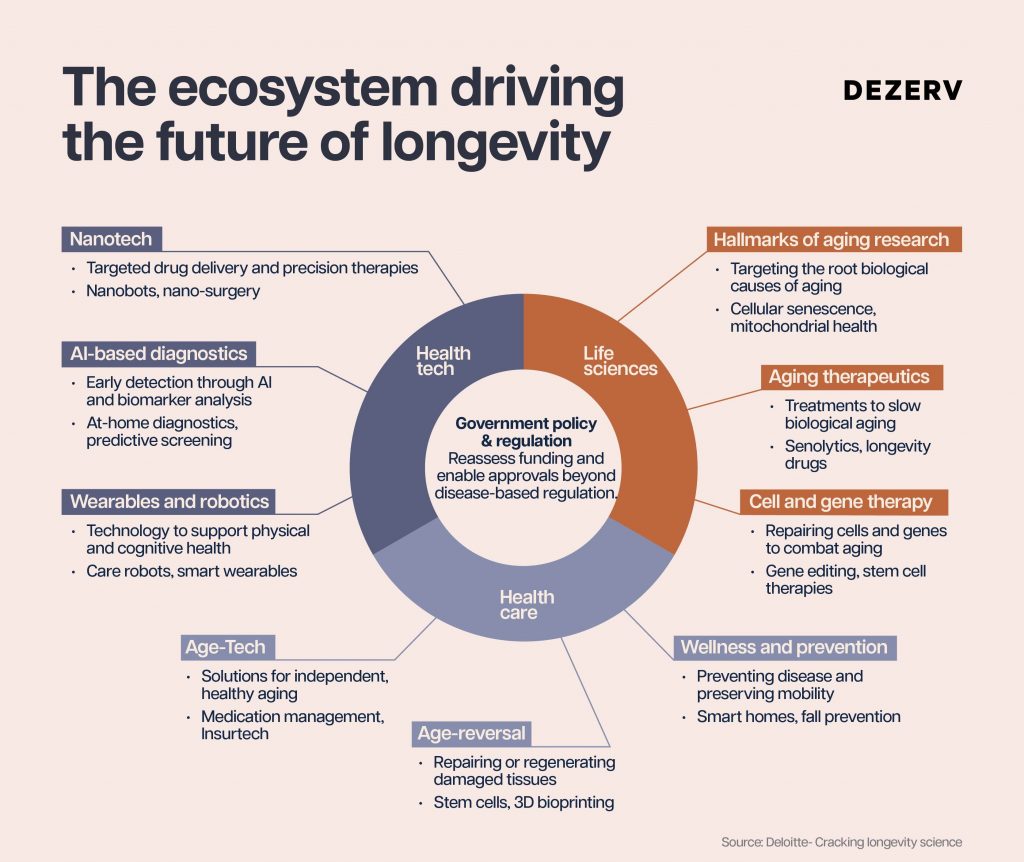
And here is what is actually being done to push it in the right direction. The longevity ecosystem is broad and is spread across eight distinct areas: aging therapeutics, cell and gene therapy, wellness and prevention, AI diagnostics, wearables, nanotech, age-reversal technologies, and age-tech, each operating simultaneously and beginning to reinforce each other.
And here is what is actually being done. The longevity ecosystem spans eight distinct areas: aging therapeutics, cell and gene therapy, wellness and prevention, AI diagnostics, wearables, nanotech, age-reversal technologies, and age-tech, each advancing simultaneously and beginning to reinforce each other.
Some of the promising experiments being pursued today:
1. Epigenetic reprogramming: Sinclair’s lab used three of the four Yamanaka factors, genes that can reset a cell’s identity, to partially reverse aging in living animals without causing cancer. In mice, they restored vision lost to glaucoma and regenerated damaged optic nerves. The cells’ biological age was rolled back by roughly 80%.
2. NAD precursors (NMN, NR): NAD is a molecule cells use to produce energy, and its levels decline with age. The idea is biologically plausible, but independent studies at the Jackson Laboratory found no lifespan extension in mice. Human evidence remains limited. The commercial excitement is well ahead of the science.
3. Parabiosis and plasma exchange: researchers connected the circulatory systems of an old and a young mouse. The old mouse became measurably younger. The young mouse aged faster. Multiple companies are now running plasma exchange trials in humans, without yet knowing exactly which factors in young blood are responsible.
4. Rapamycin and the Dog Aging Project: Rapamycin extended lifespan in mice by twenty to thirty percent, even when started late in life. Researchers are now testing it in dogs, which share our diseases and age roughly seven times faster than us, giving meaningful results in a fraction of the time a human trial would take.
5. Hyperbaric oxygen therapy: Sixty sessions of ninety minutes in a pressurised chamber did something previously thought nearly impossible in a small Israeli study: telomeres became measurably longer and senescent cells in the blood declined. First demonstration that these markers of aging could reverse in a living human.
6. Senolytics: These are the drugs designed to clear zombie cells, cells that stop dividing, refuse to die, and release inflammatory signals that damage surrounding tissue. Human trials are active across multiple companies. The biology is well established; the human drug results remain mixed.
7. GLP-1 drugs (Ozempic, Mounjaro): These drugs were originally developed to treat diabetes. But are now showing cardiovascular protection, kidney benefits, and early signals around cognitive decline well beyond what weight loss alone explains. Whether they slow aging in metabolically healthy people is still being studied.
8. DNA sequencing: In 2000, sequencing a human genome cost about $1 billion and took 13 years. Today, it can cost under $100 and be completed in about an hour. Medicine is becoming predictive, identifying your specific genetic risks years before symptoms appear.
9. Biosensors and wearables: They continuously monitor heart rhythm, sleep architecture, and inflammatory markers. Smart mirrors, sensor-fitted bathrooms, and toilets that can already test urine for glucose, nitrites, and pH levels associated with early disease, passively, without any change in behaviour.
10. AI-powered disease detection: AI systems are increasingly being used to analyze cancer scans, ECGs, and blood tests. In several studies, they have matched or exceeded human clinicians in detecting early signs of disease. Early detection is the single most powerful lever in longevity, the difference between stage one and stage four is often the difference between treatable and terminal.
Current reality: We are living longer. But are we living healthier?
Bryan Johnson is someone worth knowing about if you are thinking seriously about longevity. He sold his payments company to PayPal for 800 million dollars, and then did something that most people found baffling: he stopped trying to build more wealth and started trying not to age.
He hired a team of doctors, spent millions measuring every organ in his body, and built a protocol around the single goal of slowing his biological clock. He goes to bed at eight-thirty. His last meal is at noon. He takes over a hundred pills a day. He has generated more personal health data than any human in recorded history.
Most people find him easy to dismiss. What is harder to dismiss is what his doctors keep finding. His cardiovascular function scores at the level of an eighteen-year-old. His inflammation markers are near undetectable. His biological age across multiple systems is measurably younger than his chronological age of 47. You can disagree with his methods and still find the data uncomfortable to ignore.
Johnson talks about something he calls a society built for dying, the food systems, the sleep culture, the work norms, the chronic stress, and his argument is not that people are making bad choices but that the environment makes those choices almost inevitable. He is extreme. But he is pointing at something real: most of the factors that accelerate biological aging are not genetic. They are defaulted into.
And this is where the challenge becomes apparent. The average person today lives to around seventy-nine. Their health span ends around sixty-three. That is a 16 year difference spent managing chronic conditions, rising medical costs, and growing dependence on others. While global life expectancy is rising, the number of years people spend in poor health is expanding even faster. Medical advancements are keeping us alive longer, but they aren’t matching that extension with quality of life. The challenge for the future isn’t just adding years to life, but adding life to years.
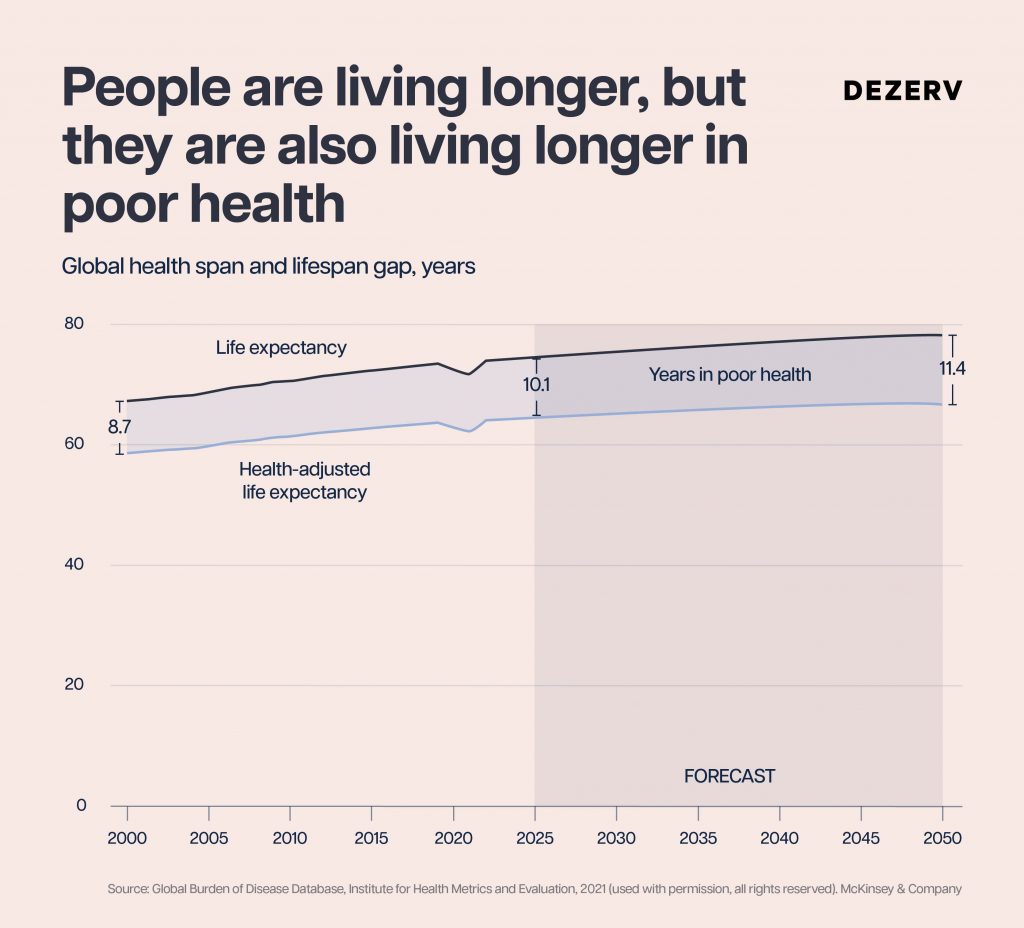
And the extra years medicine has added to human life were not added to the end. They were added to the middle, which means more people are living longer while managing diseases that previous generations died from quickly. Non-communicable diseases now account for 67% percent of all global deaths and 82% percent of years lived in poor health. Brain health conditions alone, mental, neurological, and substance disorders, account for nearly a quarter of the total global disease burden, yet receive just two percent of healthcare funding worldwide.
Living longer and living well are not a tradeoff. In every animal model tested, the interventions that extend lifespan also extend health span. Biology does not produce more years of being unwell, it produces more years of being functional. You get both or you get neither.
What does the future of health look like?
Think about what it means to age well versus age poorly, and you realise most people have only ever seen one version of it. The grandparent who spent their last decade largely bedridden. The parent whose seventies were defined by a revolving door of specialists and prescriptions. That picture, a long slow decline eating up years that could have been lived, is not inevitable. It is a consequence of how we have been treating aging, not how aging has to work.
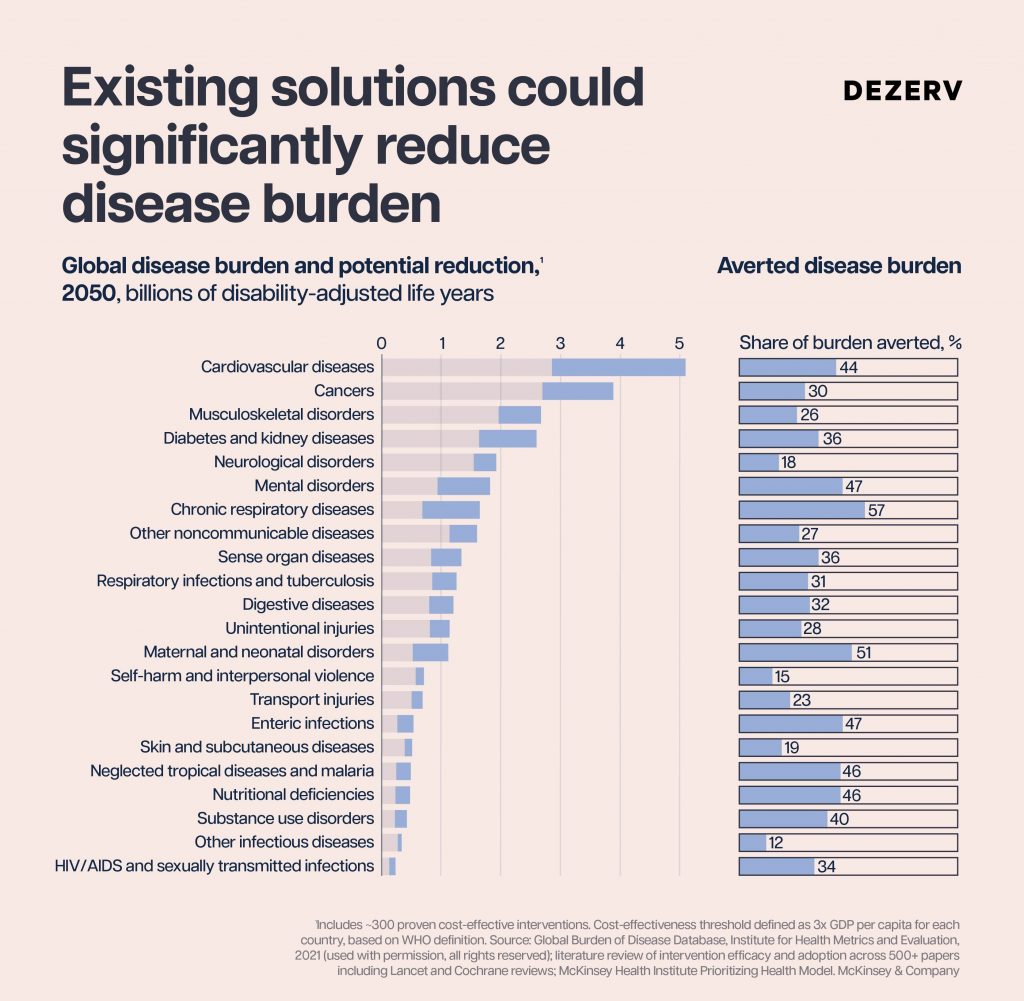
McKinsey looked at roughly three hundred proven, cost-effective interventions across every major disease category and asked a simple question: if we actually scaled these, how much of the burden could we prevent? The answers are striking. 44% percent of cardiovascular disease burden avertable. 30% of cancer burden. 57% percent of chronic respiratory disease. 47% percent of mental disorders. These treatments are already available and proven to work. They’re just not reaching enough people in time.
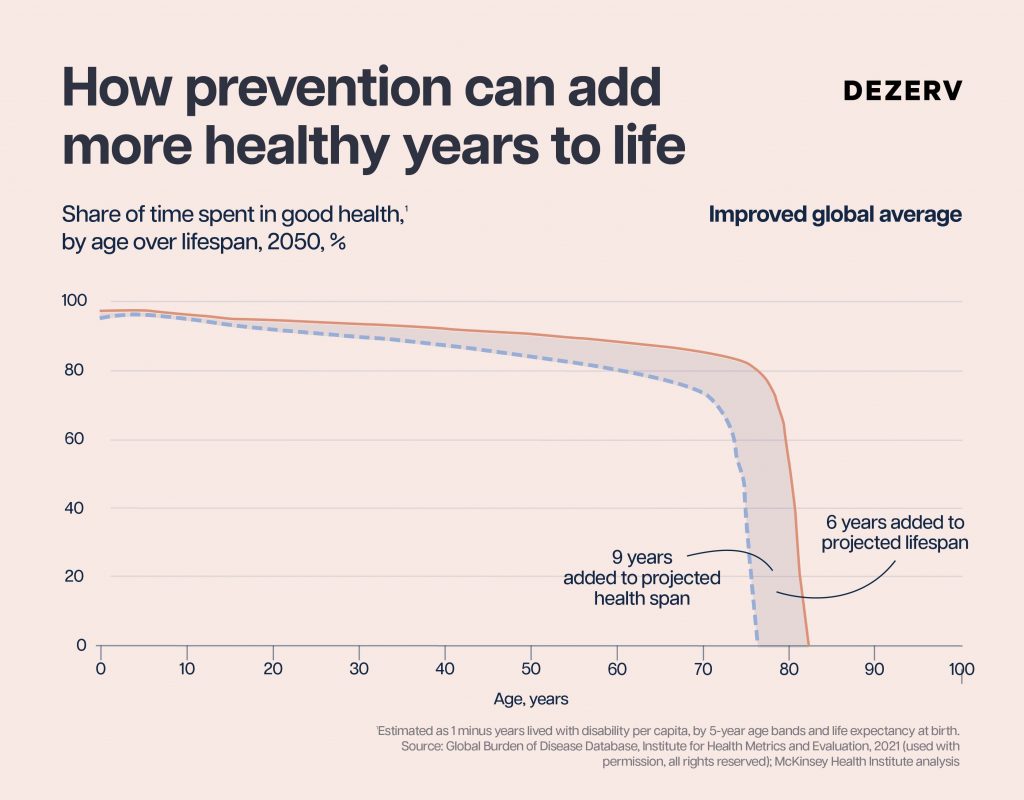
The goal is to square the curve. Right now, health declines gradually from middle age onward, with people spending long years managing deteriorating function. The alternative, which becomes possible when prevention and early detection are taken seriously, is a life where you remain in good health for the majority of your years and experience a much shorter, sharper decline at the very end. In practical terms, that could mean six extra years of life and nine extra years of good health. The share of your life spent well rises meaningfully.
There is also a counterintuitive finding that I’d like to share. A person who is 75 today and in reasonable health has a higher expected lifespan than population averages suggest, because they have already survived the most common causes of death at every earlier age bracket. A healthy 75-year-old today has a good chance of living to 90. The challenge is that most people are not preparing for a retirement that lasts another decade and a half.
And when you scale that reality from individuals to entire populations, the implications become enormous. Improved population health could add twelve and a half trillion dollars to global GDP by 2050, 10.5 trillion from increased labour force participation alone, as healthier people work longer and more productively. The longevity market is expected to outstrip the existing healthcare market over the long run, because it is shifting from treating disease after it arrives to preventing it from arriving at all.
What extra years actually cost
The good news is that people are living longer. The harder part is ensuring their money lasts just as long. Medical costs in India are rising at 12 to 15% annually, two to three times the rate of general inflation. Someone retiring at sixty and spending ₹3 lakh a month faces a financial trajectory that standard retirement calculators, built for a twenty-year horizon, simply were not designed to model. The difference between planning for twenty years and planning for thirty is not marginal. It runs into crores, and it shows up not in year one but in year eighteen, when flexibility is lowest and medical expenses are highest.
The question most retirement plans are built around is how much you need to stop working comfortably. The question that actually determines whether the plan survives is: how much do you need if you live to ninety, spend your last decade managing significant health costs, and cannot count on supplementary income after seventy? These are not the same question. And most people have only ever answered the first one.
I’ve written extensively about how increasing life expectancy changes retirement planning, the corpus you’ll actually need, how to calculate your true retirement number, and the strategies for building it over time.
In summary
Living longer is the best problem to have, if you plan for it. Science is moving fast. The costs are rising faster. And most retirement plans were written for a world where 75 was old age. The single most important financial decision you can make today is to take your longevity seriously, before you have to.
Disclaimer – The information provided herein is intended solely for educational purposes. Any statements about future developments are speculative and should not be taken as guarantees. In this material, Dezerv has utilized information through publicly available sources, and other data deemed to be reliable. All trademarks, logos, and brand names mentioned are used for identification purposes only and do not imply endorsement or recommendation.