


Last week, we had an expert from Aeka Advisors join our weekly webinar to talk about Wills and succession planning, and honestly, I wasn’t sure how many people would show up for that session. Because unlike our usual weekend webinars on wealth building, topics people actively want to discuss, this one was about something most of us avoid: what happens to everything you’ve built after you’re gone.
But they showed up.
And the session reminded me just how little most of us have actually thought about this. Fewer than 5% of Indians have a Will, the lowest among developing economies, in a country with nearly 200 million demat accounts.
Most people who spend years building wealth think carefully about how to grow and protect it. What they rarely consider is what happens to it the moment they are no longer around, and that gap is where families can come apart.
So this week I wanted to bring that conversation to a wider audience and break down everything we covered, because what came out of that session was genuinely useful, and too important to stay within a Saturday Zoom call.
In this edition,
- The cost of not having a Will
- How to draft it right: what to specify, what to avoid, and which assets need special attention
- What actually makes a Will legally valid in India, and where most people get it wrong
- The six reasons Wills get challenged after death, and how to prevent each one
- When to update you Will
Let’s begin.
Why everyone needs a Will
The consequences of dying without a Will are not abstract. More than 70 percent of Indian families face property disputes after a death, and courts take between 3 to 10 years on average to resolve them. What makes this harder is that these disputes do not arrive when families are calm and prepared. They arrive in the middle of grief.
The most common version of this story involves a spouse. A husband dies, and his wife assumes the home they spent decades building together is hers, because in every practical sense it always was. What she discovers instead is that under the Hindu Succession Act of 1956, she is one heir among several, with rights equal to each of her adult children. Any one of them can legally demand their share.
The law does not ask what her husband wanted, who cared for him, or who contributed to what he built. It applies a fixed formula where all Class I heirs, the spouse, sons, daughters, and mother, inherit simultaneously with equal priority. If any Class I heir exists, Class II heirs like siblings and father receive nothing at all.
Nobody in the family needs to be acting out of greed for this to become a serious problem. The law simply fills the space that a missing Will leaves behind, and it fills it with arithmetic rather than intention.
Having a Will changes all of this. It lets you decide who gets what, ensures your spouse is genuinely protected rather than just assumed to be, removes the ambiguity that turns grieving families into opposing parties, and gives you the ability to name a guardian for your children if something happens to both parents. With a Will, assets transfer quickly and cleanly. Without one, the courts take years, and the cost is rarely just financial.
There are reportedly over 4.5 crore pending cases in Indian courts, a large portion of which are inheritance and succession disputes that could have been avoided with a Will.
How to write a valid Will
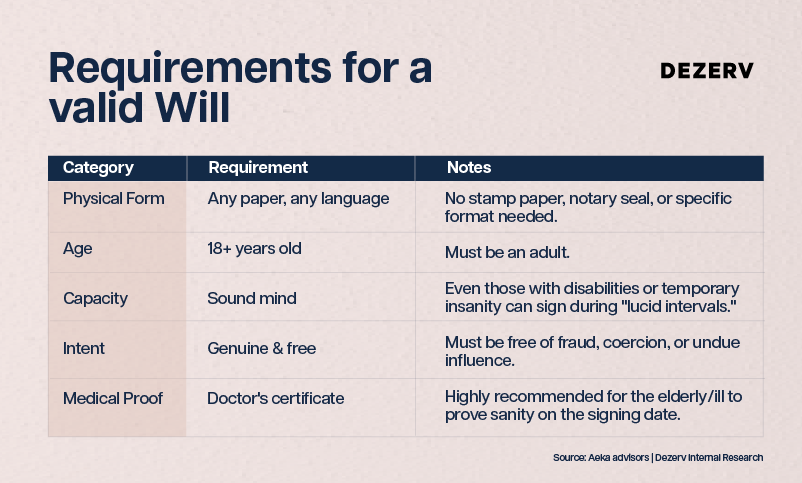
The requirements are far simpler than most people believe, which is partly why so many delay for no good reason. No stamp paper, no notary, no lawyer’s office, no specific format, and no registration needed. A Will written on plain paper in any language is legally valid as long as a few rules are followed precisely. Those rules are worth understanding clearly, because getting even one of them wrong can void the entire document in court.
1. Requirements for a valid Will
2. The signing process
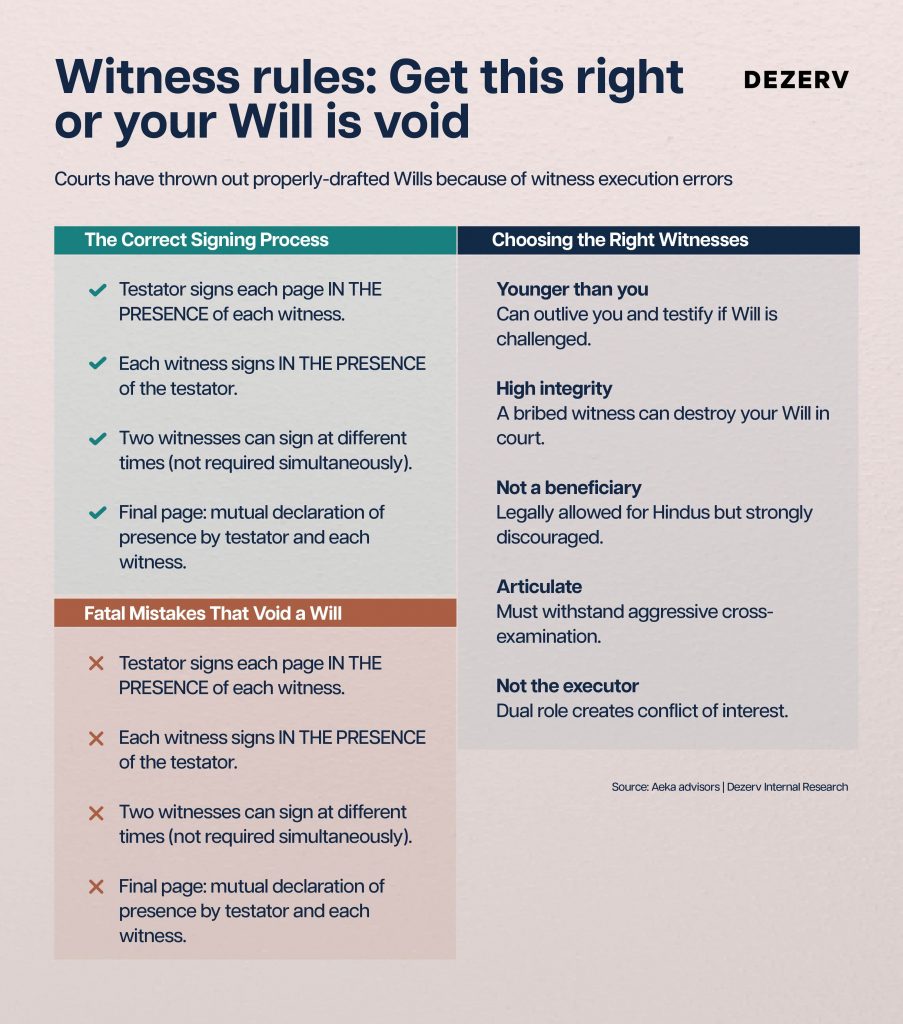
The execution is where most legal challenges occur. Follow this order strictly:
- Step 1: You sign the document while both witnesses are physically watching you.
- Step 2: Both witnesses sign the document while you are watching them.
Never have witnesses counter-sign later at their own homes. If they weren’t in the room when you signed, the Will is void.
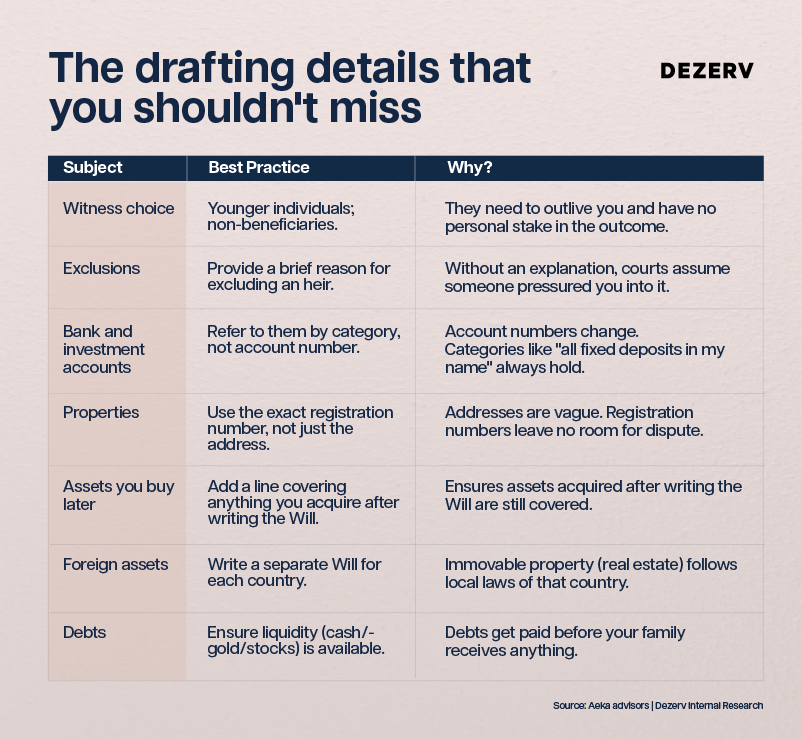
3. The drafting details that you shouldn’t miss
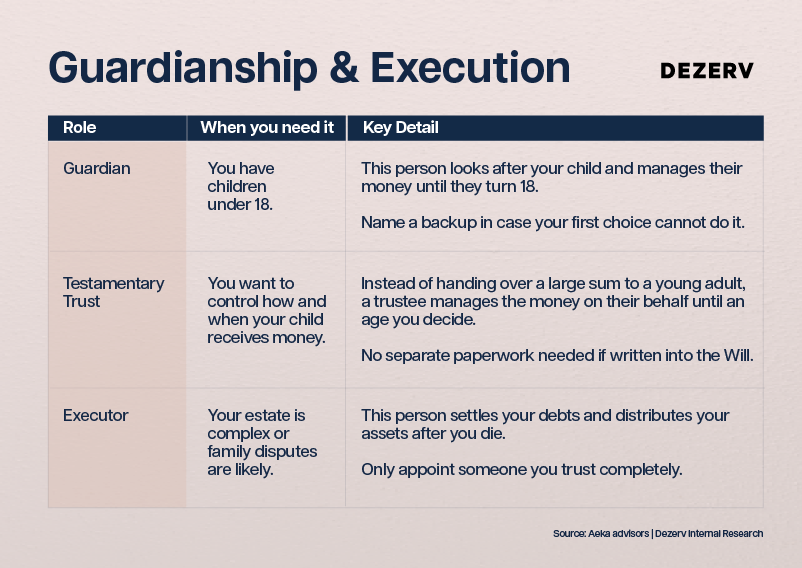
4. Guardianship & Execution
5. On registration and storage
Registration is optional, but if you are excluding a natural heir, if your estate is high-value, or if disputes are likely, it is worth doing. It keeps the original safe, reduces forgery allegations, and provides strong evidence of sound mind at the time of signing.
Whether or not you register, hand an original copy to each beneficiary directly, give notarized copies to your banks, and make sure everyone who needs to know the Will exists actually does.
After the Will: Keeping it protected & updated
A Will is not a one-time task. It is a living document that should be revisited whenever your life changes in a significant way. Marriage, the birth of a child, the death of a beneficiary, a major change in assets, a move abroad, or a change in who you have named as executor or trustee are all triggers to review the document. Note that in India, unlike in some other countries, marriage does not automatically revoke a Hindu’s Will. But it should still prompt a thorough review of every clause.
For minor updates, a codicil, which is a formal amendment executed with the same two-witness formality as the original, is sufficient. For structural changes, a fresh Will that explicitly revokes all previous Wills is cleaner and leaves less room for confusion in court. An unregistered later Will prevails over an earlier registered one, as long as it meets all the formal requirements.
One significant legal development from 2025 is worth knowing. The Repealing and Amending Act of 2025 removed Section 213 of the Indian Succession Act, which means probate is no longer mandatory for Hindus transferring assets under a Will, even in Mumbai, Chennai, and Kolkata where it was previously required by law.
In most cases, a copy of the Will and a notarized death certificate are sufficient to begin the transfer process with a bank or housing society. Contested Wills may still require court intervention, but for straightforward situations the administrative burden on your family is now materially lighter than it was a year ago.
Why Wills get challenged, and how to prevent it
Most Will disputes are not surprises. The same handful of reasons come up again and again in court, and every single one of them has a straightforward fix if you know to look for it.
The most common allegation is undue influence, which usually means a beneficiary was too involved in preparing the Will and someone else ended up excluded. The fix is simple: keep beneficiaries and their spouses completely out of the drafting and signing process. The next most common is mental incapacity, which gets raised when the testator was elderly or unwell at the time of signing. A doctor’s certificate obtained on the actual signing date makes this argument very difficult to sustain in court.
Vague drafting invites multiple interpretations, so use precise descriptions throughout. When property descriptions are imprecise, anyone with a competing claim has room to argue about what was actually meant. Specific survey numbers, account categories, and registration details leave no room for interpretation.
Witness irregularities follow the same logic: a witness who can be pressured, bribed, or discredited is a liability, so the integrity of the people you choose matters more than their availability. And forgery allegations, where someone produces an alternate Will after the testator’s death, are genuinely hard to disprove without registration. Registering the Will and distributing originals to multiple parties closes that door.
None of these risks are unavoidable. They are just things people do not think about until it is too late.
In conclusion
The best Will is one the whole family knows exists. A Will discovered months after a death, sitting in a locker no one knew about, creates exactly the ambiguity it was meant to prevent.
Starting this conversation with parents or a spouse does not have to be morbid. Frame it as an act of love, not a confrontation with mortality. Share a real example of what happens when a family has to navigate this without a Will.
Pick a moment after a celebration rather than a charged one. Lead by example by sharing that you have made or are making your own Will. If the conversation feels too personal, suggest involving a professional together. And make it urgent rather than heavy. The point is not to dwell on death but to remove a source of future stress so everyone can move forward.
Disclaimer – The information provided in herein is for educational purposes only and is as on date of the document. This document does not constitute legal advice. In this material, Dezerv has utilized information through publicly available sources, and other data deemed to be reliable. The information is not a complete disclosure of every material fact and terms and conditions. While reasonable care has been made to present reliable data in this article, Dezerv does not guarantee the accuracy or completeness of the data. Succession planning involving Wills is a legal process; we recommend consulting with a qualified legal professional or a specialized estate planning advisor before taking any action.