


On December 23, 1854, a farmer named Goryo Hamaguchi felt the ground shake in his village in Japan. When it stopped, he looked at the sea and saw something strange, the water was pulling back quickly, leaving boats stuck in the mud.
Most people in the village didn’t think much of it. But Hamaguchi remembered a warning: when the sea pulls back like that, a huge wave can follow. He predicted that a tsunami was coming.
There was no time to warn everyone. So Goryo did something drastic. He set fire to his own rice fields on the hill, his entire harvest. People saw the fire and ran up to help. As they reached the hill, the tsunami hit the village below and destroyed everything. But those who had climbed up survived. Hamaguchi wasn’t certain of Tsumani, but he saw the sign and acted on it immediately.
For most of human history, that’s what prediction was for – reducing risk, making better decisions, and surviving what was coming, in a world with no internet and very little information. That instinct hasn’t changed. But what we do with it has.
Today, predictions have become a product. There are platforms where you can put real money on real-world outcomes, elections, interest rates, sports, even something as absurd as whether the US will confirm the existence of aliens by 2027. These platforms operate like financial exchanges, and they have a name: prediction markets.
The pitch is simple: if you understand something better than others, you can make money. That appeal is genuine. But that conviction can quickly become entertainment, entertainment becomes thrill, and thrill becomes something harder to walk away from.
In this edition, we’ll cover:
- Why India’s own prediction market got raided and shut down
- How these platforms actually works and the risk of outcomes being gamed
- Who is really making money and who is losing it
- The insider trading problem that nobody wants to solve
- The psychology of people engaging with these platforms
- What the culture these platforms are building means for how you think about wealth
The same idea, different endings
The US has two dominant platforms, Kalshi and Polymarket. Both operate like financial exchanges, both allow you to bet real money on real world outcomes, and between them they executed $12 billion in trades across 2025.
Now India tried building its own version, but the government shut it down within years. Back in 2019, a Gurugram startup called Probo launched, allowing users to bet yes or no on cricket scores, election results, and budget decisions. It had over 20 million users at its peak, the appeal being obvious given a young population, rising smartphone penetration, and the human thrill of fast rewards. But the government saw it differently. The ED raided Probo in July 2025 and froze ₹284.5 crore in assets, concluding that the yes-or-no format was gambling dressed up in trading. Parliament passed the Online Gaming Bill 2025 shortly after, and Probo shut down, with ordinary users left with money stuck in accounts as legal proceedings dragged on.
What happened here is instructive: the line between investing and gambling is becoming harder to draw, and regulators around the world are drawing it in very different places.
How they actually work
A prediction market lists a question and every question has two outcomes: yes or no.
Will the Fed cut rates before June? Will this team win the championship? Will this country go to war? You pick a side and put money behind it.
What makes it more interesting than a simple bet is the pricing. Each outcome trades between 0 and 100, representing the probability the crowd assigns to it. If a contract is at 65, the market is saying there’s roughly a 65% chance it happens.
As new information comes in, people update their positions and the price moves. You don’t have to wait for the final outcome to make money. If you buy at 40 and it moves to 60, you can sell. Also platforms like Kalshi and Polymarket don’t bet against you. They match buyers and sellers and take a small fee. That’s what makes this feel more like a market than traditional betting.
But one thing that matters more than it seems is how outcomes are settled.
On Kalshi, results follow predefined rules and specific sources. On Polymarket, disputed bets are decided by voting. The votes are controlled by holders of a token called UMA, the more tokens you hold, the more power you have.
In March 2025, a $7 million bet on whether Ukraine would agree to a deal with Donald Trump jumped from 9% to 100% and settled as “Yes,” even though no official agreement happened. Some users claimed a large token holder influenced the vote. So if someone holds enough tokens, they can affect the outcome, even if reality says otherwise.
What matters isn’t just what happens, but how the platform defines and verifies it. That’s a meaningful risk you should understand before treating these markets as truth machines.
From a university experiment to a billion dollar industry
Before any of this was a product, it was an academic question: can a crowd of people, betting real money, outpredict experts?
In the late 1980s, economists at the University of Iowa built a small platform called the Iowa Electronic Markets. People could trade on election outcomes using real money. The result was surprising, the market beat leading polls, not because participants were smarter, but because they were expressing genuine, financially-committed beliefs rather than stated opinions. When money is on the line, people stop performing confidence and start revealing what they actually think.
Then In the early 2020s, two startups took this idea mainstream. Kalshi launched in the US with regulatory approval. Polymarket launched offshore and later paid a penalty for operating without approval.
Since then, growth has been rapid. Kalshi went from about $100 million in weekly volume to over $3 billion, a 30x increase in one year. Polymarket grew even faster, from $73M in trading volume in 2023 to ~$9B in 2024, roughly 120x in a single year.
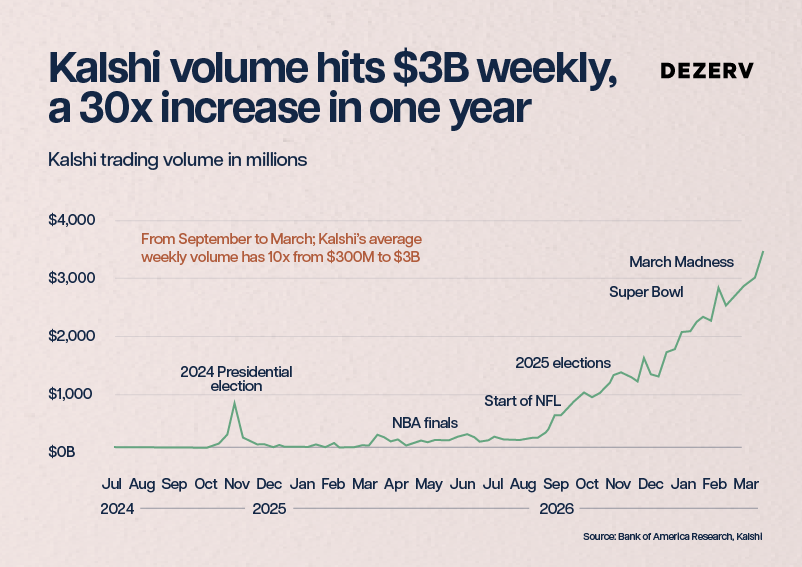
Sports drive most of the activity, accounting for around 80% of volume. And here’s what caught my attention recently: over a single week in April 2026, the IPL generated $100M in volume on Kalshi alone, more than the NHL and PGA Tour combined.
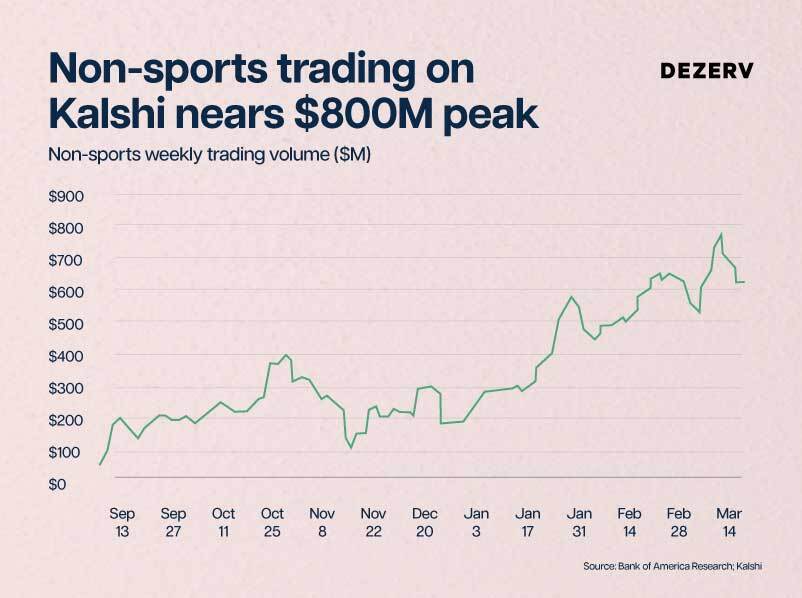
With matches airing in the US in the morning (a low betting window), demand filled the gap, showing people will bet on sports regardless of the timezone. Politics and macro events are catching up fast, from near zero to over $700 million in weekly volume in under six months. Sports bring people in, other categories keep them engaged.
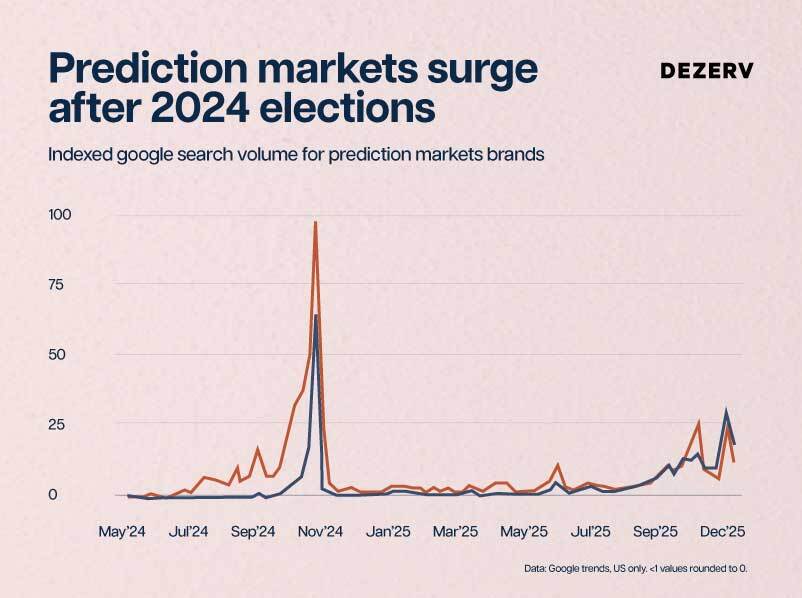
The 2024 US presidential election changed the narrative entirely. Both platforms called a Trump win well before the television networks did. Polymarket did nearly $11B in trading volume. CNN, CNBC, and Fox News signed partnership deals with Kalshi, putting its odds on screen during live broadcasts as though they were established data rather than betting lines. But one correct prediction doesn’t prove the model always works.
When the crowd gets It wrong
During the 2016 Brexit referendum, prediction markets were 80% confident that Britain would vote to stay in the EU. Britain voted to leave. The same year, markets gave Hillary Clinton up to a 91% odds of winning the US presidential election, and Trump won.
More recent data shows the same pattern. On Polymarket, about 1 in 3 markets were wrong. Accuracy was around 67%. Kalshi did slightly better at 78%.
The misses carry a financial cost too. On Polymarket, about 84% of traders are in the red. Smaller traders do the worst, with typical losses around 27%. Only very large traders (moving more than $500,000) tend to make money, and even they earn modest returns.
And yet, these platforms keep growing. That’s because losing here feels different. It doesn’t feel like luck, it feels like you were close, just slightly wrong. You can tell yourself you did the work and next time you’ll get it right.
That belief, that your judgment is the key, is what keeps people coming back, and what makes these platforms hard to walk away from.
Who is actually making money?
When you open platforms like Kalshi or Polymarket, it feels like you’re trading against someone with a different opinion. But often, you’re not. You’re trading against hedge funds running algorithms with better data, speed, and tools. They’re not guessing, they’re systematically making money from people who are. And the platforms rely on them to keep markets running.
There are also hidden costs. Fees on winning trades and bid-ask spreads reduce returns. For casual users, making consistent profits becomes very hard. On Polymarket, more than 2/3rd of all money won goes to just 740 accounts, out of over 2 million users.
There’s also a risk of manipulation. Big bets can move prices, which influences how other participants think and bet. When that happens, the “wisdom of crowds” starts to break down.
At the same time, something interesting is happening. Big institutions like Goldman Sachs and Wall Street are starting to watch these markets for signals, like inflation or interest rate expectations, similar to how they track the VIX. A former Fed official even said that for forecasting interest rate moves, Kalshi is already the most reliable real-time signal they have.
So the same platform that is taking money from retail users is simultaneously becoming a serious forecasting tool for the world’s largest financial institutions. That gap, between who it is sold to and who actually benefits, is probably the most important thing to understand about this industry.
The insider trading problem
Here is the paradox at the heart of prediction markets. The very thing that makes them powerful, that people with private information are incentivised to express it through prices, is also what makes them dangerous.
There have been at least two documented cases of this playing out. A trader made nearly $1 million on Polymarket by correctly predicting US and Israeli military strikes against Iran, winning 93% of their bets on operations that had not yet been announced publicly. In one case, someone placed $87,000 on a US strike and walked away with $515,000, with the bet placed 71 minutes before the bombs fell.
There is a real difference between someone who reads widely, thinks carefully, and forms an independent view, and someone betting on a military strike with a classified briefing in hand. The first is informed judgment; the second is a national security problem that happens to pay very well. Whether any platform rule changes are actually enforceable on an anonymous, offshore, crypto-based exchange is a question nobody has cleanly answered yet.
The psychology of a generation betting on the future
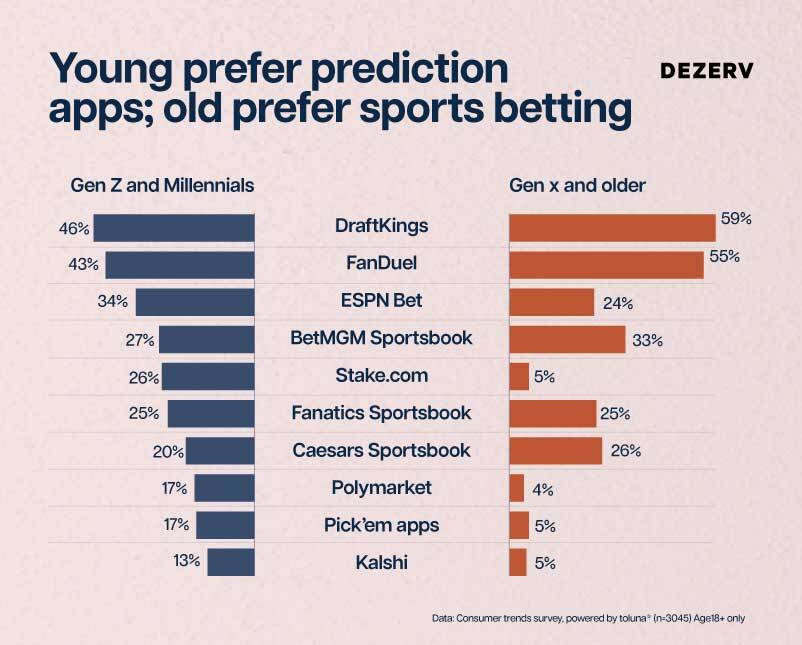
A lot of the people drawn to these platforms are young, and there’s a reason why. Many in their 20s and 30s feel like the usual paths to wealth aren’t working anymore. Housing is too expensive, and salaries haven’t kept up with living costs. Awareness also reflects this. Around 17% of Gen Z and Millennials have heard of platforms like Polymarket, and 13% know Kalshi. Among older groups, that drops to about 4–5%. This is largely a young person’s product.
And many think it will grow. In one survey, 31% of people said betting on everyday events will become more important over time.
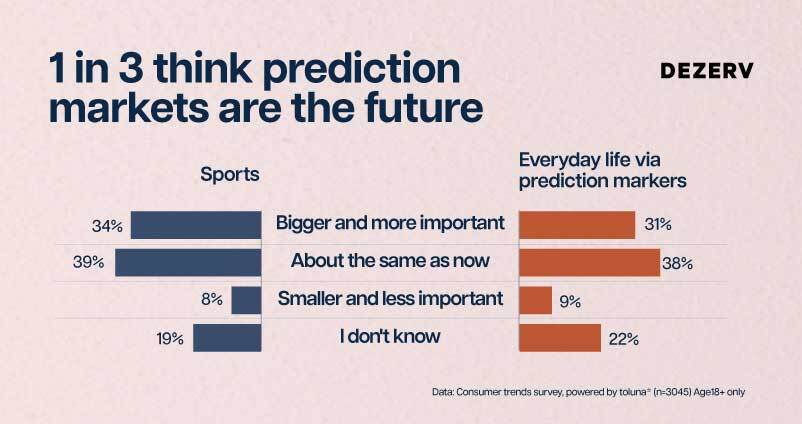
But look at what people are actually betting on. Things like whether Elon Musk will tweet a certain number of times in a week, or whether a specific politician uses a particular word in a speech. At one point, Coinbase CEO Brian Armstrong even played along, casually mentioning specific words like “Bitcoin, Ethereum, Blockchain, Staking, and Web3” during an earnings call because people had bet on them, affecting about $84,000 in wagers and then called it fun.
The broader cultural effect is subtler than individual gains and losses. When every unfolding event, an election, a military operation, a corporate announcement, is also a tradeable contract, it changes how people relate to those events. The incentive shifts from understanding what is happening and why, to correctly predicting what will happen and profiting from it.
What this means for how you read any market
The reason prediction markets are worth understanding has nothing to do with using them. It is because the mechanism behind them, crowds expressing private knowledge through money, is already present in every market you participate in.
Every time a stock moves sharply on no visible news, someone knows something you don’t. Every time a currency shifts before a central bank announcement, a belief is being expressed through a price. Prediction markets just made this visible in a new way.
But the same behavioural forces that make them interesting can be harmful. The urge to act on every signal, to treat every move as a bet, can slowly turn an investor into a speculator.
The serious question isn’t whether prediction markets are good or bad. It’s whether the broader culture they represent, betting on everything, financialising everything, treating uncertainty as entertainment — changes how you build wealth over time.
In a world that is trying to turn everything into a bet, not playing is also a choice.
Disclaimer -The information provided herein is intended solely for educational purposes. Neither Dezerv nor its affiliates endorse, promote, or encourage participation in any betting, gambling, or speculative gaming platforms. Gambling involves risk, and nothing in this material should be construed as an inducement or solicitation to participate in gambling, whether legal or illegal. Dezerv shall not be liable for any actions taken based on this content, or for any consequences arising from the use of, or reliance on, this material. In this material, Dezerv has utilized information through publicly available sources, and other data deemed to be reliable. All trademarks, logos, and brand names mentioned are used for identification purposes only and do not imply endorsement or recommendation.