


Every December 31st, the world celebrates. Fireworks. Resolutions. A fresh start.
And by January 2nd, most of those resolutions are already forgotten.
I have never understood this. Not because I have anything against celebrations. But because for anyone who builds something, runs something, earns something, or invests something in India, the real year does not start on January 1st. It starts on April 1st.
Think about it. Your salary resets on April 1st. Your tax year resets. Your company files its books by March 31st. Your appraisal cycle turns. Your bonus gets calculated. Every single financial event that actually shapes your life is indexed to the financial year. Not the calendar year.
Yet we pop champagne on January 1st and sleepwalk into April 1st like it is just another Monday. We ignore the date where everything that funds our lives, measures our progress, and determines our financial trajectory actually resets.
In a world obsessed with CYs, I want you to think in FYs.
This is the essay I wish someone had written for me twenty years ago. A case for treating April 1st as the most important day of your year.
As we step into a new financial year in 3 days, I want to challenge you to reframe how you look at the next twelve months.
In this edition, we will cover:
- The Personal P&L: Why tracking just your salary is a strategic error.
- The Balance Sheet You Never Made: Accounting for your hidden, off balance sheet risks.
- Opex Life vs. Capex Life: The single ratio that defines wealth creation.
- The Wealth Pursuits Matrix: A framework to audit how you manage your money.
- The One Capex Resolution: How to approach this April 1st differently.
Let us begin.
The Wrong New Year
Think about the sheer cognitive dissonance of the modern Indian professional. We spend December planning our personal lives and March stressing over our professional and financial realities.
By the time the financial year actually closes, we are too exhausted by tax season, board meetings, and performance reviews to step back and reflect. We survive March, breathe a sigh of relief in April, and let the cycle repeat.
What most people miss is that April 1st is the blank slate you have been waiting for.
It is the moment the counters reset to zero. The allowances refresh, the tax limits open up, and the structural design of your wealth for the next 365 days is established. If you are going to change the trajectory of your net worth, this is the window to do it.
To do that effectively, you need to stop viewing your personal finances as a collection of bank accounts and start treating yourself as an enterprise.
If Your Life Were a Company
Stay with me on this analogy. It is more useful than it sounds.
Every company, at the end of its financial year, produces two documents. A Profit and Loss statement that shows how it performed during the year. And a Balance Sheet that shows where it stands at the end of it. One measures flow. The other measures stock.
Most people, even very successful people, have never built either of these for their own lives. They have a vague sense of how the year went. They know their salary. They roughly know their expenses. They have a feeling about whether things got better or worse. But feelings are not financials. And a company that ran on feelings would not survive a single board meeting.
So here is what I would suggest. Before FY25 ends and FY26 begins, sit down and build your personal P&L.
Your Top Line
This is not just your salary. Your top line is everything you earned this year. Salary. Bonuses. Capital gains. Rental income. ESOP vestings. Freelance income. Interest. Dividends. The total productive output of your financial life in FY25.
Most people dramatically undercount this number because they only think in terms of monthly salary credit. But your top line is far more interesting than your CTC. It is the truest measure of your economic engine.
Your Bottom Line
Now subtract everything. EMIs. Lifestyle expenses. Insurance premiums. Taxes. School fees. Subscriptions. The annual holiday. The things you bought and have already forgotten about.
What is left? Did you run a surplus or a deficit?
And if you ran a surplus, where did it go? Into assets that will compound? Or into a savings account earning 3.5% while inflation ran at 4.5%? Because a surplus that sits in a low yield account is not a surplus. It is a slow leak. Your P&L might say you made money. Your balance sheet might say you quietly lost it.
A company that consistently grows its top line but cannot improve its bottom line has a cost problem. The same applies to you. And the first step to fixing it is seeing it clearly, which most people never do because they never build the statement.
The Balance Sheet You Never Made
Once you understand your cash flow, you have to look at your balance sheet.
Most wealth creators know their portfolio value, their real estate equity, and their outstanding mortgage. But that is only half the picture. A complete personal balance sheet has four quadrants. Two show up on your bank statements. Two never do, but matter just as much.
The alternative balance sheet
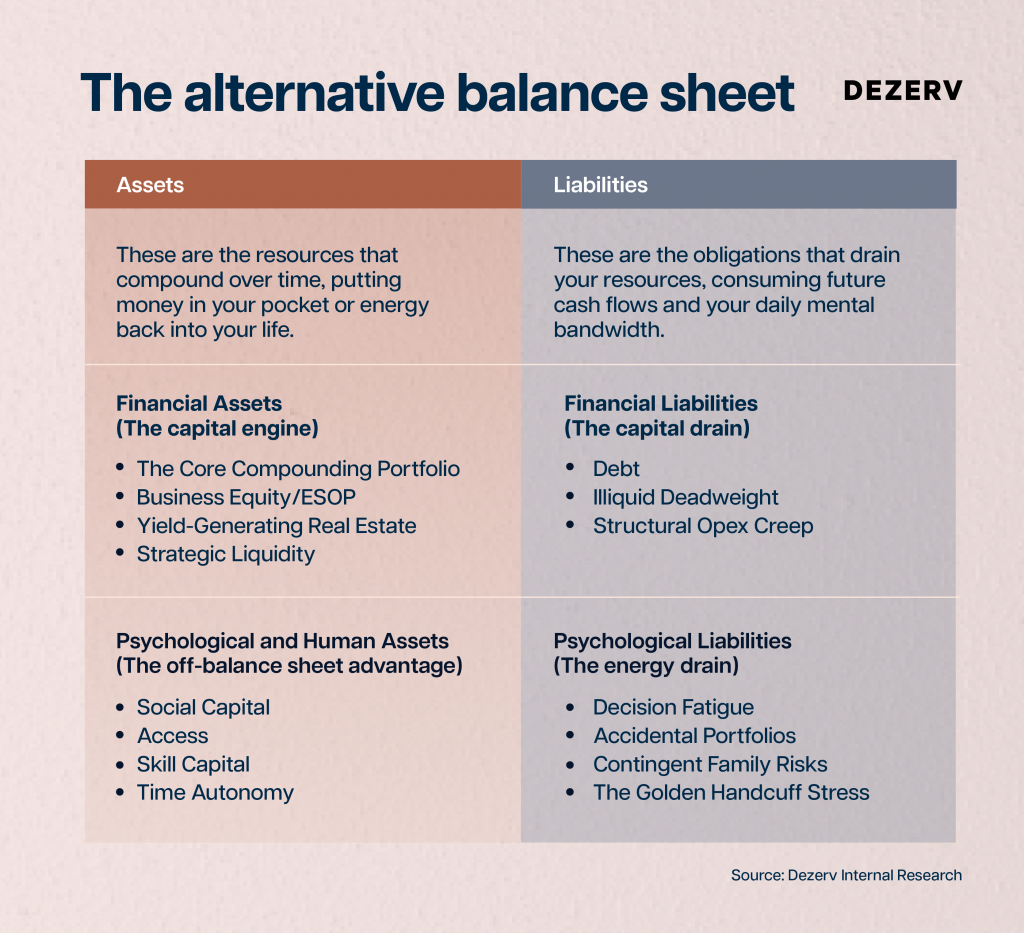
Financial Assets: The Capital Engine
Your core compounding portfolio. Business equity and ESOPs. Yield generating real estate. Strategic liquidity held not out of fear but out of optionality.
The honest question: did this engine grow in FY25 in real terms? After inflation at 4.5%, after taxes, after fees? A 10% headline return quietly becomes 4% once you strip those out. That is the number that matters.
Financial Liabilities: The Capital Drain
Debt is the obvious one. The dangerous ones are the liabilities you have normalised.
Illiquid deadweight: The real estate that generates no yield, has barely appreciated, and cannot be exited without a year long process. It sits on your balance sheet as an “asset” but behaves like a liability because it locks up capital that could be compounding elsewhere.
Structural opex creep: The lifestyle upgrades that quietly became permanent line items. The subscriptions, the club memberships, the second car. None are wrong individually. Collectively, they raise your baseline cost of living every year. A company would call this cost structure bloat. You should too.
Psychological and Human Assets: The Off Balance Sheet Advantage
These never appear on a bank statement. They are often the most valuable things you own.
Social capital: The relationships that open doors and create opportunities. Not networking for networking’s sake. The compound interest of trust built over decades.
Access: The ability to get into rooms, deals, and conversations that most people cannot. A pre IPO allocation. An introduction to a top fund manager. Access compounds, but only if you invest in maintaining it.
Skill capital: Expertise that increases your earning power over time. A new skill with a long half life, like understanding AI, is an appreciating asset. A skill becoming obsolete is a depreciating one.
Time autonomy: The most undervalued asset of all. The ability to choose how you spend your time. A founder who has built a team that operates without them has more time autonomy than a CXO chained to back to back meetings. Time autonomy is what converts money into quality of life.
Psychological Liabilities: The Energy Drain
These are the silent killers.
Decision fatigue: Managing a fragmented portfolio across five brokerage accounts, three insurance policies, and two PMS providers. Each micro decision feels small. Cumulatively, they drain the bandwidth you need for the decisions that actually matter.
Accidental portfolio: Most affluent Indians do not have a portfolio. They have an accumulation. A mutual fund the banker recommended. A stock a colleague tipped. A ULIP bought for tax saving in 2015 and never reviewed. This is not diversification. It is a liability disguised as one.
Contingent family risks: The estate plan that does not exist. The health insurance is not re-looked at since your income tripled. The aging parents whose medical costs are unplanned. In corporate finance, contingent liabilities can sink a company. These are yours.
The golden handcuff stress: Being trapped in a high paying role you have outgrown because your lifestyle depends on the income. Your salary is high. Your optionality is zero.
Net Worth = Assets minus Liabilities. Not just in rupees. In life.
Map yourself onto this framework. Be honest about what sits where. Because wealth creators often build massive financial assets while simultaneously accumulating off balance sheet risks that can wipe out their hard earned wealth
Opex Life vs. Capex Life
This brings us to the philosophical core of wealth creation.
Every decision you make with your time and money falls into one of two categories: Opex (Operational Expenditure) or Capex (Capital Expenditure).
An Opex life is one where your resources are entirely consumed within the current period. You spend money to maintain your current lifestyle. You spend time managing daily fires. The value is generated and immediately exhausted.
A Capex life is fundamentally different. It involves allocating resources today to build capacity for tomorrow. Capex decisions depreciate slowly and compound quietly over time.
A luxury vacation is Opex. Upgrading to the latest smartphone every year is Opex. Mindlessly scrolling through market news to feel productive is psychological Opex.
Setting up an automated, low cost investment system is Capex. Spending premium fees to hire a top tier tax consultant to restructure your holdings is Capex. Investing in your physical health through a disciplined routine is Capex.
The difference between wealth consumers and wealth creators is simply their Capex to Opex ratio.
The question is not whether you are spending your money and time. The question is whether your spending will show up as an asset on next year’s balance sheet, or if it will vanish the moment the financial year closes.
The Wealth Pursuits Matrix
To help you increase your Capex ratio, we need to audit how you interact with your financial life.
Recently, I was looking at how highly successful founders choose to spend their time. I adapted a framework that perfectly illustrates how you should approach your wealth management duties.
I call it the Wealth Pursuits Matrix.
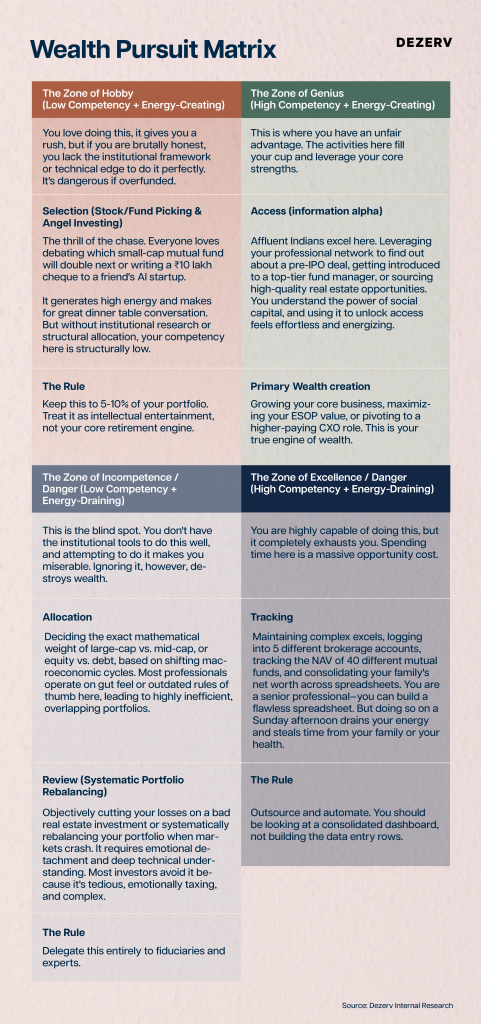
Most affluent professionals trap themselves in the bottom half of this matrix. They try to manage every granular detail of their wealth, assuming that control equals safety. It does not. It just equals exhaustion. And exhaustion is Opex.
One Capex Resolution
This April 1st, I suggest we skip the traditional, generic resolutions. Do not make a list of ten things you want to change about your budget.
Instead, make one Capex resolution.
Choose one single action that requires upfront effort or capital today, which will not necessarily pay off this quarter, but will compound massively over the next decade.
It could be consolidating your fragmented, legacy portfolio into a single, cohesive strategy. It could be finally drafting your estate plan and setting up a family trust. It could be moving yourself out of the Zone of Excellence by fully delegating your wealth management to an institutional team, freeing up 20 hours a month.
But it does not have to be financial.
It could be booking the comprehensive health checkup you have postponed for three years. It could be having the honest conversation with your spouse about money, goals, and what you actually want from the next decade. It could be building a system that buys back ten hours of your week so you can redeploy that time toward your Zone of Genius.
Capex is not just about money. It is about any decision that creates an asset on next year’s balance sheet.
Make that one commitment. Execute it in April.
Happy New Financial Year.
May your top line grow. May your bottom line grow faster. And may your balance sheet, the real one, the one that includes your health, your time, your relationships, and your freedom, be stronger on March 31st, 2027, than it is today.
Make this the year your Capex finally outweighs your Opex.
Disclaimer – Investment in the securities market is subject to market risks, read all the related documents carefully before investing. The information provided herein is intended solely for educational purposes and should not be construed as solicitation, advertising, or providing any financial or investment advice. Readers are advised to consult with their financial advisor before making investment decisions based on the information provided herein.
In the preparation of this document, Dezerv has used information developed in-house and publicly available information and other sources believed to be reliable. Dezerv, along with its directors, employees, or partners or any of its affiliates, shall not be held liable for any loss, damage, or liability arising from the use of this document. Additionally, all trademarks, logos, and brand names mentioned are the property of their respective owners and are used for identification purposes only. The use of these names, trademarks, and logos does not imply endorsement or recommendation.