
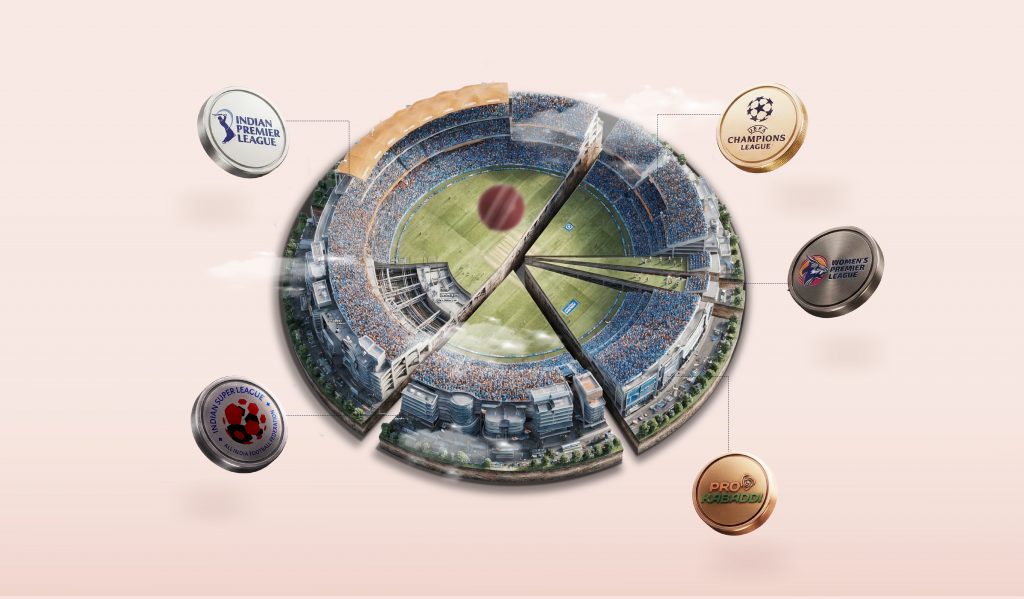

In 1923, a man named Edoardo Agnelli did something unusual for an Italian industrialist. His father had founded Fiat — Italy’s largest car company. The family was already one of the wealthiest in Europe. But Edoardo didn’t buy another factory or expand into a new market. He bought a football club in Turin called Juventus.
A hundred and two years later, the Agnellis still own Juventus. Four generations. Through two world wars, fascism, corporate scandals, a billion-dollar inheritance dispute, and the complete reinvention of the automobile industry. Fiat merged into Stellantis. Brands came and went. But Juventus endured, and became the emotional anchor of the dynasty. The family’s net worth today is estimated at $20 billion. The club has won 36 league titles.
Now here’s what I find fascinating. The same year Edoardo Agnelli bought Juventus, the Maharaja of Patiala, Bhupinder Singh, was doing something remarkably similar eight thousand kilometres away. He was funding India’s cricket tours to England, maintaining polo teams that drew over 150,000 spectators, and using sports patronage to build political influence with the British.
In 1910, after an Indian revolutionary assassinated a British official, Bhupinder Singh financed and personally captained the All India Cricket Tour of 1911 to England, using a sports team as a diplomatic instrument.
Sports ownership as a vehicle for power, wealth, and legacy isn’t a 21st century invention. Indian families were among the world’s earliest practitioners. What’s changed is the scale, the economics, and who gets to participate.
In this edition, we’ll cover:
- Why sports franchises are quietly outperforming traditional asset classes
- India’s 130-year history of sports ownership — from maharajas to billionaires
- How India’s ultra-wealthy are building global sports empires
- The revenue engine behind every franchise
- Why a family from Indore now co-owns a sports team with Amitabh Bachchan
Let’s dive in.
India’s original sports franchise owners
Most people trace Indian sports franchise ownership to 2008 and the launch of the IPL.
The real story starts much earlier.
By the late 1800s, Indian maharajas had turned sports patronage into a sophisticated tool of power. The Maharaja of Natore in Bengal recruited cricketers from across India to build a squad capable of beating the Patiala side — essentially India’s first franchise rivalry, fuelled by inter-princely competition.
Ranjitsinhji, the Maharaja of Nawanagar, played for England against Australia in 1896 — a prince who used sporting excellence on foreign soil to build personal brand and political leverage. The Ranji Trophy is named after him.
The Maharajas of Jodhpur, Jaipur, and Patiala maintained polo teams as extensions of their royal identity; the Indian Polo Association, established in 1892, was one of the country’s earliest formal sports bodies, entirely driven by princely wealth.
After independence, the baton passed to industrialists. Sir Dorabji Tata single-handedly funded India’s first Olympic contingent to Antwerp in 1920 and the second to Paris in 1924. He became the first president of the Indian Olympic Association. The Tata Sports Club, established in 1937, produced players for India’s gold-winning Olympic hockey teams. Cricketers like Ravi Shastri, Dilip Vengsarkar, and Sourav Ganguly all played for Tata-backed teams.
The corporate teams that followed — at Tata, Railways, Air India — were proto-franchises: they employed players, built stadiums (Tata Sons helped fund the construction of Brabourne Stadium in Mumbai), and proved that sports could be a vehicle for brand identity and national influence.
Then came 2008.
The IPL married this centuries-old Indian tradition with the American franchise model. What followed was the most explosive growth in sports franchise value the world has seen.
Sports teams are the new real estate
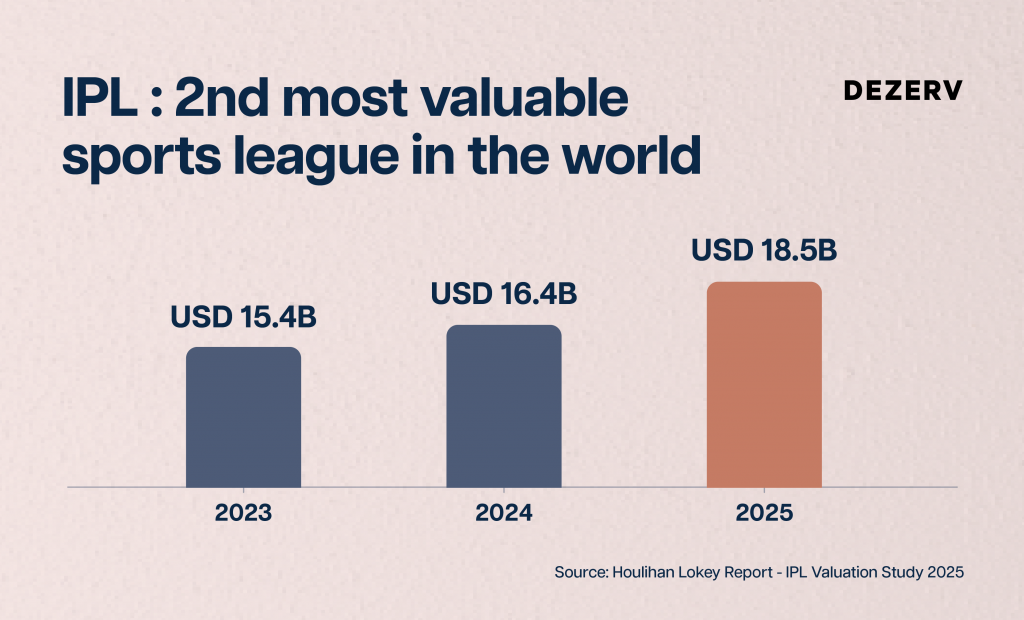
The IPL’s business value has surged to $18.5 billion, up 12.9% in a single year. Its brand value alone stands at $3.9 billion, up 13.8%. That places the IPL comfortably among the top five most valuable sports leagues in the world.
What makes this more interesting than just a headline number is the structure underneath it. Top IPL franchises now clock ₹650–700 crore in annual revenues, with up to 80% visibility secured before the season even begins, a combination of locked-in media rights, pre-committed sponsorships, and guaranteed central pool distributions.
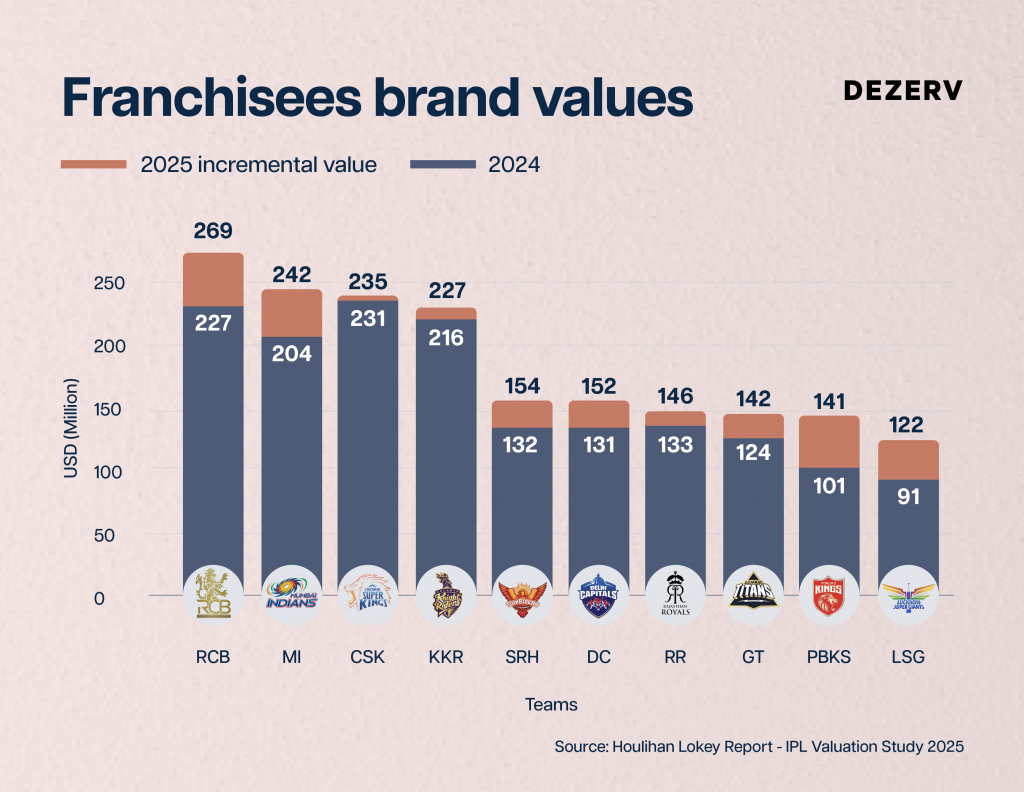
The franchise-level appreciation tells the same story. When RCB won their first maiden title their brand value surged to $269M, up 18.5% in one year. This established RCB as the no. 1 IPL brand in 2025.
Cricket in India was never just a sport. It is the closest thing this country has to a shared religion, a ritual that cuts across language, class, and geography in a way that almost nothing else does. The IPL understood this from day one and built a product designed to intensify that obsession: shorter format, city identities, local heroes, prime-time scheduling. Seventeen years later, the numbers reflect what that bet produced.
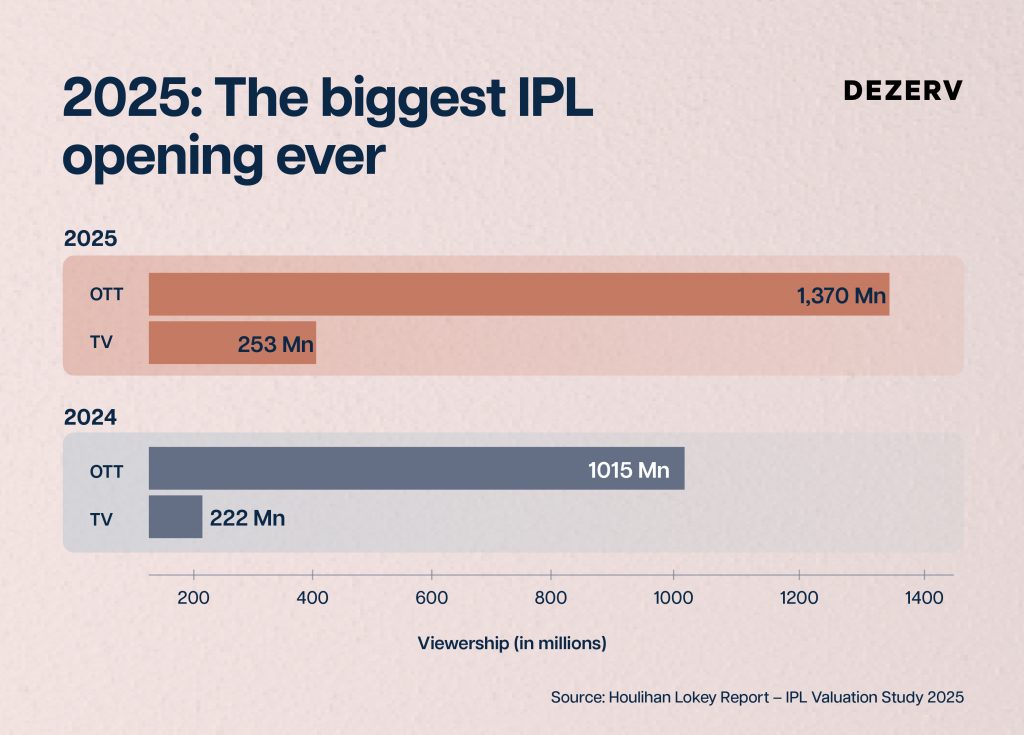
In 2025, the league drew 1,370 million views on JioHotstar, up 35% year-on-year, alongside 253 million unique television viewers on Star Sports. To put that in context: the IPL’s opening weekend now draws more eyeballs than the Super Bowl draws in its entirety.
India’s billionaires are building sports empires
Most people know Mukesh Ambani owns Mumbai Indians. Here’s what they don’t know: he owns six cricket teams across five countries, controls India’s football league infrastructure, holds a 49% stake in a franchise in England’s The Hundred, and was reportedly in the running to buy Liverpool FC.
Mumbai Indians (IPL), MI Women (WPL), MI Cape Town (SA20), MI Emirates (ILT20), MI New York (MLC), the Oval Invincibles (The Hundred) — plus Reliance’s Football Sports Development Limited which commercially runs the Indian Super League.
This isn’t just team ownership but a global sports conglomerate. The Mumbai Indians franchise alone carries a brand valuation of $242 million, second only to RCB in the IPL ecosystem.
Shah Rukh Khan’s Knight Riders group has taken a different but equally sophisticated approach. KKR in the IPL, Trinbago Knight Riders in the Caribbean, LA Knight Riders in Major League Cricket, Abu Dhabi Knight Riders in the ILT20, same brand identity, four continents. This is franchise-as-a-platform thinking, where the brand travels across leagues.
The quieter expansionists are just as strategic. Sanjeev Goenka’s RPSG Group owns Lucknow Super Giants, Manchester Originals in The Hundred, and Mohun Bagan Super Giant in the ISL. Kalanithi Maran’s Sun Group bought Sunrisers Hyderabad, then Sunrisers Eastern Cape in the SA20, and recently acquired a 100% stake in Northern Superchargers in The Hundred. The JSW Group, led by the Jindals, holds Delhi Capitals, Bengaluru FC, and sponsors a roster of Olympic athletes.
And the crossover into international football has already begun. VH Group from Pune became the first Indian owner of an English Premier League club when they acquired Blackburn Rovers in 2010. Lakshmi Mittal holds a stake in Queens Park Rangers.
What struck me, looking at this landscape, is the sophistication. These aren’t impulsive trophy purchases. Indian billionaires are applying the same diversification logic to sports that they apply to their business empires, spreading across geographies, sports, and leagues. They’re buying into emerging leagues early, riding the valuation wave as media deals mature. It’s portfolio construction, not fandom.
Follow the money: How sports franchises actually make money
A sports franchise generates revenue the way a premium hotel does — from many doors at once. And just like a hotel, the most valuable revenue streams are often invisible to the spectator.
Media rights are the foundation. The IPL’s domestic media revenues for 2026 are projected to cross $1.2 billion. In 2025, IPL advertising revenues hit $600 million — a 50% jump year-on-year. The Tata Group extended its title sponsorship through 2028 in a $300 million, five-year deal. These are locked-in, multi-year contracts — annuities that underpin every franchise valuation.
Sponsorships and advertising are the amplifier. BCCI’s sale of just four IPL associate-sponsor slots in 2025 generated ₹14,850 crore — a 25% increase from the previous cycle. Every jersey, boundary board, strategic timeout, and digital overlay is monetised. Mumbai Indians alone signed a ₹120 crore kit deal with Lauritz Knudsen, a three-year commitment from a European industrial brand.
Matchday revenue and hospitality are the lifestyle layer. Premium boxes, VIP experiences, exclusive fan zones — this is where sports intersects with the world our readers know well.
Merchandising and licensing extend the brand. Apparel, co-branded products, digital collectibles — the team becomes a consumer brand. Top IPL franchises are already testing this with creator collaborations, regional-language fan content, and early moves toward gamified loyalty programs.
Player development and trading is the hidden upside. The November 2024 IPL mega-auction saw ~$76 million spent on 182 players. Rishabh Pant went for ₹27 crore. Shreyas Iyer for ₹26.75 crore. These aren’t expenses — they’re assets on a franchise’s balance sheet.
Stack these streams together and a sports franchise starts looking less like an entertainment expense and more like a diversified operating business. The league contributes over ₹11,500 crore to India’s GDP annually. The league’s ecosystem generated $9.5 billion in total revenue in 2024. These aren’t vanity metrics. This is real economics.
The velvet rope is coming down
For decades, sports franchise ownership in India belonged to a very small club. Ambanis, Jindals, Goenkas. You needed ₹7,000 crore to get a seat at the IPL table. But something interesting is happening. The entry barriers are falling.
India now has professional franchise leagues in cricket (IPL, WPL, ISPL), football (ISL), kabaddi (Pro Kabaddi League), badminton (PBL), and most recently, pickleball.
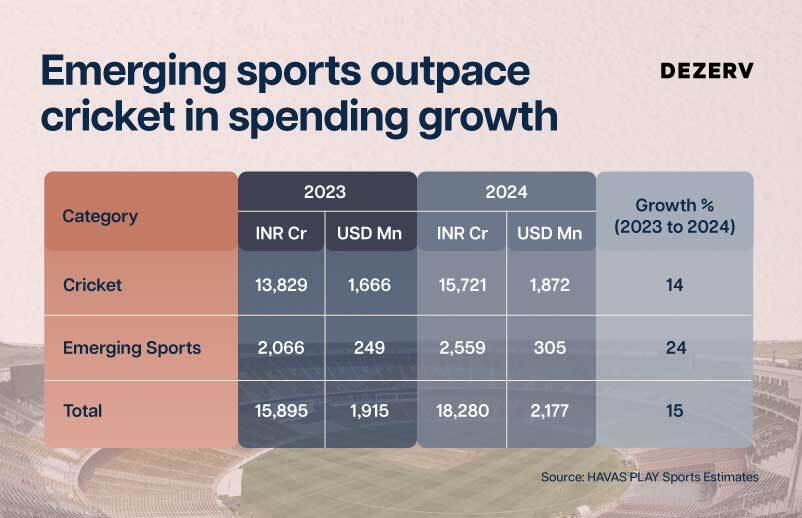
The numbers are striking: the non-cricket sports economy now contributes 14% of India’s total sports spending, roughly ₹2,559 crore, and is growing at 24% annually. For context, cricket’s growth in the same period was 14%. The challenger sports are moving faster than the incumbent. Every new league creates a new tier of entry for aspiring sports owners.
The Pro Kabaddi League now draws 350 million viewers per season — 310 million on TV, 40 million on OTT — with franchise valuations ranging from ₹150–250 crore. The Indian Super League attracts 232 million viewers, with ISL franchises seeing 20–30% annual sponsor growth. The Women’s Premier League, launched just two years ago, already draws 130 million viewers and registered 42% year-on-year viewership growth in 2024.
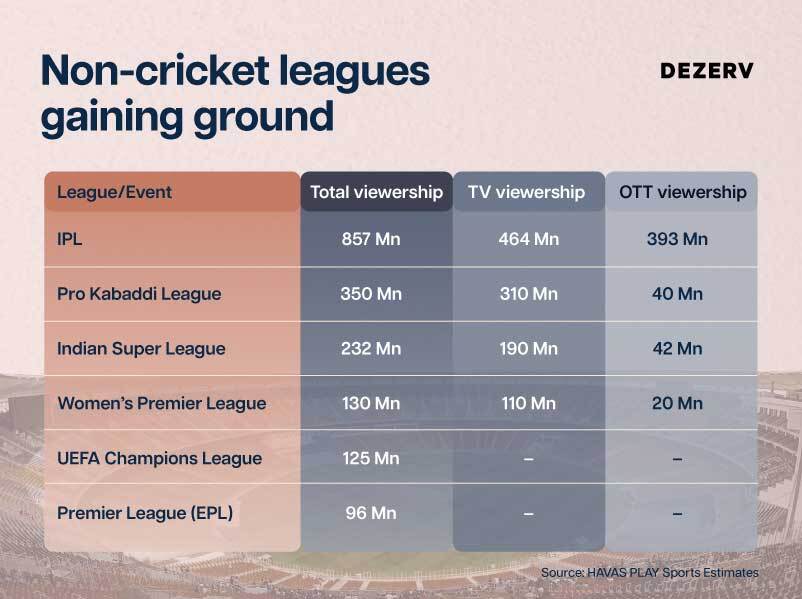
These three leagues together — PKL, ISL, WPL — represent a combined audience of over 700 million viewer interactions a season. No media property in India outside the IPL and news television comes close.
Consider the Indian Street Premier League.
The ISPL is India’s first tennis ball T10 cricket tournament, born out of a talent hunt in the Dharavi slums. Six teams, each with a celebrity owner. One of those teams — Majhi Mumbai, the 2025 champions — is co-owned by Amitabh Bachchan and Neeti and Nipun Agrawal, directors of PATH India Limited, a construction company headquartered in Indore.
The total investment flowing into ISPL has crossed ₹1,165 crore. But the individual team economics are a different universe from the IPL — Majhi Mumbai spent ₹84.30 lakh at its debut player auction. This is the story within the story. A family from Indore, running an infrastructure business, co-owning a championship-winning sports team
(Majhi Mumbai) with one of India’s biggest film stars. Five years ago, they would not have been part of this conversation. The league is now planning a Middle East edition.
And then there’s pickleball, currently the fastest-growing urban sport in India, with over 100,000 regular players across 17 states, with projections targeting one million by 2028. India now has not one but two franchise-based pickleball leagues (The World Pickleball League and The Indian Pickleball League). The sport is popular with people of all ages, and support from companies and local communities has helped more people notice it.
The entry price for pickleball is a fraction of cricket. But the playbook is identical: franchise-based, city-identified, media-backed, celebrity-anchored. The IPL template is being replicated across a widening set of sports. India’s sports sector is projected to reach $130 billion by 2030 at a 14% CAGR, with core and allied sub-sectors — from nutraceuticals to sports technology — expected to contribute equally to the sporting economy.
What the IPL did for cricket in 2008, newer leagues are doing for a broader set of sports and a broader set of owners. The funnel is widening, fast.
In summary
When Edoardo Agnelli bought Juventus in 1923, it wasn’t about owning a football club. It became something that defined the family for generations. A hundred years later, the Maharaja of Patiala’s legacy lives on in the Ranji Trophy, and the Tatas’ sporting investments are woven into the fabric of Indian athletic history.
Sports ownership was never about the trophy in the cabinet. It was always about legacy, influence, and increasingly, extraordinary wealth creation.
Three things to take away:
1. Sports franchises are a legitimate asset class. With 14%+ annual compounding over two decades globally, they’ve outperformed public equities. The combination of scarcity, guaranteed media revenues, and institutional capital is creating a valuation flywheel.
2. Indian billionaires are building global sports portfolios. Ambani’s six-team, five-country cricket empire. SRK’s four-continent Knight Riders brand. The Goenkas, Marans, and Jindals expanded across leagues and geographies. This is diversification with strategic intent.
3. The ownership circle is expanding. New leagues, new sports, and dramatically lower entry points mean that sports franchise ownership is no longer the exclusive preserve of the top 100 richest Indians. From pickleball franchises to tennis ball cricket tournaments, a new generation of wealth creators is entering the game.
The Maharaja of Patiala would have recognised the impulse. Economics would have delighted him.
Disclaimer – The information provided herein is intended solely for educational purposes. In this material, Dezerv has utilized information through publicly available sources, and other data deemed to be reliable. All trademarks, logos, and brand names mentioned are used for identification purposes only.