

I was scrolling through X late at night — a habit I usually try to break before bed — when a data set stopped my thumb mid-scroll.
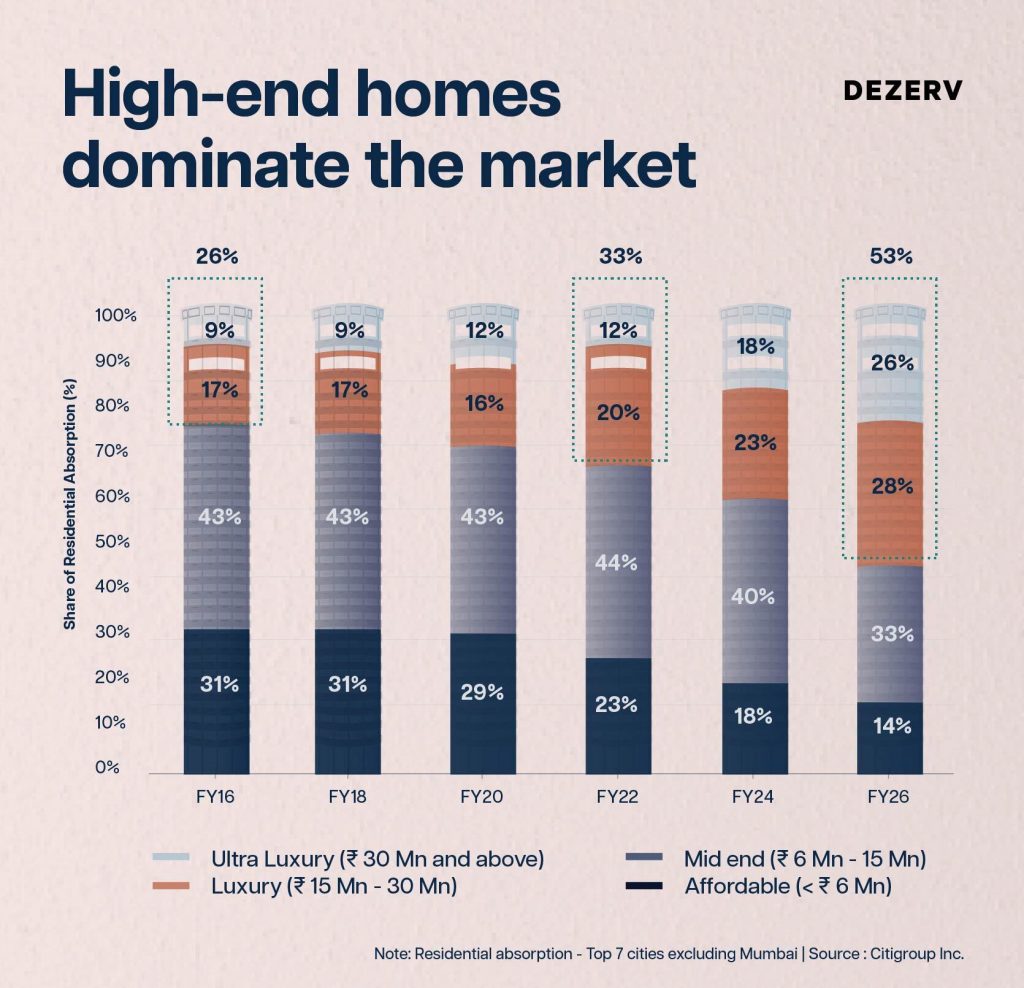
In FY26, over 50% of homes sold across India’s top 7 cities (excluding Mumbai) were priced at ₹1.5 crore or higher.
Think about that for a moment. For decades, “affordable housing” was the centrepiece of every urban policy debate in India. Subsidies, priority lending, government schemes — the entire system was built around the premise that India was a nation of budget buyers. That narrative is dead.
In FY16, the affordable and mid-end segments powered 74% of residential absorption. Fast forward a decade to FY26, luxury and ultra-luxury represent 53% of the market. The affordable segment’s share has been cut in half. Ultra-luxury demand has nearly tripled.
But here’s what’s most interesting to me: the real story isn’t that Indians aren’t buying homes. It’s that the profile of the Indian who is buying has changed entirely. And the second-order effects of that shift — on rents, on banking, on cities themselves — are still underappreciated.
In this edition, we’ll cover:
- The structural shift from a volume-led to a value-led market
- What’s really driving the luxury boom — GCCs, ESOPs, and a new class of wealth
- Why affordable housing is quietly disappearing from Tier-1 supply
- The rent paradox: rents up 24%, yields flat
- Why banks are writing bigger cheques to fewer people
- What all of this means for your portfolio in 2026
Let’s begin!
The volume – value reversal: a market splitting in two
For most of India’s post-liberalisation history, residential real estate was a volume story. Build as many homes as cheaply as possible, and the market would absorb them. That model worked in an economy where most households earned below ₹15 lakh a year, saved aggressively, and viewed homeownership as the primary financial milestone.
That thesis has broken. The market today is both cooling and booming — depending entirely on which segment you examine.
The mid-range segment (₹50L– ₹1Cr), once the core of India’s housing market, is down 40% year-on-year in sales. Affordable housing has almost disappeared from Tier-1 cities. In contrast, homes priced above ₹1.5 crore are still growing, with the ₹3 – ₹5 crore segment up 14%.
The demand is migrating. The buyer who can afford to buy has moved up the price ladder. The buyer who cannot has been priced out entirely.
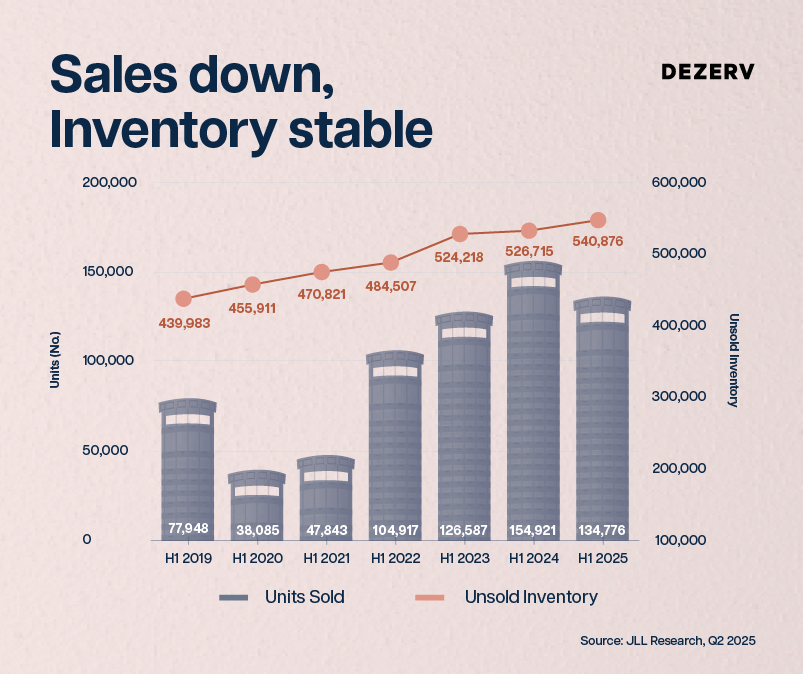
The supply-demand data reinforces this divide. Developers, still operating on the optimism of prior years, continue to launch. But mid-market absorption has slowed. The system is no longer clearing inventory at the same pace.
At the aggregate level, the slowdown is visible.The RBI’s House Price Index shows annual nationwide price growth decelerating from 7% to 2.2% by Q2 FY2025–26. By conventional metrics, momentum has faded. And for a large portion of the market, it has.
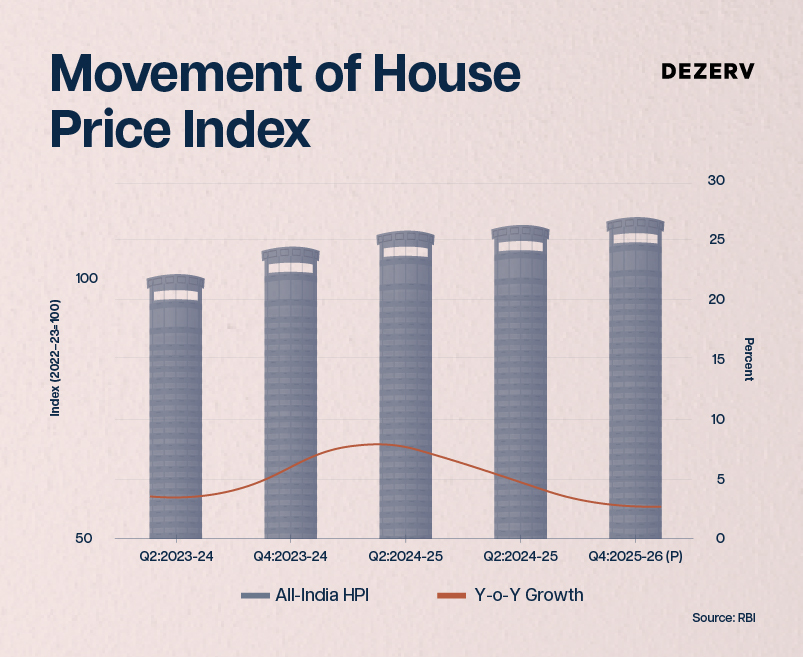
But averages mask composition. When high-value transactions dominate deal flow, the average price rises — even if underlying breadth is weakening. That is precisely what we are seeing. Transaction data across leading cities shows rising average ticket sizes, driven by a narrower cohort: GCC professionals, liquidity-rich founders, and HNI investors operating at the premium end.
The buyer profile has fundamentally shifted. Rate-sensitive middle-class demand has retreated. What remains is a thinner, wealthier cohort that is less bothered by EMI calculations and more focused on asset quality, location, and long-term capital appreciation. The market has not crashed. It has simply gotten more exclusive.
The three engines powering the luxury boom
Every market cycle has a structural driver. This one has three, and they are reinforcing each other in ways that I don’t think are fully appreciated yet.
1.The rising income inflection
There is a precise economic threshold behind the luxury housing surge — and it is not arbitrary. Historically, when per-capita GDP sits below $2,500, spending is almost entirely captured by needs: food, basic shelter, and essentials. India currently sits at approximately US$2,500 per capita. We are right at the inflection point.
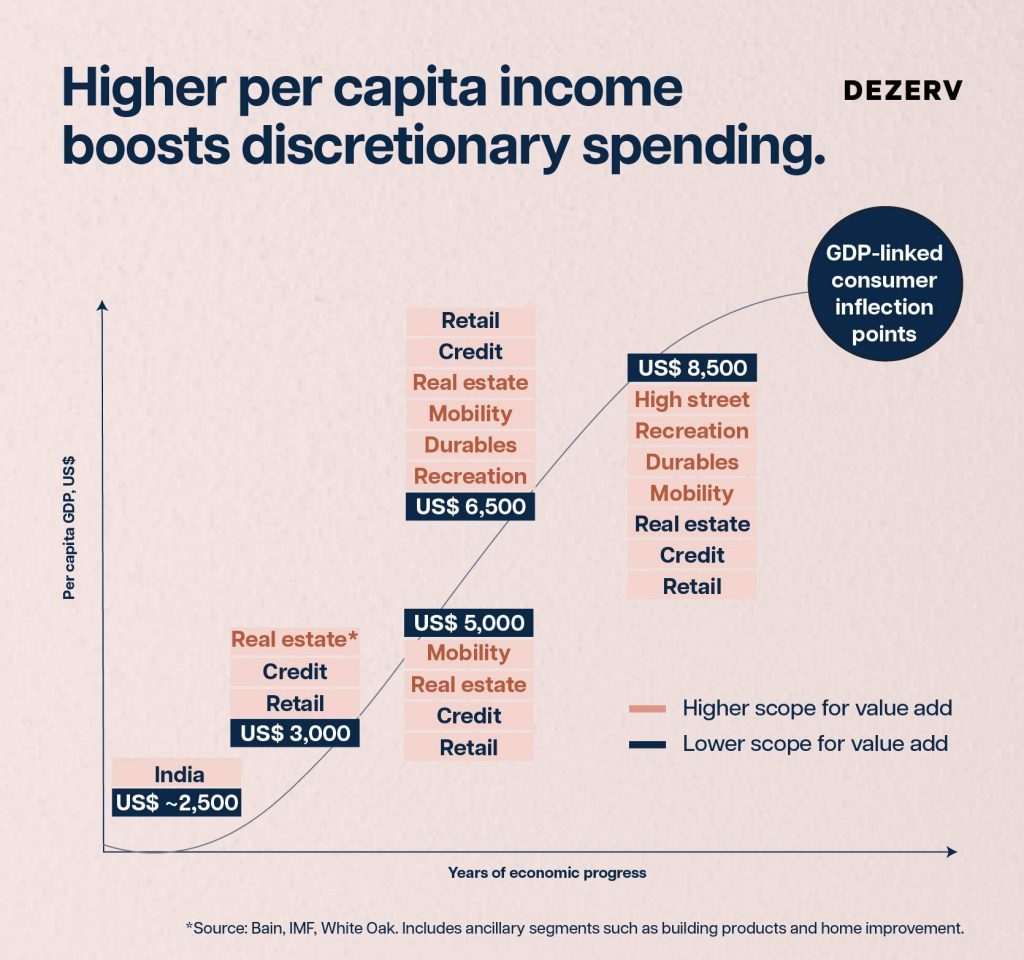
Once incomes cross the $3,000 mark, the housing and home-upgrade cycle does not grow linearly — it explodes. At this level we see a massive acceleration toward real estate and ancillary segments — including building products and home improvement. This also explains why luxury housing is currently defying broader market trends.
The demand base itself is deepening. India now has over 13 lakh HNIs. And wealth remains highly concentrated — the top 1% of households control nearly 60% of total wealth, according to the Bernstein report 2025. That concentration matters.
Dual-income nuclear families, tech-driven entrepreneurship, and GCC-linked compensation structures are expanding the pool of households with genuine surplus capital. We are moving from a nation of savers to a nation of sophisticated consumers — and that shift is arriving faster than most supply-side analysis accounts for.
2. The GCC flywheel
A tech lead at a Bengaluru GCC (Global Capability Centres) may earn around ₹25–60 lakh a year. She isn’t buying what her parents bought. She wants a gym, a co-working lounge, EV charging, and smart-home automation. Not as upgrades — as baseline expectations. This demand isn’t aspirational. It is income-driven.
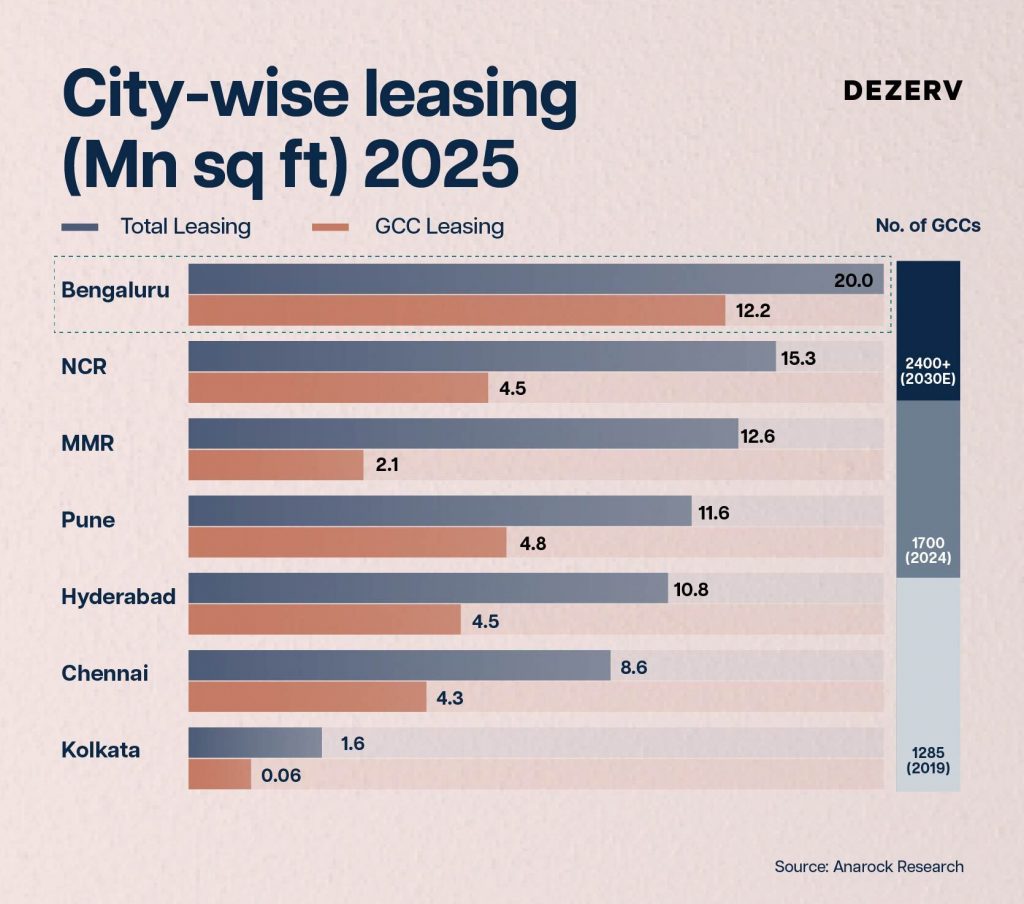
Nearly 2 million people work in India’s GCC today. By 2030, that number will touch 2.8 million. These aren’t back-office roles anymore — global companies are planting their actual nerve centres here. R&D, product, strategy. The GCC count has jumped from 1,285 in 2019 to over 1,700 today, heading past 2,400 by decade’s end.
Bengaluru alone captured more than one-third of the country’s total GCC leasing in 2025. The flywheel is spinning. And what it’s producing, at scale, is a new kind of homebuyer — one the Indian residential market is still learning to serve.
3. The ESOP and IPO effect
India’s startup ecosystem has quietly created its first generation of genuine early-stage wealth. ESOP liquidations — which we’ve analysed at a ₹14.2 lakh crore opportunity — and IPO proceeds have created a buyer who doesn’t need a 20-year home loan. They can put down 50% upfront or pay outright.
Swiggy’s 2024 IPO alone unlocked $1 billion for over 5,000 employees. Zomato, Nykaa, Policybazaar together added another $3.3 billion. These are not small numbers. A portion of that liquidity is finding its way into real estate — specifically, the premium tier.
This cohort is skipping the starter home entirely and entering the market at the luxury rung. It is a fundamentally new buyer pattern in India.
4. Post-COVID psychological shift
Post-pandemic, the psychology of the Indian buyer has shifted from need to aspiration. The home is no longer just a place to sleep; it is a multifunctional space that must accommodate a home office, a gym, and a creative studio.
But it goes deeper than function. There’s an emotional recalibration happening. People who spent months locked inside their homes came out the other side with a sharper sense of what they actually wanted their lives to look like — and the home became the primary canvas for that
Why affordable housing Is quietly disappearing
The affordable segment’s share of demand has collapsed from 52% in 2018 to just 17% today. At the same time, new launches in this category are down 28%.
So It’s not just a demand problem. India has tens of millions of households who want to buy an affordable home. It is a supply problem driven by the economics of building one.
Since 2020, construction costs have surged 35–40%. Land now accounts for 30–50% of total project costs in major cities, and because Indian banks cannot fund land acquisitions, developers borrow privately at 18–22% annual interest. To justify that cost of capital, they must build units commanding a high per-square-foot price.
The government’s own definition of “affordable housing” — capped at ₹45 lakh — has become dangerously outdated. Finding a decent 2BHK below that threshold in Bengaluru, Pune, or Delhi NCR is nearly impossible today. Yet cross that threshold and developers lose their GST benefit, dropping from 1% to 5%. With margins already thin, the rational decision is to stop building.
The deeper consequence is urban stratification. Essential workers are being pushed to the periphery, commuting further for the same jobs that are generating the luxury demand they cannot access.
Why can’t we just build more?
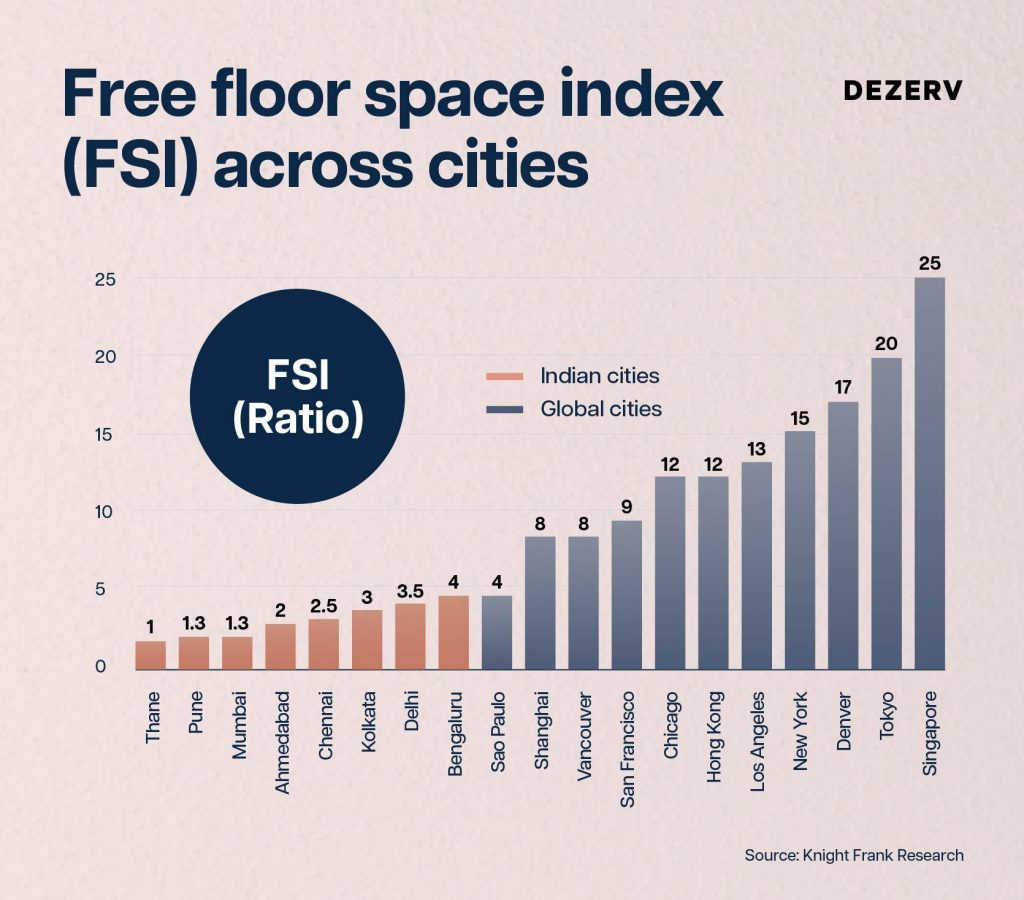
The constraint in India is not land. It is a lack of FSI — Floor Space Index, the ratio which determines how much can be built on a plot. And by global standards, India is severely restricted. India’s major cities operate with some of the lowest FSI ceilings in the world.
Low FSI forces sprawl. Developers move outward where land is cheaper, but infrastructure lags. Core city land becomes artificially scarce — and therefore unaffordable.
And when core-city supply is structurally constrained and ownership becomes unaffordable, households don’t disappear — they shift to renting. Every household priced out of buying becomes a long-term renter.
Low FSI forces sprawl. Developers move outward where land is cheaper, but infrastructure lags. Core city land becomes artificially scarce — and therefore unaffordable.
And when core-city supply is structurally constrained and ownership becomes unaffordable, households don’t disappear — they shift to renting. Every household priced out of buying becomes a long-term renter.
The rent paradox
So If you’re a landlord right now, the headline numbers look excellent. Rents were up 23.6% year-on-year as of Q4 2025. Delhi led at 27.8%, Kolkata at 39.6%, Mumbai at 19.3%. That is extraordinary rent inflation by any measure.
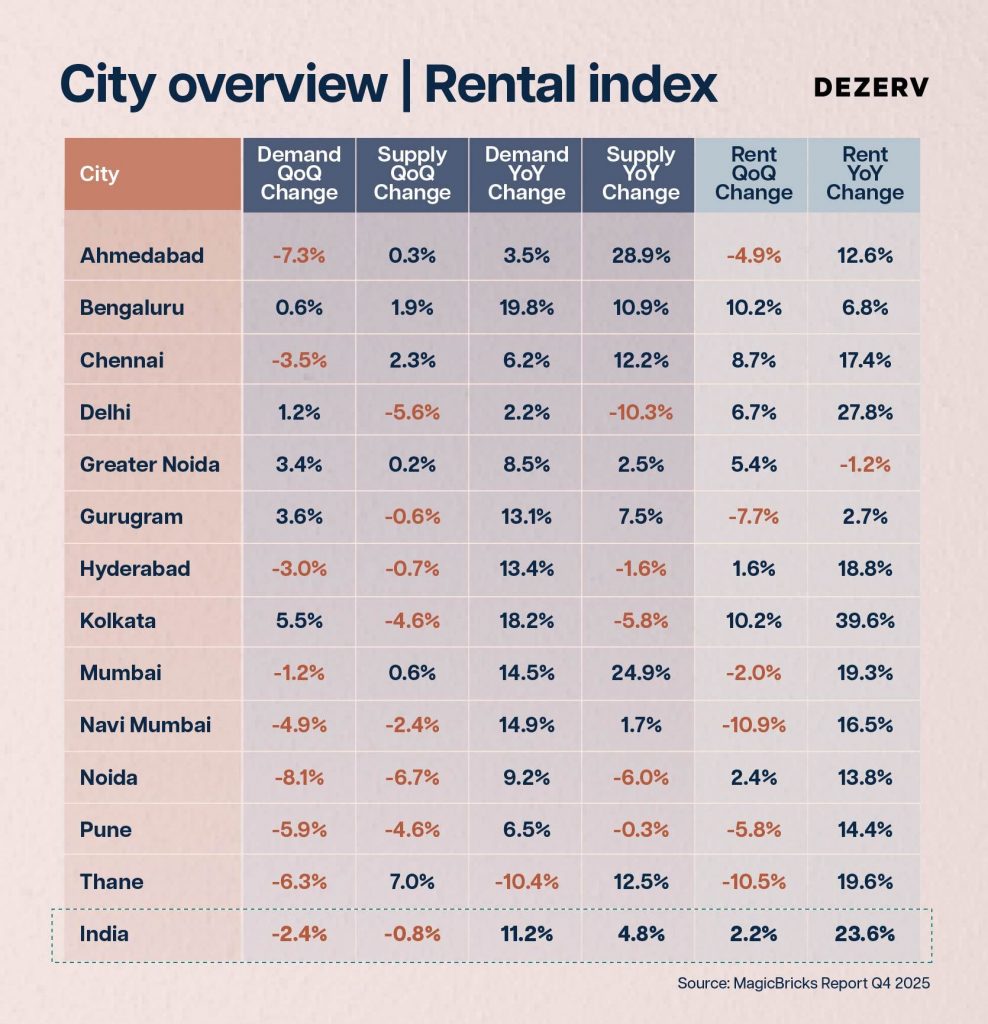
But look past the headline and the picture becomes more nuanced. The cities with the biggest rent jumps are not producing the best rental yields. Mumbai and Bengaluru — where prices have run furthest ahead of rents — are yielding just 3.3 – 3.9%. Chennai, Hyderabad, and Ahmedabad, where property hasn’t been bid up as aggressively, offer gross yields above 3.9%.
The real estate truism holds: capital appreciation and rental yield are frequently in tension. When a market runs on price appreciation narratives, buyers pay up for the asset and compress the yield. Right now, India’s tier-1 cities are in that compressed-yield phase.
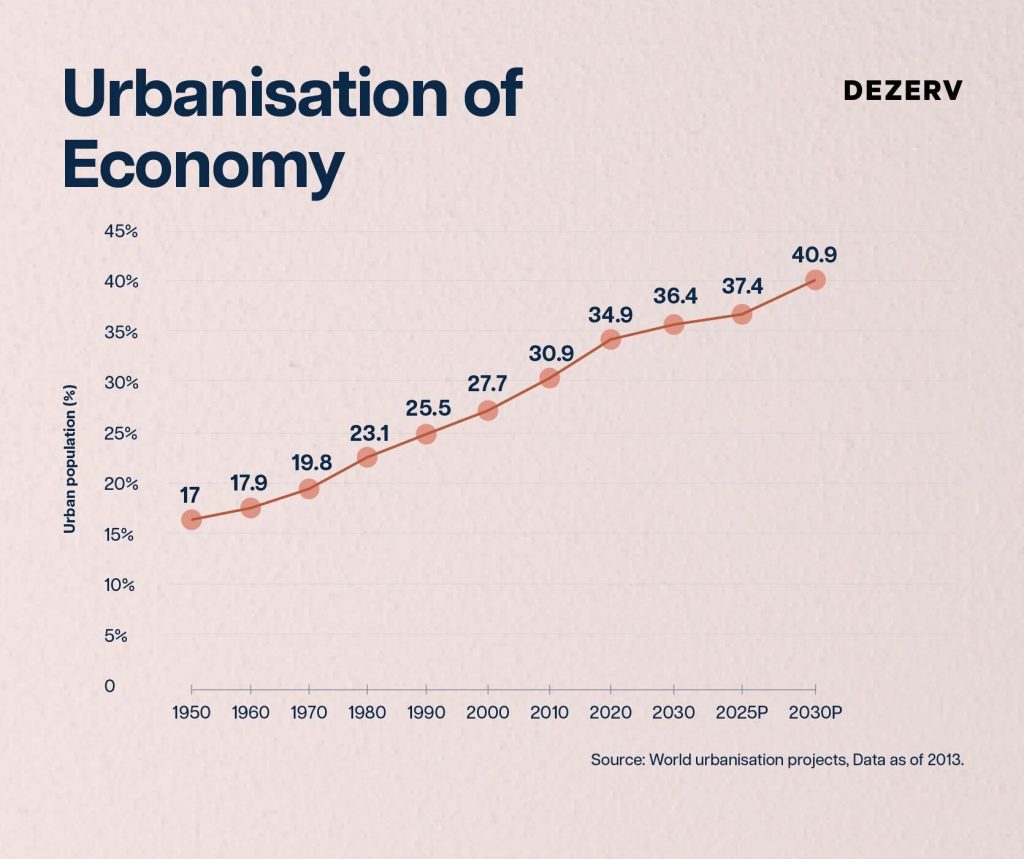
The structural case for rental demand is solid — India’s urban population is rising, supply is tight, and more middle-class households are choosing to rent as buying becomes unaffordable.
Bigger loans, fewer borrowers
Here is a data point that tells the story of this entire cycle in a single line: India’s home loan market grew from ₹11.9 lakh crore to ₹19.3 lakh crore in four years. Yet the number of unique borrowers actually fell — from 27.3 crore to 26 crore.
The RBI cut the Policy Repo Rate by a cumulative 100 basis points between February and June 2025, bringing home loan rates below 8% for the first time since 2022. This was supposed to be the affordability catalyst. It has not worked in the affordable segment — at least not yet.
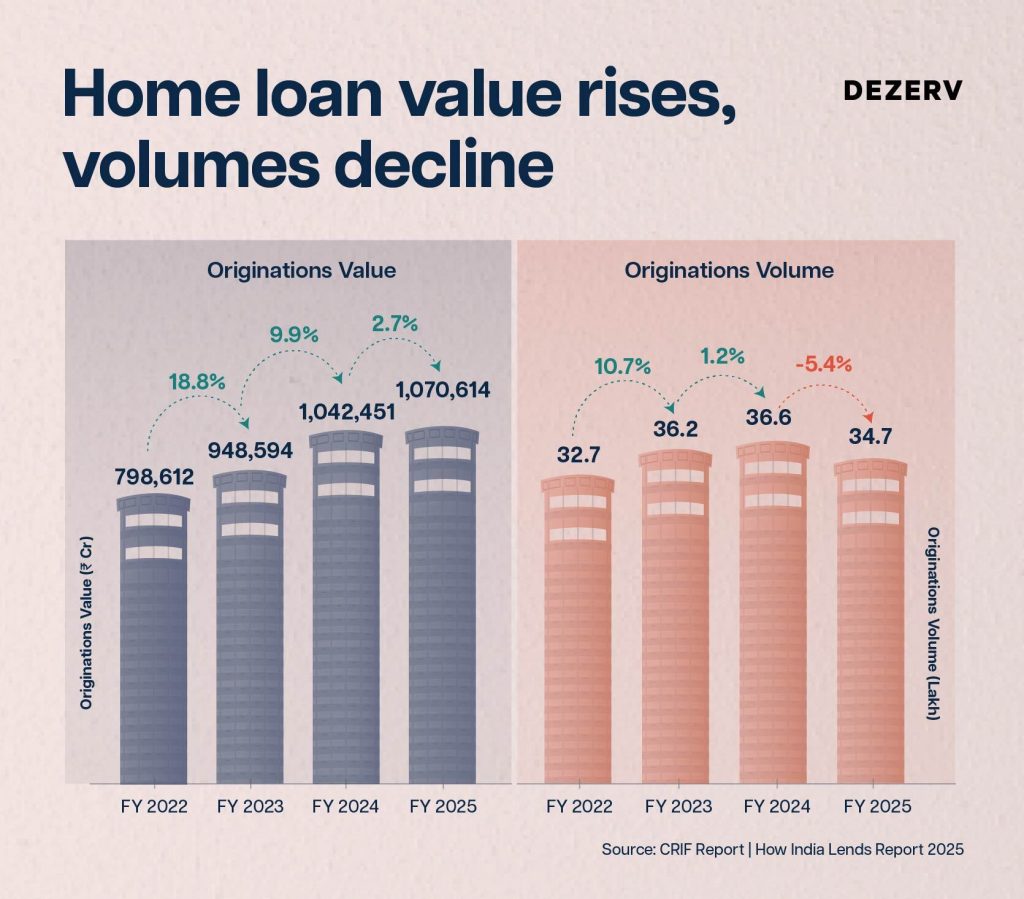
Origination value is still growing — up 2.7% in FY25 — but volume has declined 5.4%. What that tells us is unambiguous: loans are getting larger, not more numerous. Credit is concentrating upward into high-income professionals and higher-ticket properties (₹75 lakh and above), while sub-₹35 lakh lending has effectively collapsed.
The rate cuts I feel have helped sentiment more than they’ve helped affordability. The primary constraint on the affordable segment isn’t the interest rate — it’s the price of the underlying asset. A 50 bps cut does little when property prices are going rising at double-digit rates.
The banking opportunity hidden inside
For banks, the premiumisation of real estate is actually a tailwind. High-income borrowers have significantly lower default probability, and the shift toward larger loans compensates for lower volume. Gross NPA ratios at Scheduled Commercial Banks fell to 2.22% as of September 2025 — a multi-decade low. Net profit for SCBs reached ₹4.01 lakh crore in FY25, up from ₹3.5 lakh crore the previous year.
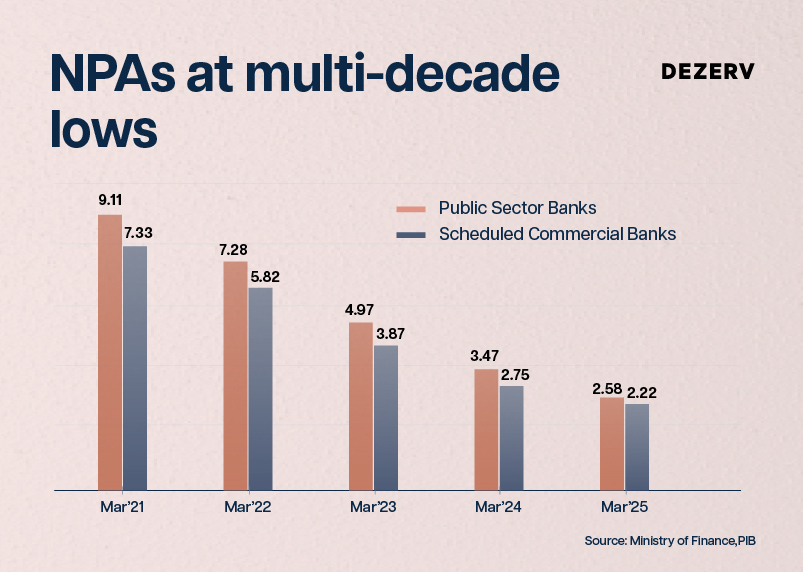
The banks with the best exposure to premium mortgages — ₹2 crore and above — are quietly benefiting from the same structural shift that is squeezing affordable housing. Fewer borrowers, larger loans, lower delinquency. It is a better book, even if it is a smaller one.
What does this mean for you?
Every structural shift of this scale creates an investable universe that extends far beyond the obvious play. Most people think of the luxury housing boom and immediately jump to listed real estate developers. That is one part of the picture — but not the most interesting one.
Where the real opportunity sits
Premium Real Estate Developers. Focus on those with strong balance sheets, low debt, and projects concentrated in Bengaluru, Hyderabad, and NCR premium micro-markets. The cycle favours execution quality over volume.
Building Materials and Smart Home Tech. As ultra-luxury becomes the baseline expectation, the specification upgrade cycle will run for a decade. Companies supplying smart-home systems, EV charging infrastructure, premium fittings, and wellness amenities are quietly riding this wave.
Buy-to-Let in the Right Micro-Markets. Rental yields in Bengaluru and Hyderabad are currently at 2.5–3.5% — still thin relative to borrowing costs. But in Chennai, Ahmedabad, and select Pune markets, yields above 3.9% are available with realistic appreciation potential. The buy-to-let case in India is becoming real for the first time.
Banks Targeting Premium Mortgages. Lenders with a growing book of ₹2 crore+ loans and sub-2.5% NPA ratios are structurally advantaged. Lower provisions, higher margins, lower volatility.
The common thread across all of these is the same underlying dynamic: purchasing power in Indian urban real estate is concentrating, not diffusing. The investable universe isn’t just the developers — it’s everything that feeds, finances, furnishes, and manages the ecosystem they’re building.
The longer view: space as the scarce resource
There is a structural argument for India’s real estate that goes beyond any single cycle, and I want to leave you with it.
The average Indian currently lives in roughly 130 square feet of built space. The equivalent in smaller Chinese cities is approximately 550 square feet. In the US, it is close to 700 square feet. As incomes rise, people don’t eat meaningfully more food — but they consistently demand more space.
This gap is not going to close quickly. Land constraints, restrictive FSI regulations, and a decade-long underinvestment in affordable supply mean the structural demand for premium residential space will run well beyond this cycle.
The luxury boom isn’t a bubble, in my view. It is the early expression of a permanent recalibration in how India’s professional class thinks about where and how it lives. The question isn’t whether to pay attention to real estate — it’s whether you’re positioned in the right part of the market when the next wave arrives.
In summary
India’s residential real estate market has crossed a threshold from which it will not easily return. The majority of transactions in the top cities are now in the luxury bracket. Affordable supply has structurally collapsed. Rents are rising sharply but yields are compressed in the cities that have appreciated most.
The forces driving this shift — GCC-driven income concentration, ESOP and IPO liquidity, dual-income households, rising HNI counts — are structural, not cyclical. They will not reverse when interest rates move or when markets correct.
For wealth creators, the lens should shift accordingly. This is no longer a market you analyse for affordability metrics. It is a market you analyse for where purchasing power is concentrating, and what ecosystem benefits from that concentration.
The volume story is over. The value story is just beginning.
Disclaimer – The information provided herein is intended solely for educational purposes. In this material, Dezerv has utilized information through publicly available sources, and other data deemed to be reliable. All trademarks, logos, and brand names mentioned are used for identification purposes only and do not imply endorsement or recommendation.