
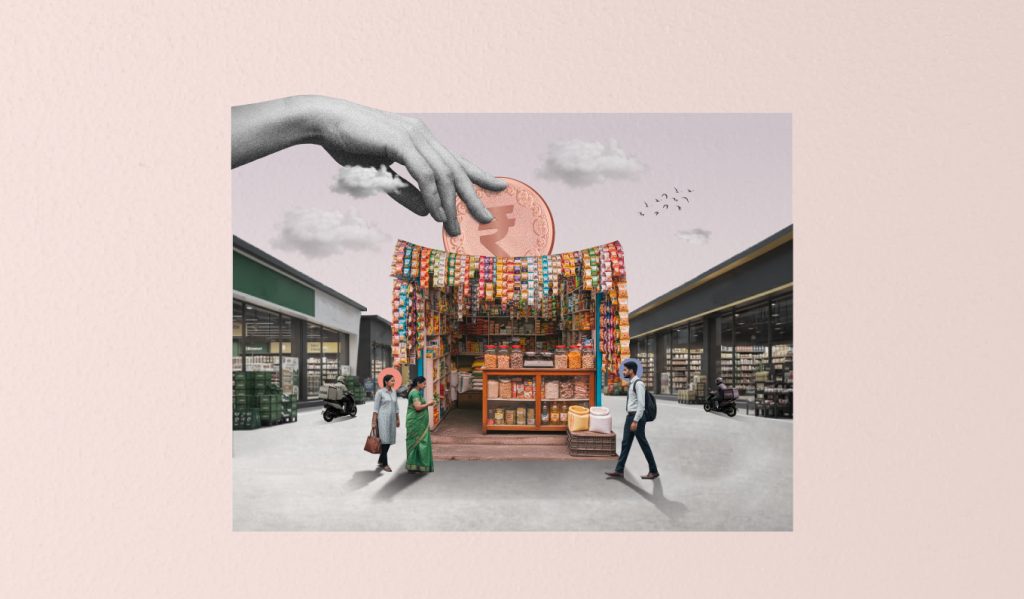

Every few years, a “death certificate” is written for the Indian Kirana store.
In the early 2000s, it was the arrival of Modern Trade—the gleaming aisles of supermarkets like Big Bazaar, Smart Bazaar. We were told the air-conditioned comfort of a mall would make the local shopkeeper a relic of the past.
A decade later, it was E-commerce. The convenience of bulk buying online with scheduled delivery was supposed to be the final nail in the coffin.
Fast forward to 2026, and the world is obsessed with Quick Commerce. 10-minute delivery is the new benchmark. Surely, if I can get a packet of bread in 8 minutes through an app, I’ll never walk 50 meters to the neighborhood shop again?
But then, a report lands on my desk that flips the entire narrative on its head.
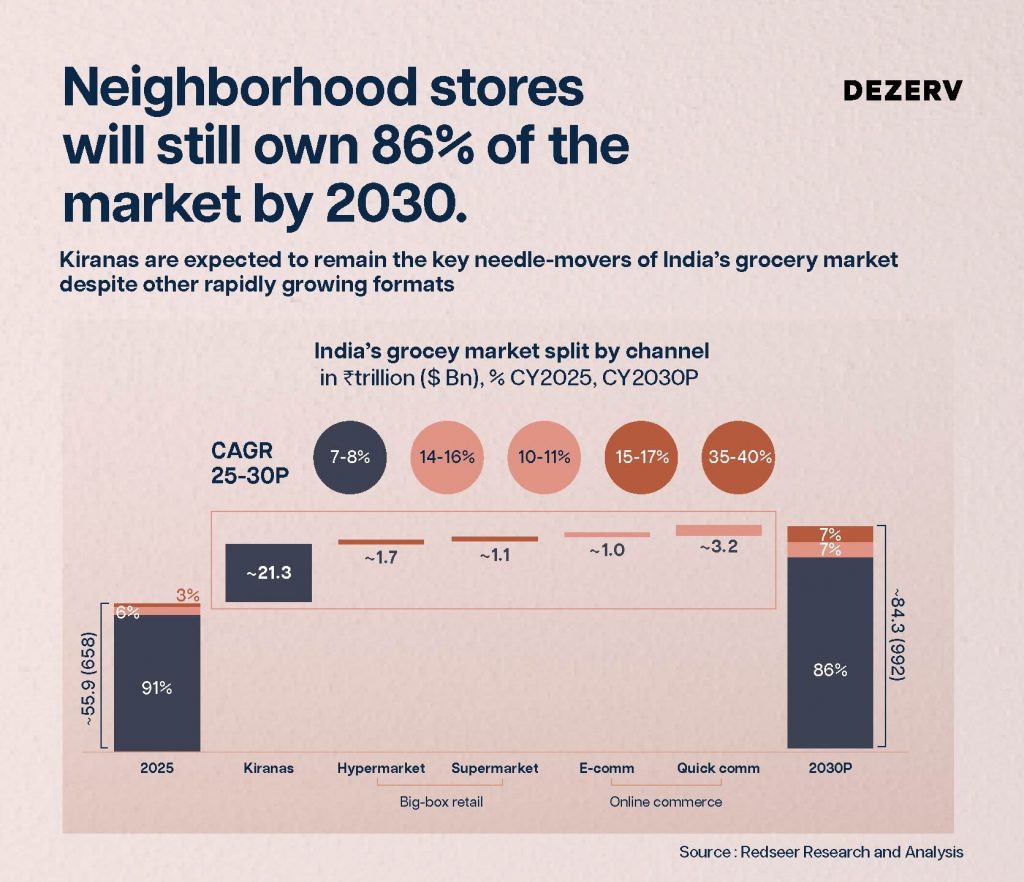
According to the latest Redseer Strategy Consultants report (January 2026), traditional Kirana stores still command a staggering 91% share of the total grocery market in India. Even by 2030, after five more years of aggressive digital expansion by quick commerce platforms, neighborhood shops are projected to still retain 86% of the market.
Here’s the real story: While urban affluent India lives on apps, the mass market—the hundreds of millions who actually drive India’s consumption—remains anchored in the “khata” and the corner shop.
In this edition, we’re going behind the data to explore why the Kirana isn’t just surviving, but thriving in a $1 trillion retail landscape.
In this edition:
- The AOV Trap: Why “Quick” isn’t enough to solve the economics of a ₹150 basket.
- The Coexistence Formula: Why Quick Commerce is actually hurting supermarkets more than local shops.
- The Zero-Cost Advantage: How family labor and owned real estate create an unbeatable economic moat.
- The Psychological Counter-weight: Why trust and hyper-locality beat 10-minute speed every time.
- The 2026 Modernisation: Why the “Traditional” Kirana is more tech-enabled than you think.
Section 1: The AOV Trap – Why Tech Struggles with Small Baskets
Most of us in tech and affluent circles suffer from a “metro bias.” We assume the way we shop—₹1,500 baskets on a Sunday evening—is the national norm.
The data tells a different story. India’s grocery consumption is driven by its largest cohort: 233 million low-to-mid-income households. For this massive segment, the typical grocery basket is between ₹100 and ₹200, purchased 10–20 times a month.
This is the Average Order Value (AOV) Trap.
At these low price points, the unit economics for digital platforms start to break. A Quick Commerce platform has to pay for dark store rent in prime locations, delivery partner payouts, and high customer acquisition costs. If the total order is only ₹120, the logistics and fulfillment cost—estimated at 18-22% of the order value for online players—eats up most of the margin.
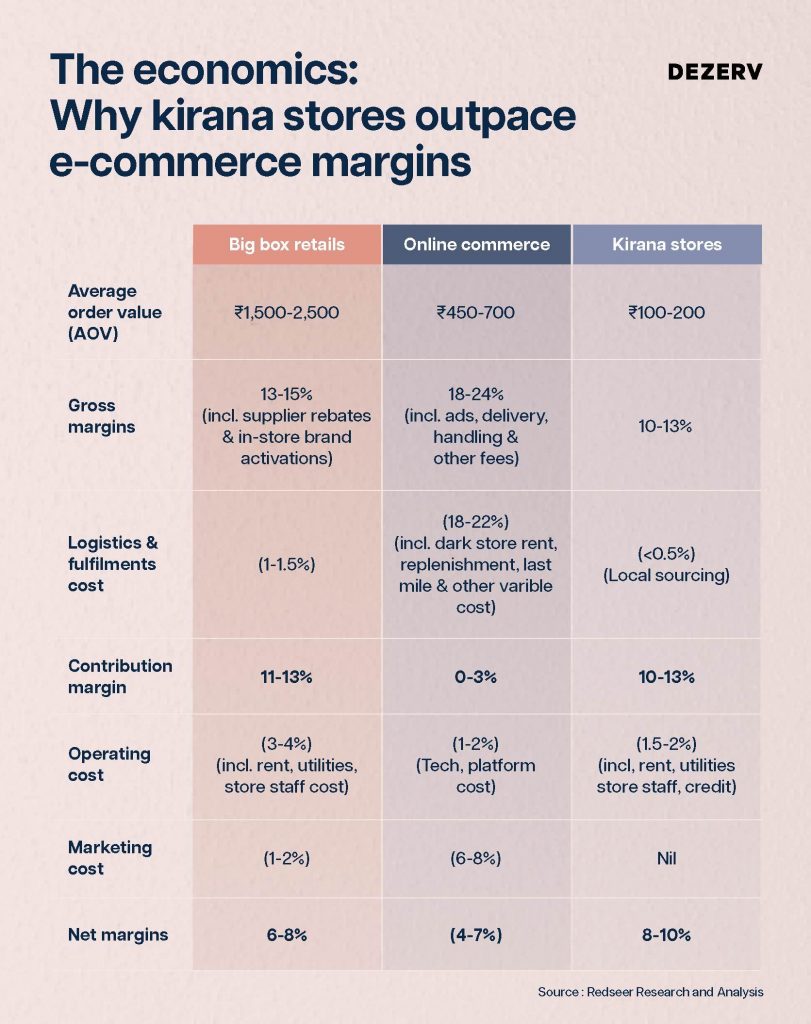
For a Kirana store, the math is fundamentally different. Their logistics cost is effectively less than 0.5%. They operate from owned or low-rent premises. Their labor is family-managed, which removes the fixed “per-delivery” payout that cripples app economics for small orders. This allows them to stay profitable on a ₹100 order of bread, eggs, and a small sachet of shampoo—a transaction that would be a “loss-maker” for almost any app.
Section 2: The Demographic Map: Why Formats Coexist
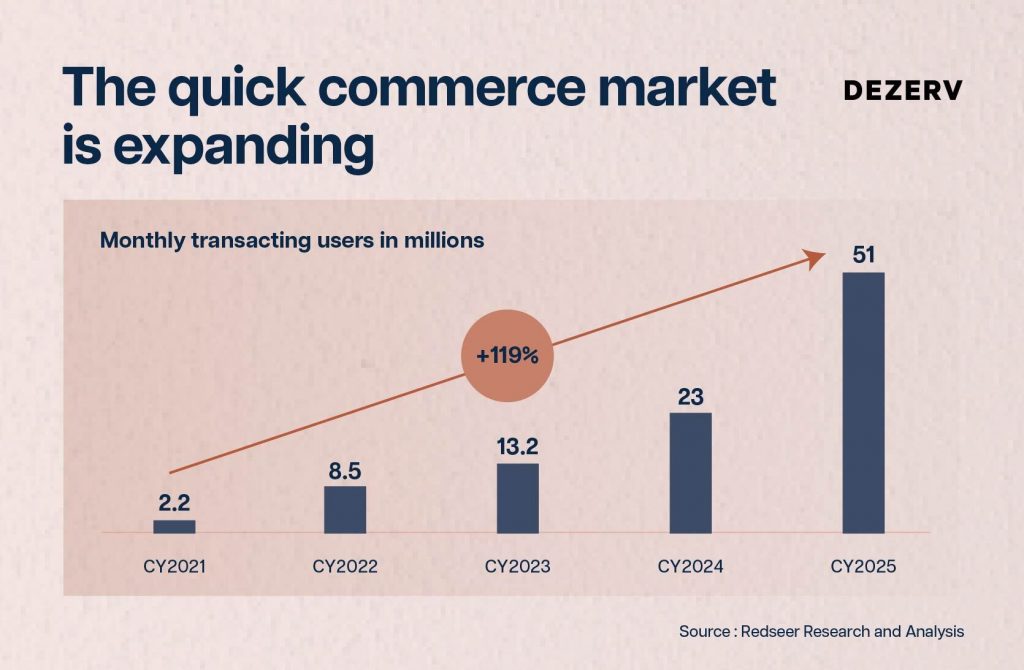
When I look at the recent explosion in Quick Commerce, it’s easy to get swept up in the hype. We’ve gone from 2.2 million users in 2021 to a massive 51 million as of late 2025.
But here is the “Social Capital” insight: while apps are booming, Kiranas are projected to grow by ₹21 trillion by 2030. In absolute terms, the neighborhood shop is adding more value than the entire online sector combined.
How is that possible? Because they’re not competing for the same customer. Let us look at detailed segment profiles to understand this.
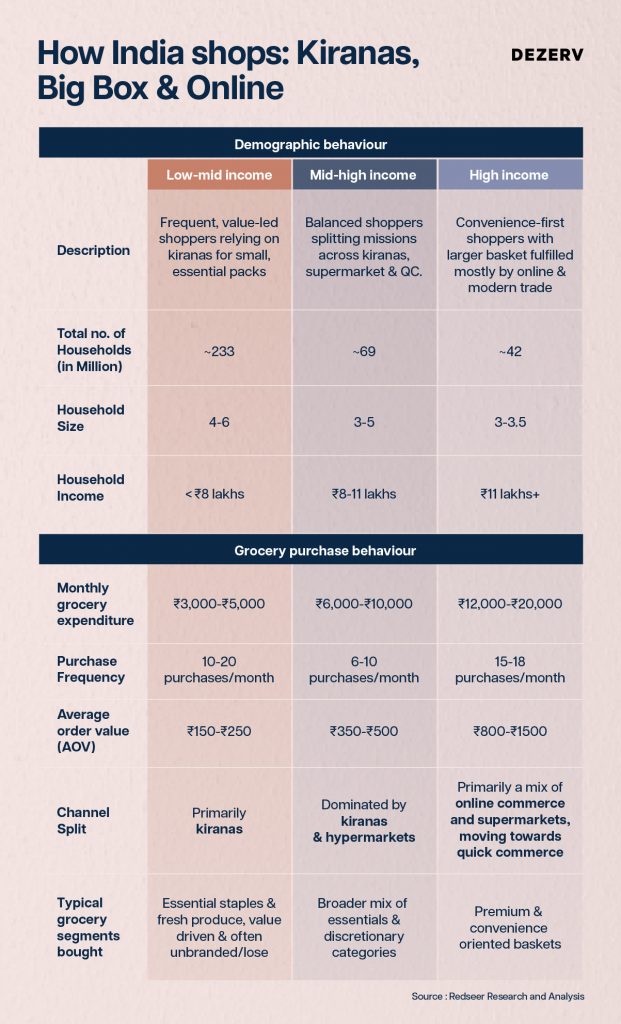
The Real Story: Mapping Formats to Income
These formats aren’t fighting for the same customer; they are solving for different household economics:
- The Mass Market (233M households): They buy “small and often.” With an Average Order Value (AOV) of ₹150, digital logistics costs (18-22%) make apps unviable. The Kirana wins on micro-liquidity.
- The Affluent (42M households): Time is the scarcest commodity. They pay a premium for convenience, driving the Quick Commerce surge.
- The Hybrid Segment (69M households): These families split their loyalty—hypermarkets for the monthly stock-up and Kiranas for the “missing ingredient” moments.
Section 3: The Myth of Disruption – The Real Casualties of Quick Commerce
When looking at a $658 billion market, it’s easy to assume everyone is fighting everyone. But if you look closer at the data, India’s grocery ecosystem isn’t a monolith—it’s a three-speed economy.
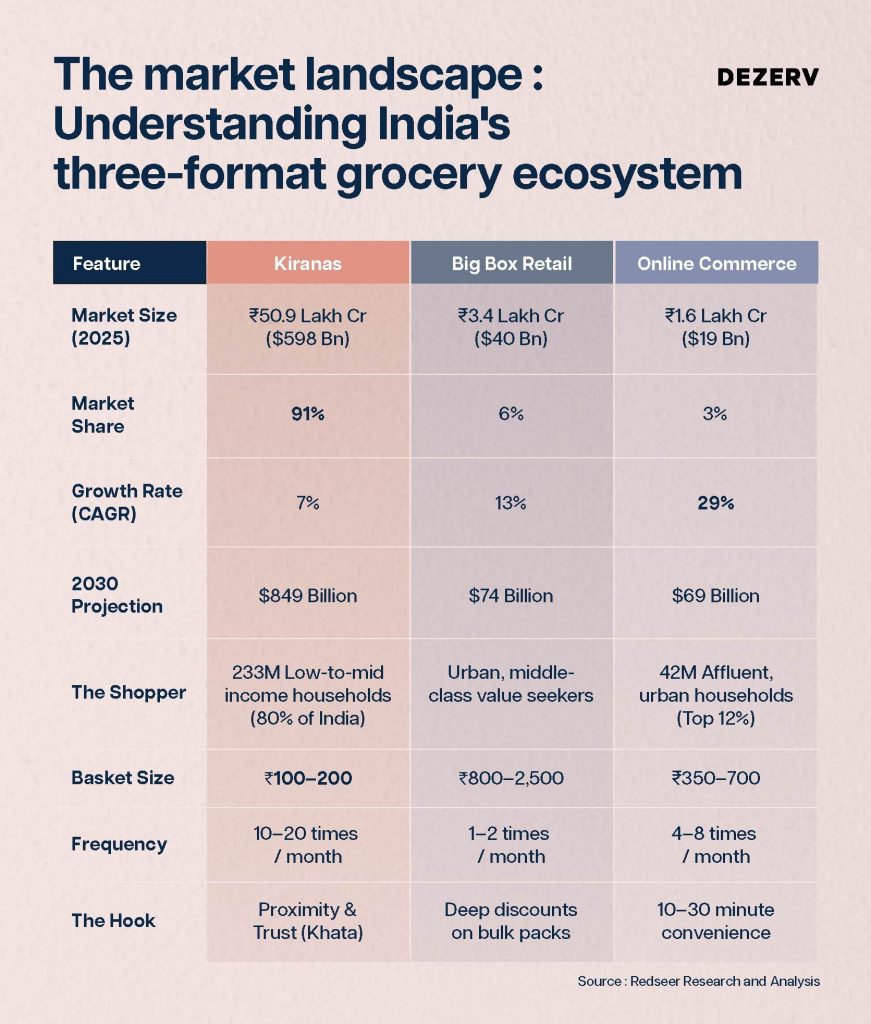
And one of the most surprising insights from the 2025-2026 data is that the rise of 10-minute deliveries is hurting slotted e-commerce (like original BigBasket or Amazon Fresh) and supermarkets far more than local shops.
Quick Commerce is gaining share from affluent consumers who already preferred digital convenience. It is effectively absorbing “planned” grocery missions from high-income households that used to go to supermarkets.
- The Real Loser: Supermarkets. They sit awkwardly in the middle—not cheap enough to beat hypermarkets, and not fast enough to beat Zepto or Blinkit.
- The Resilient Giant: Hypermarkets. Players like DMart continue to hold firm because they serve the monthly stock-up mission with value-led bulk packs.
- The King of Top-ups: Kiranas. They remain the go-to for high-frequency, immediate needs for 80% of India.
In urban centers, an A-class Kirana might feel some heat from Quick Commerce for a midnight ice-cream craving. But for the mass market, the Kirana’s “khata” (interest-free trust-based credit) is a retention tool no algorithm can replicate. As Bain & Company notes, e-retail is projected to reach 9-11% penetration by 2030, but that still leaves nearly 90% of the market for physical formats.
Section 4: Quick Commerce – The war within
The headlines focus on “Quick Commerce vs. Kirana,” but the real bloodbath is happening within the apps. The early movers no longer have the field to themselves, and the rules of the game are shifting.
The Death of the “10-Minute” Promise
Notice how your apps recently swapped “10 Minutes” for “Delivering in minutes”?
The reason is regulation and reputation. With rising scrutiny over rider safety and road ethics, platforms are dialing back the aggressive clock.
A Crowded Field:
The “Big Three”— Blinkit, Zepto, and Swiggy Instamart — now face a siege from India’s deepest pockets. It’s no longer a startup playground; it’s a conglomerate battlefield.
- Amazon has launched Amazon Now with 30-minute delivery
- Flipkart has rolled out Flipkart Minutes
- BigBasket (now part of the Tata Digital Ltd) is pushing deeper into quick commerce
- JioMart is testing fast delivery in select cities
- And nearly 19 smaller startups are chasing whatever share is left
More players chasing the same 42 million affluent households means one thing: heavier discounts, higher burn, and tighter margins.
The Social Capital Take: The apps are fighting over who can burn more capital to deliver a pack of biscuits. The Kirana wins because apart from the zero-cost marketing budget, it is also a community hub. Every transaction rests on personal relationships. The store owner knows your name, your brand of tea, and even which regional masala you prefer. While Quick Commerce platforms are scaling their SKU counts to 10,000+, they lack the hyper-local intelligence of a store owner who curates his 500-1,500 SKUs based on the exact preferences of the 200 families living on his street.
Section 5: Structural Efficiency – Frugality as a Strategy
In my experience, many founders fail because they try to “out-spend” their way into a market. The Kirana does the opposite: they out-frugal their way into a market.
The Kirana operating model is defined by:
- Fast Inventory Cycles: They turn over their stock every 9-10 days. This rapid cycle keeps cash circulating and holding costs low.
- Zero Marketing Cost: Unlike apps that spend heavily on discounts and digital ads (estimated at 6-8% of order value), Kiranas spend zero on customer acquisition. Their “advertising” is the storefront you walk past every morning.
- Pricing Flexibility: By selling a mix of branded FMCG and GST-exempt loose staples, they can manage their margins more flexibly, offering small discounts to regular customers without central approvals.
This lean cost base allows them to achieve net margins of 8-10%, which often rivals or exceeds organized retail models. While Quick Commerce players are currently seeing negative or razor-thin contribution margins on small orders, the Kirana is inherently profitable from Day One.
Section 6: The 2026 Kirana – Modernizing from Within
If you picture a 2026 Kirana as a dusty, analog shop, you’re missing the transformation happening under the hood. The “Traditional” sector is modernizing faster than we give it credit for.
- Fintech & AI Integration : The adoption of UPI has formalized the Kirana economy. Over 90% of Gen Z digital transactors prefer UPI, and this habit has forced Kiranas to go digital.
AI could be the next frontier for small business owners. In a recent conversation, Paytm CEO Vijay Shekhar Sharma shared his vision of a personalised AI agent for shopkeepers. By consolidating payments and POS data, this “digital COO” can tell owners exactly why a product isn’t moving and how to optimise hyper-local marketing. - Digital Sourcing (eB2B): Store owners are moving away from 5-hour trips to the mandi. They now coordinate across distributors and place selective online orders through eB2B platforms (like Udaan or JioMart) to manage margin leakages.
- The Employment Multiplier: Contrary to the fear that tech will kill jobs, Quick Commerce is actually employment-neutral or positive compared to Kiranas. Both formats employ roughly 62-66 people per INR crore of monthly GMV, meaning the “labor-intensive” heart of Indian retail remains intact.
In Summary
The Indian grocery story is not a zero-sum game. We are moving toward a coexistence of formats where:
- Quick Commerce captures the convenience-driven urban affluent for routine top-ups.
- Hypermarkets capture the value-led, monthly stock-up behavior.
- Kiranas continue to anchor the mass grocery market, serving the daily, small-ticket needs of 80% of India’s population.
As wealth creators and investors, the lesson is clear: Betting against the Kirana is betting against the fundamental economics of the Indian household. The “AOV Trap” is a structural reality of our economy. Until the average transaction size for a mass-market household moves from ₹150 to ₹1,500, the neighborhood store will remain the undisputed king of the Indian basket.
Here’s to the shops that know us by name—and the data that finally proves their power.
Until next week.
Disclaimer – The information provided herein is intended solely for educational purposes. In this material, Dezerv has utilized information through publicly available sources, and other data deemed to be reliable. All trademarks, logos, and brand names mentioned are used for identification purposes only and do not imply endorsement or recommendation.