

I moved to Bengaluru in 2024 to build Dezerv.
The decision wasn’t random. The talent, the capital, and the closeness to first-generation wealth creators — who make up a majority of our clients — drew me here. As a Mumbaikar throughout my life, I wasn’t sure how I would adapt to the city.
What I found surprised me.
I’ve seen this city’s hunger to build. The cafes and bars here discuss ideas. In fact, very recently, I discovered that there are lectures happening in Bengaluru bars on quantum physics and wormholes. This is so incredible and different. It really tells you about the culture of this city.
But it’s not just Bengaluru. Something profound is happening across India’s southern states — a structural shift that will reshape wealth creation for the next decade. The economic centre of gravity is moving, and the implications for investors are significant.
Welcome to this week’s Create Wealth newsletter.
In this edition, we’ll cover:
- India’s position as Asia Pacific’s fastest-growing major economy
- Why Southern states will lead the next phase of growth
- The productivity divergence that’s widening the wealth gap
- The demographic paradox: Will the South grow rich before growing old?
India’s Growth Story: The Numbers Behind the Headlines
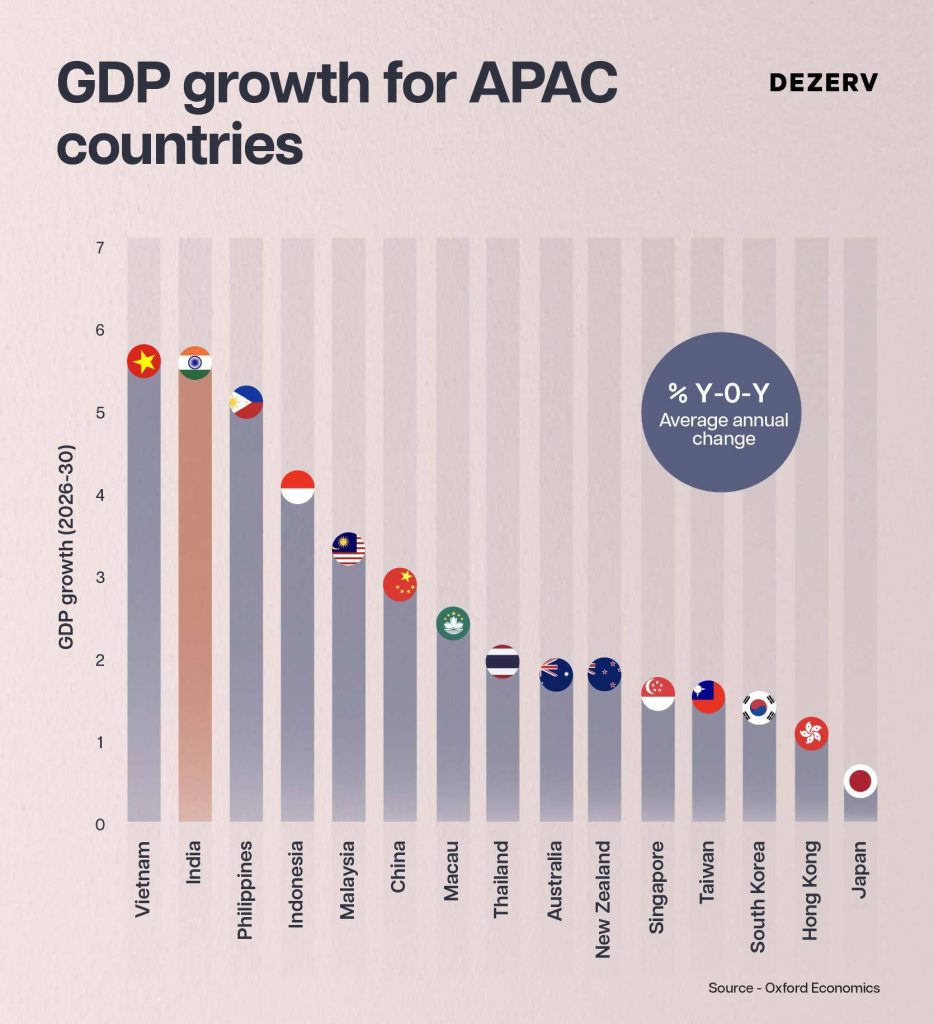
Over the next five years, India is set to be one of the fastest-growing major economies across Asia Pacific, alongside Vietnam. Oxford Economics forecasts India’s real GDP to grow on average by 6.3% per year between 2026 and 2030, with total GDP reaching ₹268 trillion in real terms — just over $5 trillion — by 2030.
What’s remarkable is the shift in India’s growth drivers. While exports account for around 20% of GDP, domestic demand is the more critical factor. India consumes a lot of what it produces domestically, making the economy somewhat less vulnerable to trade shocks than others.
But here’s what most investors miss: within India, these expectations vary dramatically across states and cities.
The South is pulling away.
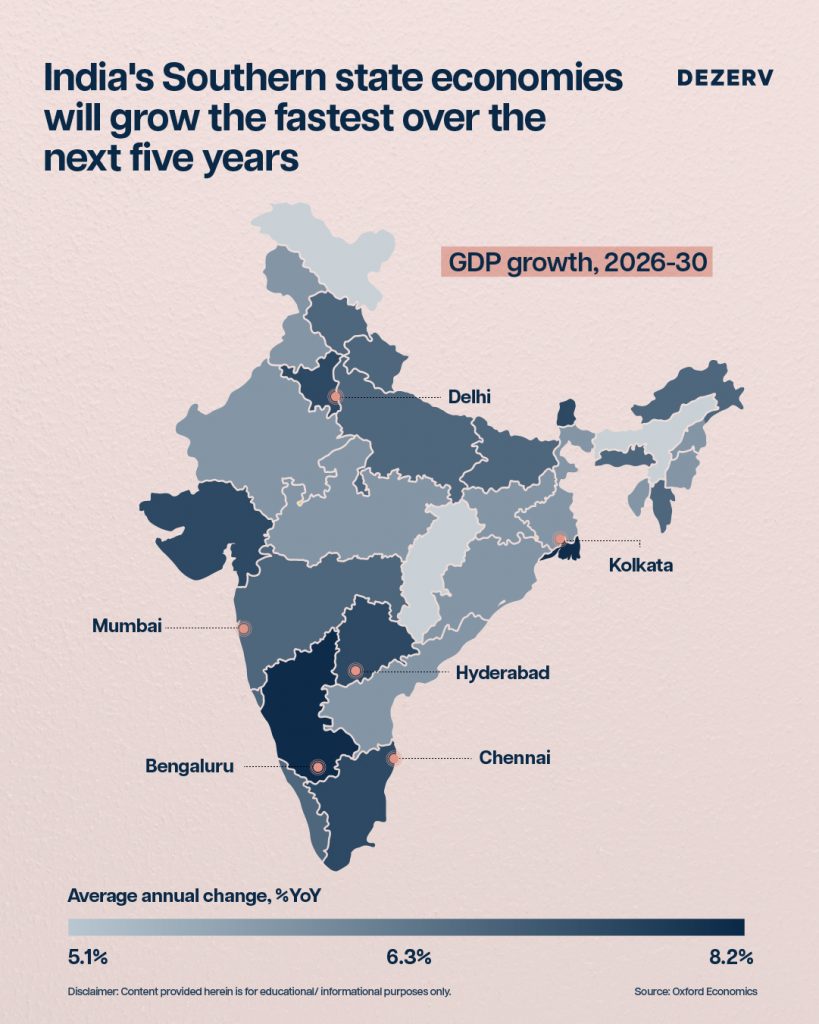
We expect Southern states to average GDP growth of 6.8% per year between 2026-30, with Karnataka and Telangana at the very top — achieving 7.4% and 7.2% respectively. That’s around one percentage point higher than India overall. It might sound marginal, but compounded over years, this divergence creates significant wealth concentration.
The Service Economy Advantage
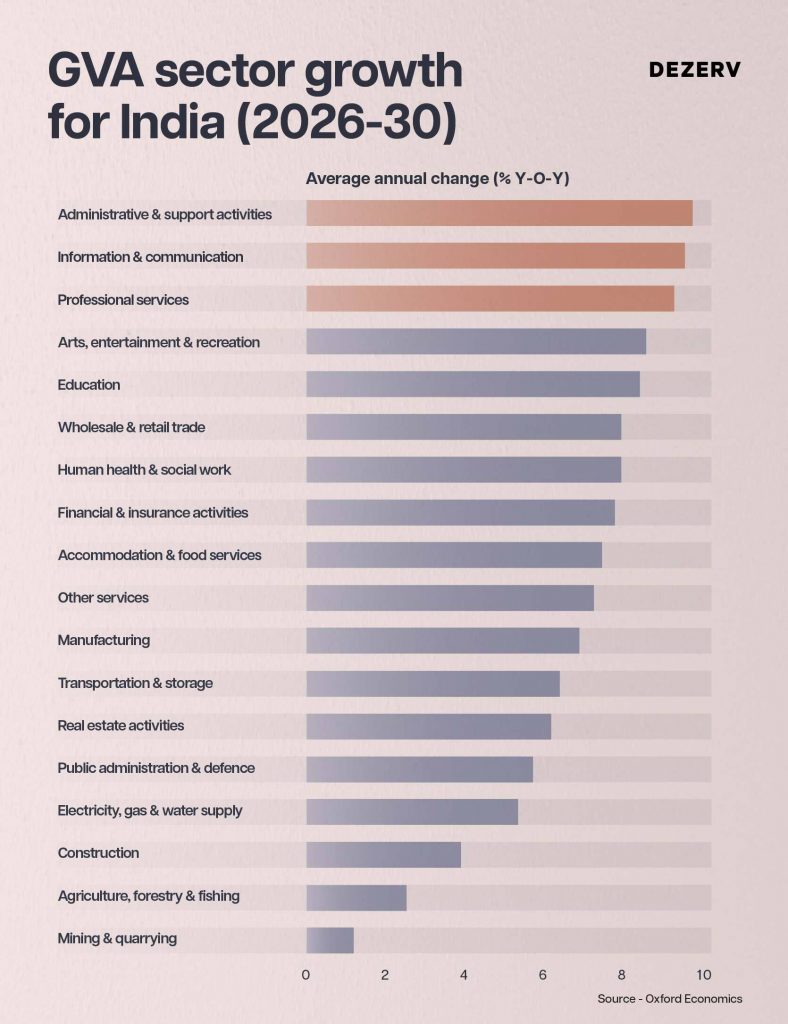
A key factor in determining these differences is each state’s industrial structure. Over the next five years, India’s professional and technological service sectors — particularly IT – will drive the country’s strong economic growth. Real gross value added (GVA) in these sectors is expected to expand by nearly 9.5% per year.
Consider this: In Telangana, the IT sector accounts for nearly 13% of the state’s economy, compared to just over 8% nationally. We expect that sector’s GVA to grow by almost 12% on average between 2026-30. In Karnataka, information & communications makes up almost 22% of the economy — the highest among all Indian states — and is forecast to grow at almost 11% per year.
At the heart of this transformation are dynamic cities like Hyderabad and Bengaluru.
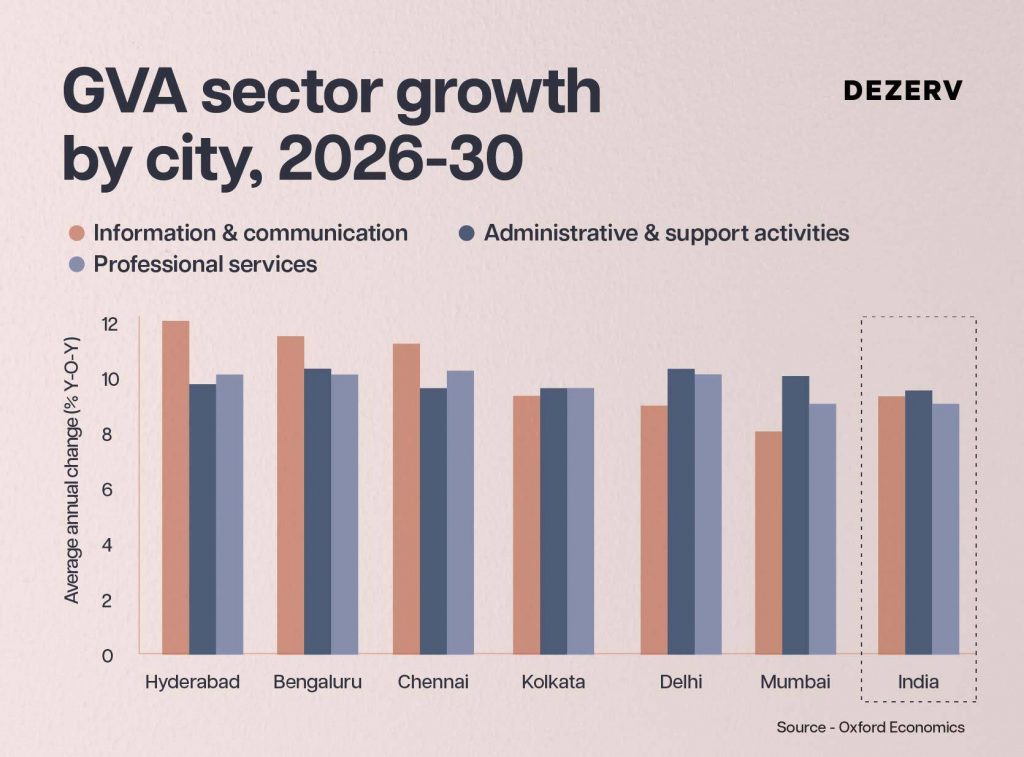
Greater Hyderabad’s IT sector will grow the fastest out of all major Indian cities at just over 12%, supported by more global companies announcing plans to set up in HITEC City. During the Bengaluru Tech Summit 2025, plans were announced for a new 9,000-acre AI city near Bidadi — a signal of where investment is flowing.
Chennai isn’t far behind. Its IT sector is expected to grow by 11.3% annually, while its professional services sector will grow the fastest among major Indian cities at 10.3%. The North Chennai Development Plan, launched with Tamil Nadu government support, has sparked investment from multinationals including AstraZeneca and Ford, particularly in Global Capability Centres and engineering hubs.
Global Capital Is Voting With Its Feet
The investment flows tell a story that spreadsheets alone cannot.
Microsoft is building AI/cloud hyperscale data centres in Hyderabad — a $17.5 billion commitment (₹1.46 lakh crore) spanning 2025-2029, creating the largest hyperscale region for AI infrastructure. Google is investing ₹51,000 crore (~$6 billion) in Asia’s largest data centre in Visakhapatnam, Andhra Pradesh — their first AI hub outside the US, complete with cloud and AI labs. Walmart has leased 465,000 square feet in Chennai for a tech and operations hub.
When I speak with founders and CXOs who’ve made similar moves, they all say variations of the same thing: the talent density in these cities is unmatched. A tech lead in Bengaluru has likely worked at two or three global product companies. An AI researcher in Hyderabad has access to a network that rivals Bay Area clusters.
Tamil Nadu’s story is particularly striking. According to RBI data, the state — India’s second-largest economy — increased its GSDP from ₹26.88 lakh crore in 2023-24 to ₹31.19 lakh crore in 2024-25, recording 16% growth — the fastest among major states. Manufacturing GSDP grew by ₹1.46 lakh crore, nearly double Maharashtra’s increase. The services sector, accounting for 53.6% of state GVA, registered 11.3% real growth in 2024-25.
This isn’t abstract economic data. It’s capital making long-term bets on where India’s future will be built.
The Productivity Premium
Here’s where the divergence becomes structural.
Professional and technological service sectors are highly productive — in 2030, productivity in the IT sector will be over five times higher than the national average. This underpins why Southern and Western states will see significantly higher productivity growth.
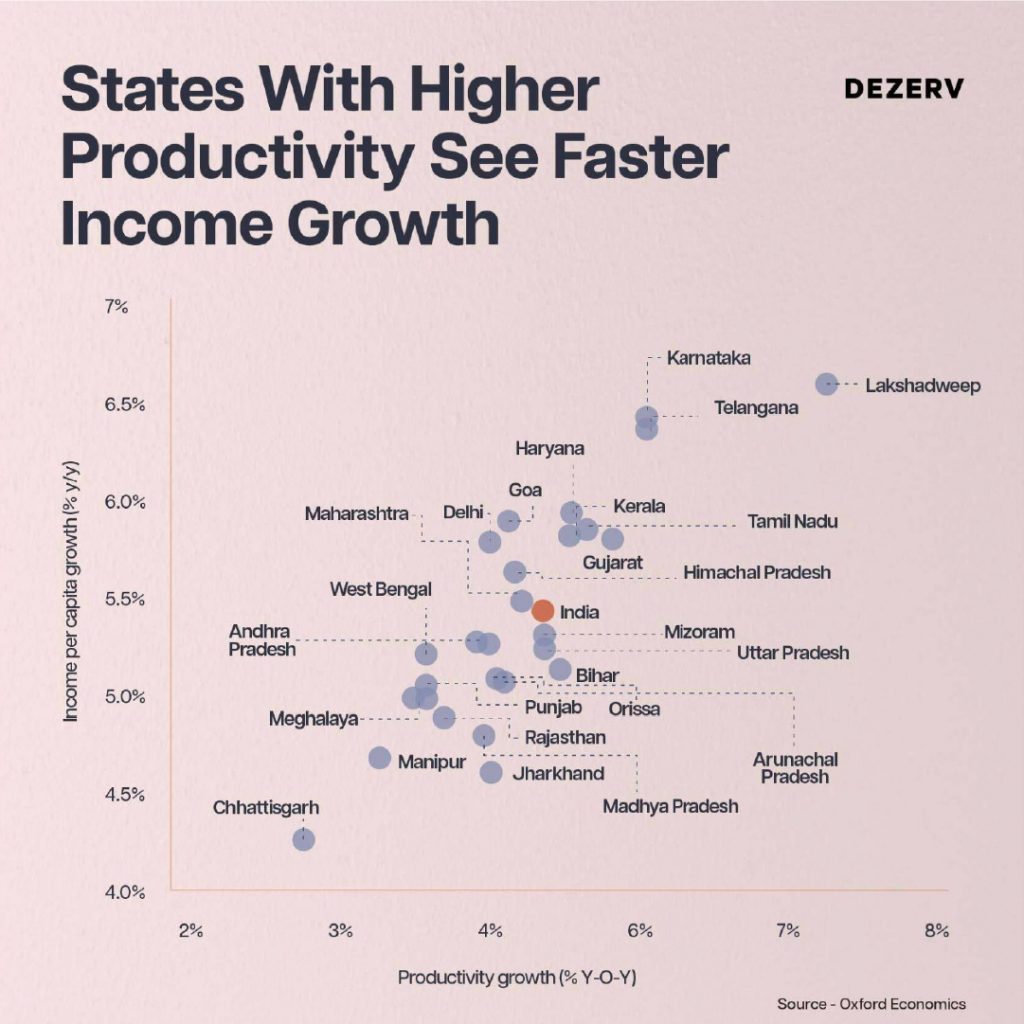
In contrast, states like Assam, Jammu and Kashmir, and Chhattisgarh — with high concentrations in agriculture and manufacturing — have workers who are only 50-65% as productive as the average Indian worker. Their productivity growth will lag the national average by around 1.5 percentage points, meaning productivity in these states will remain fairly stagnant.
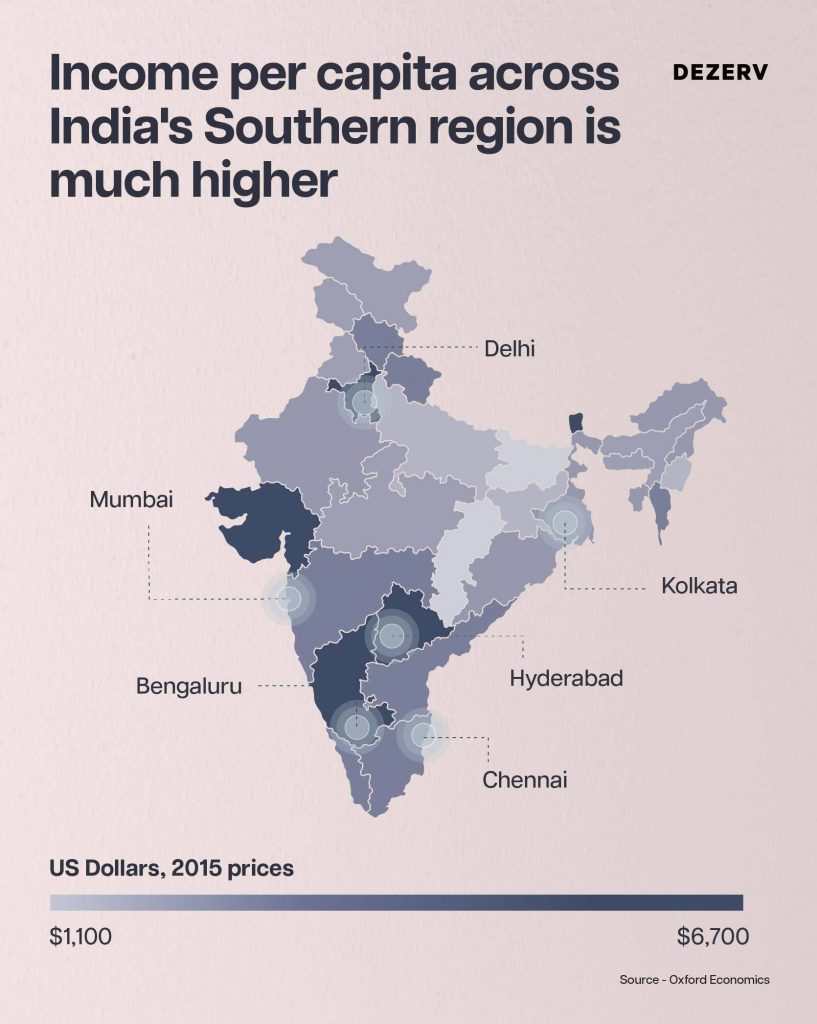
The economic implications are profound. By 2030, income per capita in Karnataka is forecast to reach almost ₹198,000 — over three times greater than Bihar at around ₹57,000. Within Bengaluru specifically, average income per capita will be nearly ₹350,000 — more than double what someone outside the city earns.
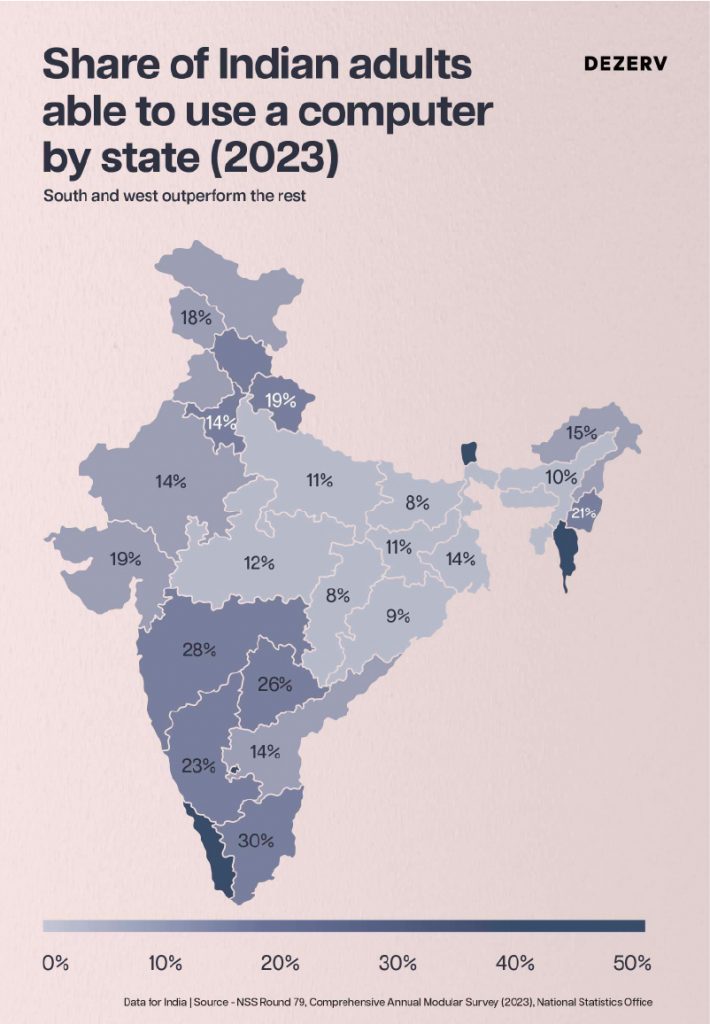
The computer literacy data tells a similar story. Western and Southern states have the highest share of adults able to use computers — Gujarat at 28%, Karnataka at 26%, Kerala at 30%. In contrast, states like Bihar, Jharkhand, and Uttar Pradesh hover between 8-12%. This digital divide isn’t just about technology; it’s about economic participation in a services-driven future.
City Affluence Drives Consumption
As incomes rise, so does consumption. Consumer spending per capita across the Southern region will grow the fastest — 6.6% annually in Karnataka and Telangana, and even stronger in Hyderabad at 7%.
What’s changing in spending patterns? As real incomes rise, food will account for a lesser share of household budgets by 2030. Instead, spending on telephone equipment and services is forecast to grow at around 9% per year across Indian states. Healthcare and dining out in major cities will grow by over 10%, reflecting improvements in leisure and quality of life enjoyed by better-renumerated workforces.
The Demographic Paradox: Rich Before Old?
This brings us to the most fascinating — and perhaps most consequential — dimension of India’s regional story.
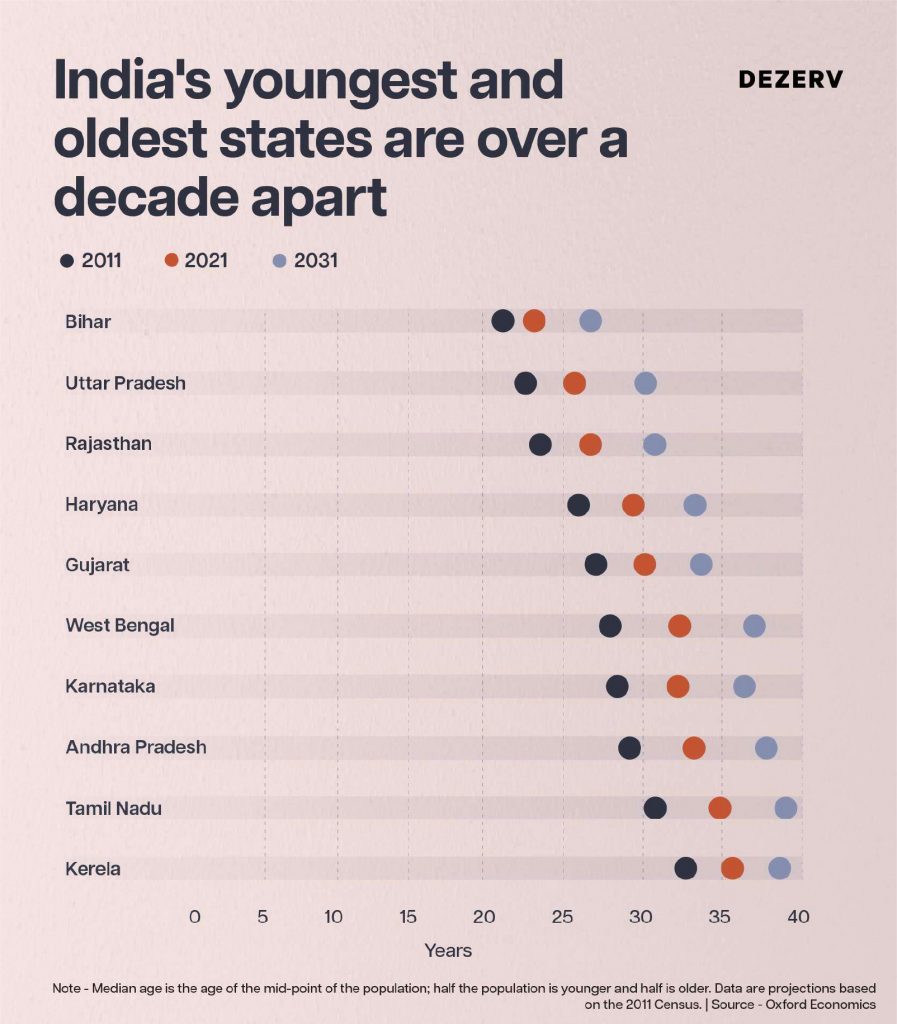
States in India’s centre-north have historically been poorer with lower levels of education, resulting in higher fertility rates. A larger number of children born every year makes these states, on average, relatively younger. India’s richer southern and western states, meanwhile, have lower fertility rates and are ageing rapidly.
Kerala, for instance, has twice the share of elderly people (age 60+) in its population compared to Bihar or Uttar Pradesh.
The variations are striking. As of 2021, Kerala was India’s oldest state and Bihar the youngest. By 2031, Tamil Nadu is projected to be India’s oldest state with a median age of nearly 40 years. The median person in Tamil Nadu or Kerala is over a decade older than the median person in Bihar or Uttar Pradesh.
In per capita terms, this divergence becomes even sharper — because the richer states are also where population growth has slowed most dramatically.
Here’s a reversal that captures this transformation: In 1981, West Bengal’s per capita income was 16% higher than Karnataka’s. In 2021, Karnataka’s per capita income was 111% higher than West Bengal’s. A complete reversal of positions — and a widening gap between one of India’s richest and one of its relatively poorer states.
The critical question for Southern states: Can they become rich before they grow old?
The window is narrowing. Tamil Nadu’s median age will approach 40 by 2031. But with IT sector growth at 11%+ annually, productivity premiums over five times the national average, and foreign investment flowing into GCCs and tech hubs, these states are running a race against demographics — and currently winning.
In Summary
India’s economic story is no longer monolithic. The South is pulling away, driven by a services-led transformation that rewards productivity, education, and digital capability.
For wealth creators, the implications are clear: The next decade’s opportunities will be concentrated in states and cities that have built the infrastructure for a knowledge economy. Karnataka, Telangana, Tamil Nadu — these aren’t just geographic locations. They’re where India’s economic future is being written.
The divergence also carries risks. Widening inter-state inequality could create social and political pressures. Within-state disparities — where Bengaluru residents earn more than double those outside the city — need monitoring.
But for those building wealth and businesses, the direction is unmistakable. The economic centre of gravity has shifted. The question isn’t whether to pay attention to the South — it’s whether you’re positioned to benefit from this structural transformation.
Disclaimer: Content provided herein is for educational/ informational purposes only.