


For the past year, we’ve recommended staggering your equity deployment. Valuations were stretched, earnings were slowing, and the macro picture was murky. Patience made sense.
That’s no longer the case. We’re now recommending full upfront allocation to equity.
Here’s why.
While headlines swung between tariff wars and rate cut speculation, something quietly shifted beneath the surface. The chart below tells the story better than any commentary could:
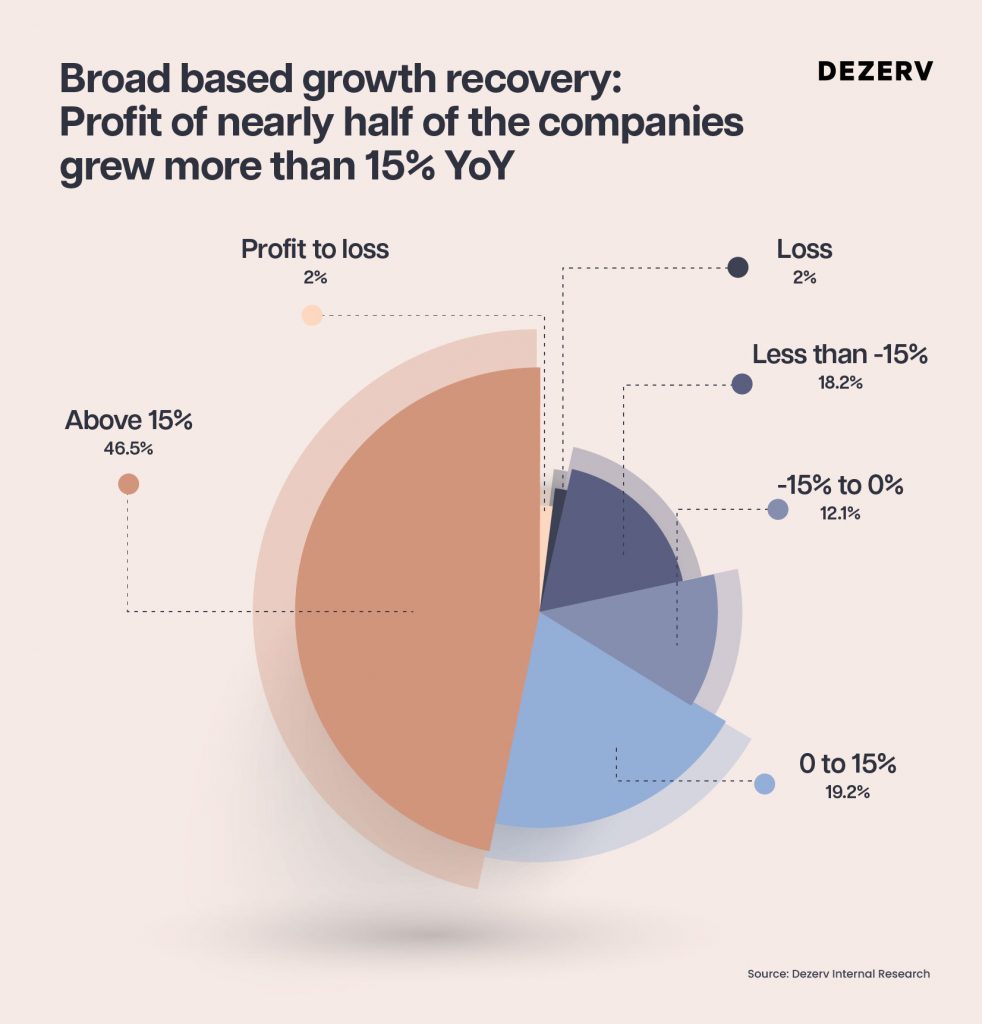
Nearly half of India’s listed companies just reported profit growth above 15%. Not a handful of megacaps carrying the index — broad-based, across-the-board strength. We haven’t seen this kind of earnings breadth in several quarters.
This matters because markets don’t build durable rallies on narrow leadership. They build them when the tide lifts most boats. That’s what’s happening now.
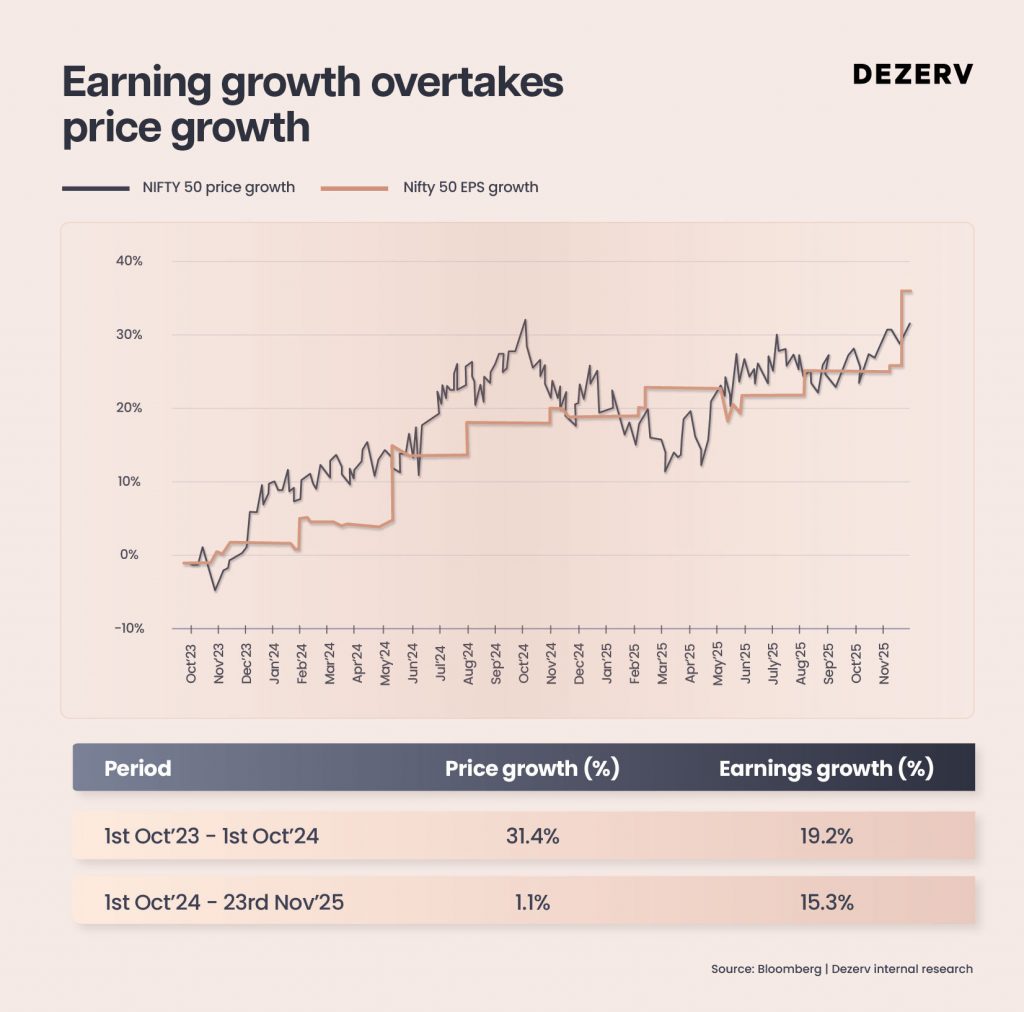
And here’s the part most investors missed: while everyone was debating whether to buy the dip or wait for lower levels, the market subtly did its homework. Prices went nowhere for 14 months. Earnings grew 15%.
What makes this even more compelling is the backdrop into which it arrives. The quarterly GDP print at 8.2% exceeded expectations by a wide margin, reinforcing the strength of the underlying economy.
And there is reason to believe this momentum may carry forward. Early high-frequency indicators for the Diwali quarter are already signalling an even stronger performance ahead. The festive season has delivered record Diwali sales, consumption trends have firmed across categories, auto sales have held up impressively, and the rural economy is showing clearer signs of buoyancy. Credit activity has also begun to pick up meaningfully. My recent newsletter on consumption had highlighted many of these drivers, especially the improvement in spending appetite and sentiment that is now becoming visible in the data.
To build a clear view, it helps to piece together the elements that brought us here and, more importantly, what they mean for your portfolio at this stage of the cycle.
We talk about:
- The time-correction we needed
- Earnings are doing the heavy lifting now
- The growth pickup
- Valuations have normalised
- How markets behave after time corrections
- Macro support has improved
- The Dezerv view
Let’s go.
The time-correction we needed
By late last year, it was clear that parts of the market had begun to run ahead of themselves. Small and midcaps were showing visible exuberance, valuations were stretching, and narratives were driving far too many stocks..
The past year, in hindsight, delivered something essential: a time-correction that allowed the market to cool, reset expectations, and rebuild a healthier base for the cycle ahead.
The median stock corrected close to 18% from its 52-week high, a far deeper adjustment than the index suggested. The drawdown was far more pronounced in the broader market — the Nifty slipped about 8%, midcaps corrected around 13% and smallcaps fell nearly 21% giving back a large part of the excess built up during the earlier phase of exuberance.
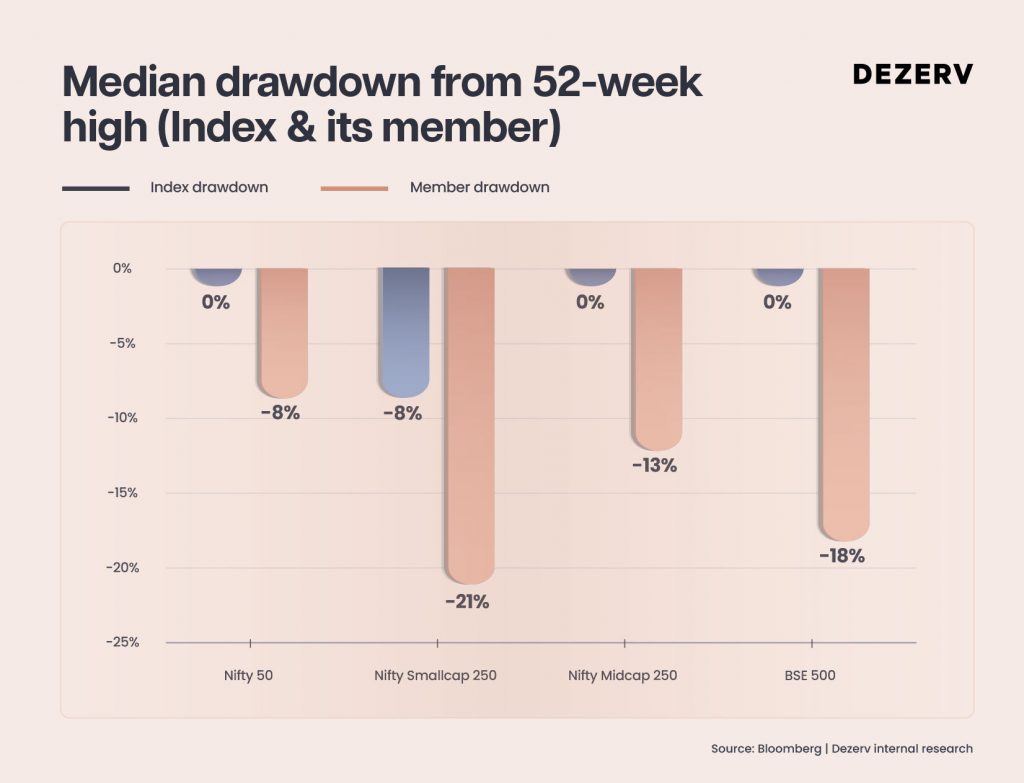
The froth is gone. What’s left is a market trading at 25.9x earnings against a 10-year average of 26.5x — no longer expensive, no longer cheap, but finally fair.
This is what cycle turns look like. Not dramatic. Not obvious. Just a slow, steady improvement in the things that actually matter.
Earnings are doing the heavy lifting now.
Between 1 October 2024 and late November 2025, Nifty 50 returns were barely 1.1% while earnings grew more than 15% over the same period. That is a gap wide enough to reset an entire cycle. For almost eighteen months prior, prices had consistently run ahead of earnings, an imbalance that left valuations stretched and sentiment fragile.
The chart showing price growth outpacing EPS captures that phase well.
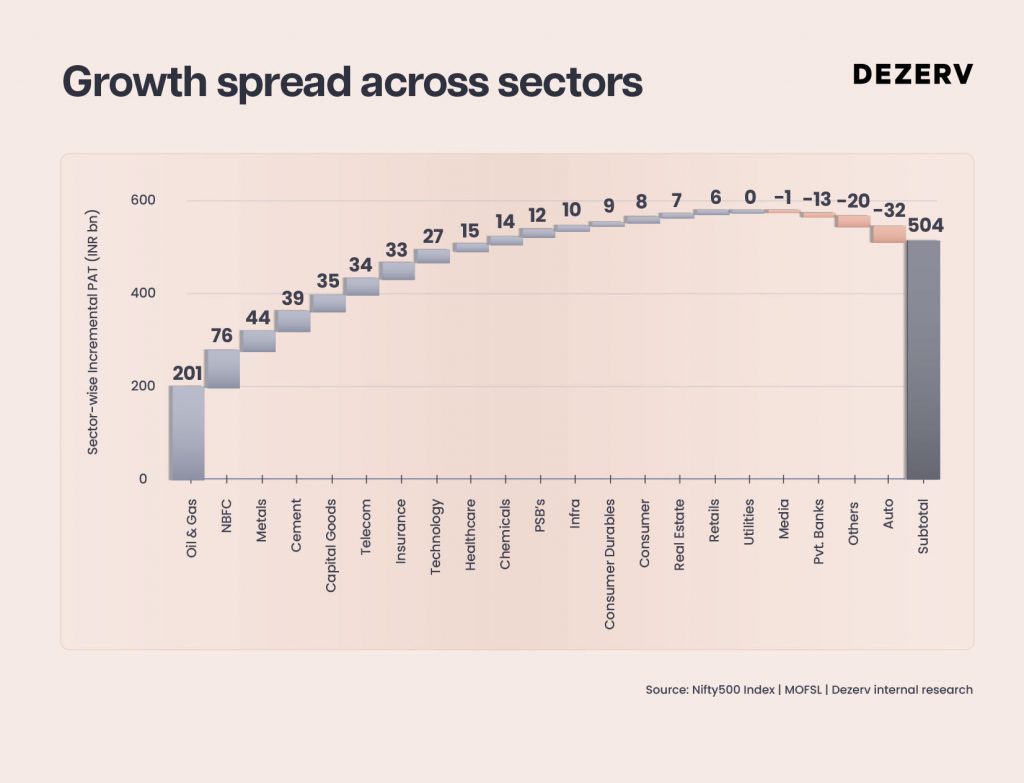
We have already spoken about how broad-based the profit expansion was this quarter, but the Q2FY26 distribution is worth revisiting through the lens of where the strength actually came from. The contribution chart makes it clear that the uplift was not driven by a narrow set of outliers. The bulk of the improvement came from core parts of the economy, oil and gas, NBFCs, metals, cement, and capital goods, sectors that often serve as early indicators of improving business conditions.
The middle of the earnings curve held steady as well, with insurance, healthcare, chemicals, technology, and telecom contributing to a stable base. Even the areas that reported weaker numbers — private banks, utilities, media, and autos — represented a relatively small drag compared to the strength delivered elsewhere.
The growth pickup
If the last few quarters were about stabilisation, the next few are likely to be about acceleration. The forward-looking data makes this increasingly clear. Analysts have begun upgrading earnings estimates for the first time in several quarters, and the pace of these revisions is strengthening. The chart in the note shows this shift unequivocally: FY26, FY27, and FY28 earnings expectations have all moved higher, reversing a period that was dominated by downgrades.
This is an important change for two reasons:
- Upgrades usually occur when management commentary turns constructive, order books firm up, and demand visibility improves.
- They tend to cluster early in a cycle rather than late in one, which makes the timing significant.
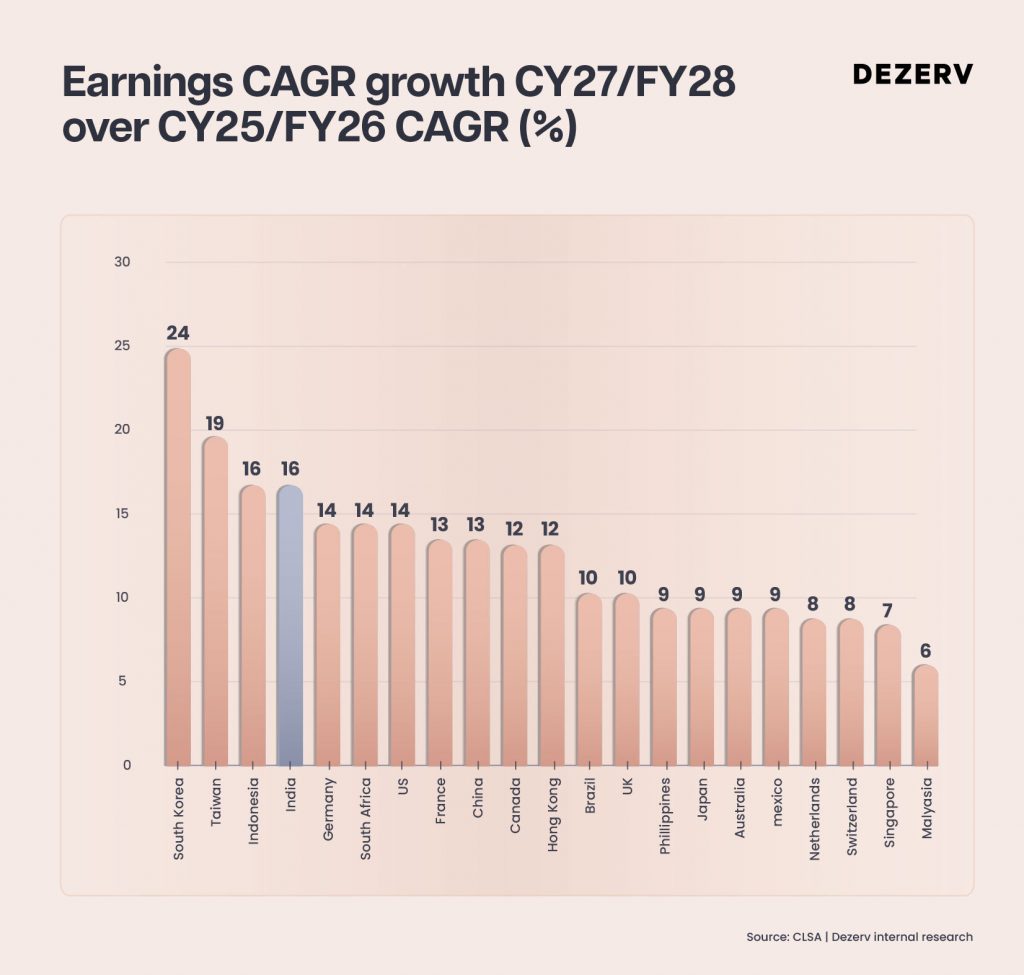
The underlying drivers of these upgrades are visible across multiple parts of the economy:
- Industrial activity is picking up as capacity utilisation improves and the investment pipeline broadens.
- Financials, particularly lenders with strong deposit franchises, are seeing healthier credit demand and stable asset quality.
- Manufacturing and capital goods companies have reported improving order flows, indicating that private capex is slowly turning from conversation into reality.
- Select consumer categories are beginning to benefit from stronger sentiment and a more stable inflation environment.
All of this has taken place while the market has traded in a narrow range. When earnings strengthen during a sideways phase, the setup for future returns usually improves. It reduces valuation risk, creates a cleaner entry point, and allows fundamentals to do the heavy lifting rather than liquidity or sentiment.
The combination makes the case significantly more constructive for long-term investors.
Valuations have normalised
India’s relative valuation premium versus emerging markets, China, and US equities has compressed significantly:
If you want to understand how much the market has cooled, the valuation charts tell the story. They show a steady return to levels that are far more in line with long-term reality.
A closer look reveals a few notable adjustments:
- The premium is no longer prohibitive and is at ~1 SD below the long-term average across the board.
- On trailing PE, India has moved closer to its long-term trend and is trading at 25.9 times PE vs 10Y avg of 26.5.
- Valuations now reflect underlying earnings rather than excessive sentiment.
- Nifty 500 Valuations offer better value vs. gold.
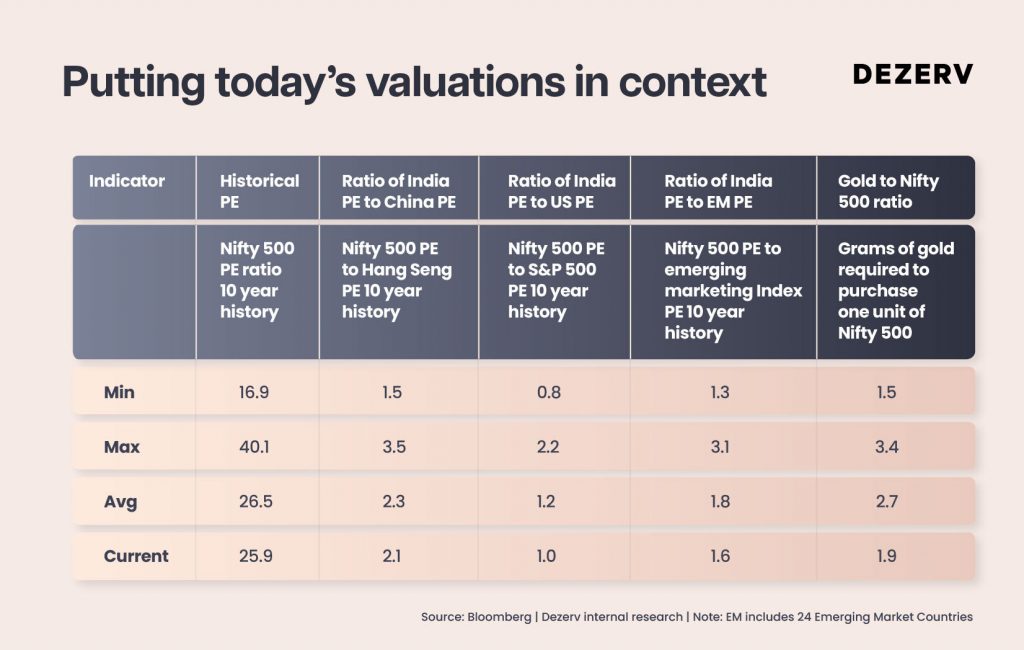
Collectively, these shifts tell us that:
- The froth in valuations has somewhat dissipated
- The entry point today is cleaner than it has been in the past 18 months, and
- Fundamentals now anchor price, not the other way around.
How markets behave after time corrections
History shows that phases of sideways consolidation often set the stage for healthier forward returns, especially when earnings continue to improve during the pause. Time corrections reduce valuation risk without damaging fundamentals, and the catch-up phase, when prices realign with earnings, often happens quickly.
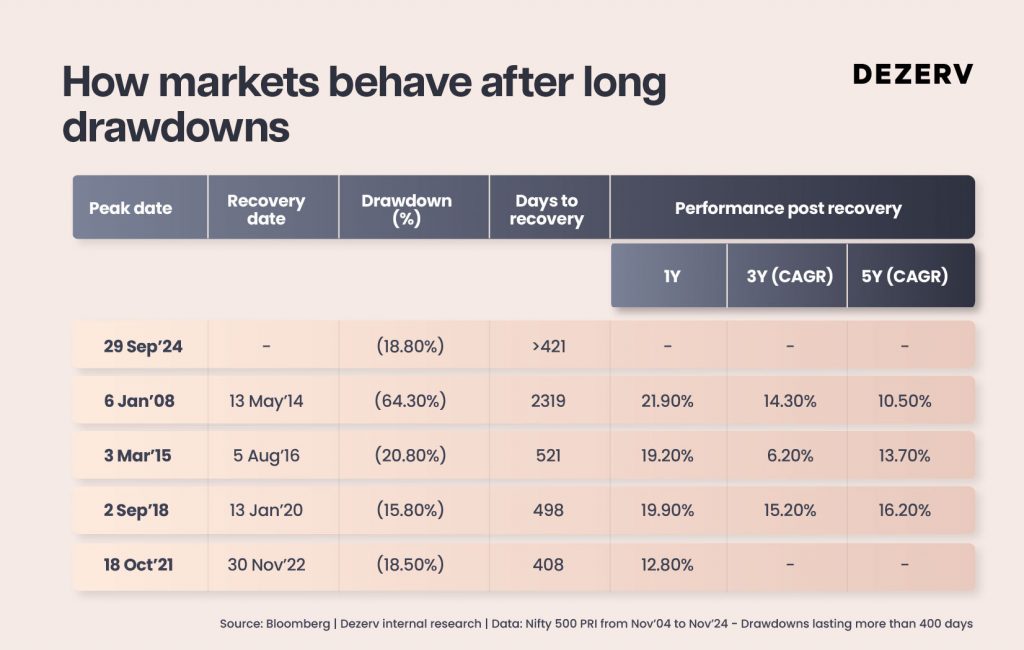
Macro support has improved
The macro environment today looks materially different from where it stood a year ago. The shift has been steady rather than dramatic, but the impact is meaningful.
A few developments stand out:
- Inflation has cooled sharply- CPI is now at 0.25% YoY, well below the RBI’s comfort band. A stable inflation path gives both businesses and consumers room to plan with more confidence.
- Rate cuts have begun- With inflation falling faster than expected, monetary conditions have started easing. There is now room for further accommodation, which supports credit transmission and investment decisions.
- GST collections remain resilient- Even after rationalisation, collections continue to hold strong, pointing to healthy transactional activity across sectors
- Consumption tailwinds are building-driven by the 8th Pay Commission, firmer sentiment, and stable fuel and food prices that typically translate into stronger discretionary demand with a lag.
- Liquidity is comfortable- Ample system liquidity improves credit transmission for banks and NBFCs, and supports on-ground execution for capex-intensive businesses.
- Fiscal stability remains intact- The government has maintained discipline without sacrificing growth, an important anchor for medium-term confidence.
The Dezerv view
A year ago, staggering deployment made sense because:
- Valuations were stretched
- Earnings were slowing
- The macro outlook was uncertain
Those conditions no longer exist.
Today, staggering may lead to some opportunity costs. With valuations reset, earnings accelerating, and macro conditions turning favourable, the balance shifts decisively toward immediate deployment. We are therefore changing our stance and investors may consider full upfront equity deployment, subject to individual suitability and risk profile.
What this means for you and your investments:
1. Faster participation in the next compounding cycle- Markets typically move ahead of visible earnings trends. Deploying earlier allows participation as and when the next phase of the market cycle unfolds.
2. Stronger fundamental support- The earnings base is now stronger and more predictable, potentially reducing drawdown risk.
3. Lower valuation risk- The internal correction has already occurred. Today’s entry point is cleaner than anything we’ve seen in the past 18 months.
In summary
The pieces have fallen into place: the market has reset, earnings are delivering, valuations are reasonable, and the macro backdrop is stronger than last year. This combination improves the probability of favourable outcomes and creates a cleaner runway than anything we have seen in recent quarters.
The opportunity to deploy capital at attractive valuations, supported by improving fundamentals, is rare. The time to act is now.
Disclaimer: Dezerv Investments Private Limited is a Portfolio Manager with SEBI Registration no. INP000007377. Distribution services are offered through Dezerv Distribution Services Private Limited (APRN) – 00615.
Investment in the securities market is subject to market risks, read all the related documents carefully before investing. Past performance may or may not be sustained in future. Details stated herein are confidential and strictly for the personal information of the recipient. This document should not be reproduced or redistributed to any other person without the prior permission of Dezerv. This document should not be construed to be an offer to buy/sell any securities. Please refer to the disclosure document, client agreement, and other related documents for securities/ assets/ portfolios specific risk factors. This document is not intended for distribution to or use by any person or entity who is a citizen or resident of or located in any state, country or jurisdiction where such distribution, publication, availability or use would be contrary to local law, regulation or which would subject Dezerv and its affiliates to any registration or licensing requirement within such jurisdiction.
Dezerv uses in-house and publicly available sources believed to be reliable but does not guarantee the accuracy or completeness of the information. The data may be subject to change from time to time without notice. The information / data herein alone is not sufficient and shouldn’t be used for the development or implementation of an investment strategy. Dezerv and/or its subsidiary/associates/employees are not liable for any risks/losses pertaining to any assets/securities or investment opportunities available from time to time. The statements made herein may include statements of future expectations and other forward-looking statements that are based on our current views and assumptions. Actual results may differ from expressed or implied performance due to market uncertainties. All performance related information provided herein is not verified by SEBI or any other regulatory authority.
Please consult your legal, tax and financial advisors before making any investment decisions.